
How D365 F&O’s Financial Period Close workspace centralizes the multi-entity period close, the task template and dependency configuration Finance must build before the workspace delivers value, how to use completion data to drive measurable close-time reduction, and the five close governance failures that keep Finance organizations running a 10-day close on a system designed to support a 5-day close.
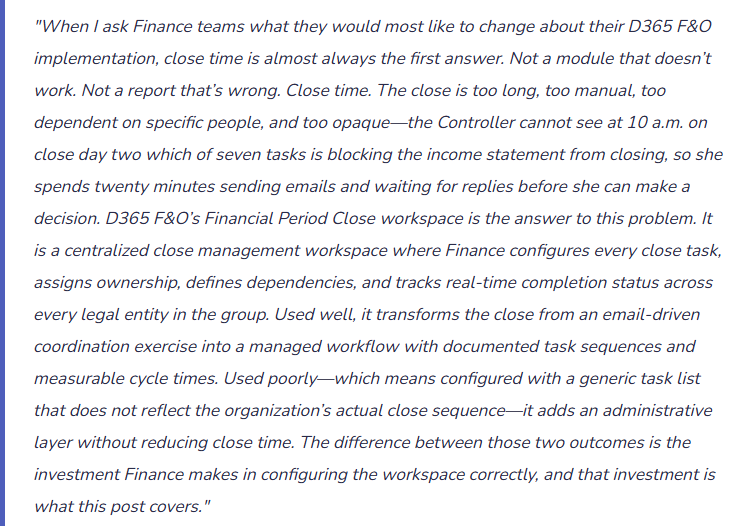
What the Financial Period Close Workspace Is—and What It Is Not
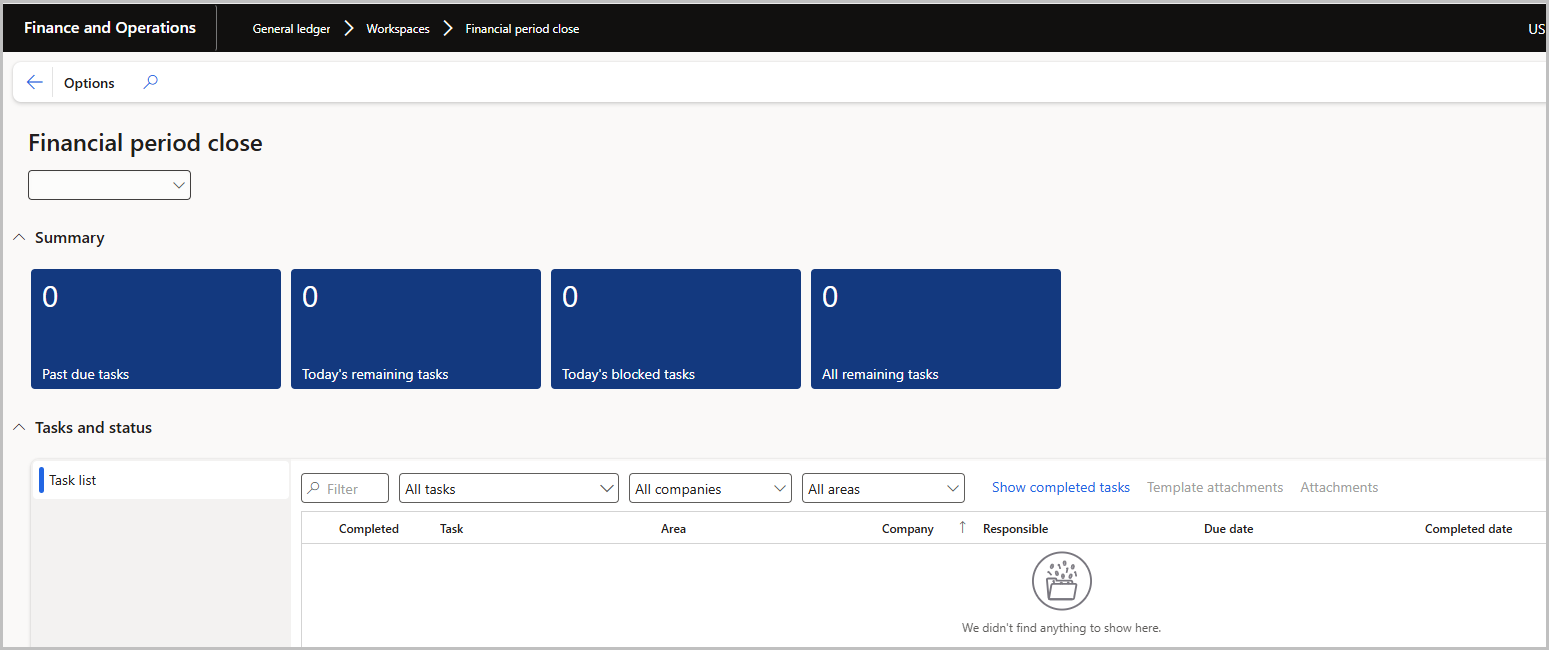
The Financial Period Close workspace (General ledger → Period close → Financial period close) is a task management workspace, not an automated close engine. It does not run close processes automatically. It tracks whether the humans responsible for each close process have completed their assigned tasks, enforces the sequence Finance defines by blocking dependent tasks until predecessors are marked complete, and provides the Controller with a real-time view of close progress across all legal entities and all task areas.
What the workspace manages: a hierarchical task structure organized into Task areas (the major phases of the close), Tasks within each area (individual close activities), and Links between tasks that define dependencies (Task B cannot start until Task A is complete). Each task has an assigned owner (a D365 F&O user responsible for completion), a target date, and a completion status. The Controller sees the full picture across all entities; task owners see their assigned items. Multiple legal entities share a single closing template, which Finance configures once and applies to all entities—with entity-specific tasks added where the close sequence differs between entities.
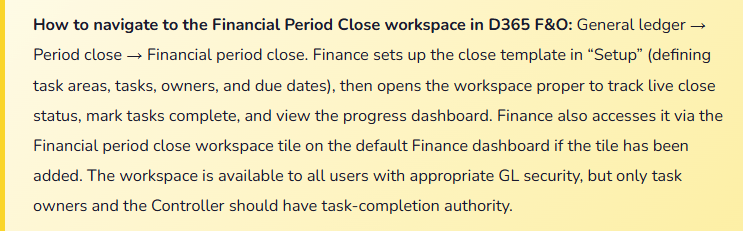
The Financial Period Close Workspace Configuration Finance Must Build
The workspace has zero value with zero configuration. Finance must build the task structure before the first close cycle it is used for—not during it. The configuration investment is one to two days. The return is every close cycle for the life of the implementation.
- Closing Template—The Reusable Task Structure Finance Builds Once
- Finance creates a closing template (Setup → Closing templates) that defines the complete task structure for a period close. The template is reusable—Finance opens it each period and generates a new period-specific instance from it rather than rebuilding the tasks from scratch. Finance names the template clearly (e.g., “Monthly Close—All Entities” or “Quarter-End Close”) and builds all task areas and tasks within it. The template also defines which legal entities the close applies to—all entities appear in the same workspace view, giving the Group Controller a single screen showing close status across the entire group.
- Finance owns: The template must reflect the organization’s actual close sequence, not a generic template from an implementation partner. Finance produces the close narrative (Post 62 of this series) before building the template and uses the narrative as the source material. If the narrative does not exist, build it first.
- Task Areas—The Major Close Phases That Organize Individual Tasks
- Task areas are the top-level groupings within the template—the equivalent of phases or sections. Finance creates task areas that reflect the logical phases of the close: Subledger Processing, Bank Reconciliation, Accruals and Adjustments, Fixed Assets and Depreciation, Management Reporting, and Period Lock. The task area structure is visible in the workspace dashboard as the highest-level close status indicator: the Group Controller sees at a glance which task areas are complete across each entity, without needing to drill into individual tasks unless something is behind.
- Finance owns: Task area granularity should match the reporting granularity the Controller needs. Five generic task areas produce five status lights. Eight specific task areas (each reflecting a genuine phase of the close with its own natural owner and completion point) produce an actionable status picture.
- Tasks—Specific Close Activities With Named Owners and Target Dates
- Within each task area, Finance creates the individual tasks that a specific Finance team member must complete. The task record specifies: the task name (specific and action-oriented—“Reconcile AR aging to GL AR control account” not “AR close”), the assigned owner (the D365 F&O user responsible for completion), the target date (the day within the close cycle by which this task should be complete), and any notes that describe how the task is performed or what evidence Finance produces to confirm completion.
- Finance targets 30–50 tasks for a standard entity close. Fewer tasks produce the generic status view that tells the Controller nothing useful. More tasks produce overhead without additional visibility. Finance determines the right number by listing every discrete step in the close narrative that has a natural handoff point—when one person’s work is done and another’s can begin.
- Task Dependencies—The Sequence Logic Finance Encodes Once
- Task dependencies in the Financial Period Close workspace are configured as Links: Finance opens a task and adds a link to its predecessor task, specifying that the current task cannot be marked complete until the predecessor is done. Finance configures the minimum viable dependency chain for every close: all transaction cutoff tasks precede all subledger reconciliations; all subledger reconciliations precede accrual postings that depend on subledger balances; all period-end entries precede the trial balance review; the trial balance review precedes the Management Reporter financial statement task; the financial statement sign-off precedes the period lock.
- The dependency configuration encodes the close sequence logic Finance already knows and enforces it automatically—without needing the Controller to manually verify that tasks are being completed in the right order. A Finance coordinator who marks the income statement review complete before the accruals are posted will find that the dependency prevents the premature completion.
- Backup Owners and Escalation Assignments
- Each task in the workspace has a primary owner. Finance also designates a backup owner for every critical-path task—the task that, if delayed, delays the entire close. The backup owner receives the task notification if the primary owner has not marked the task complete by a defined escalation threshold (Finance configures this as a target date; a task past its target date signals to the Controller that escalation may be needed). Finance uses the workspace’s notification configuration to send automatic alerts to backup owners when primary owners miss target dates.
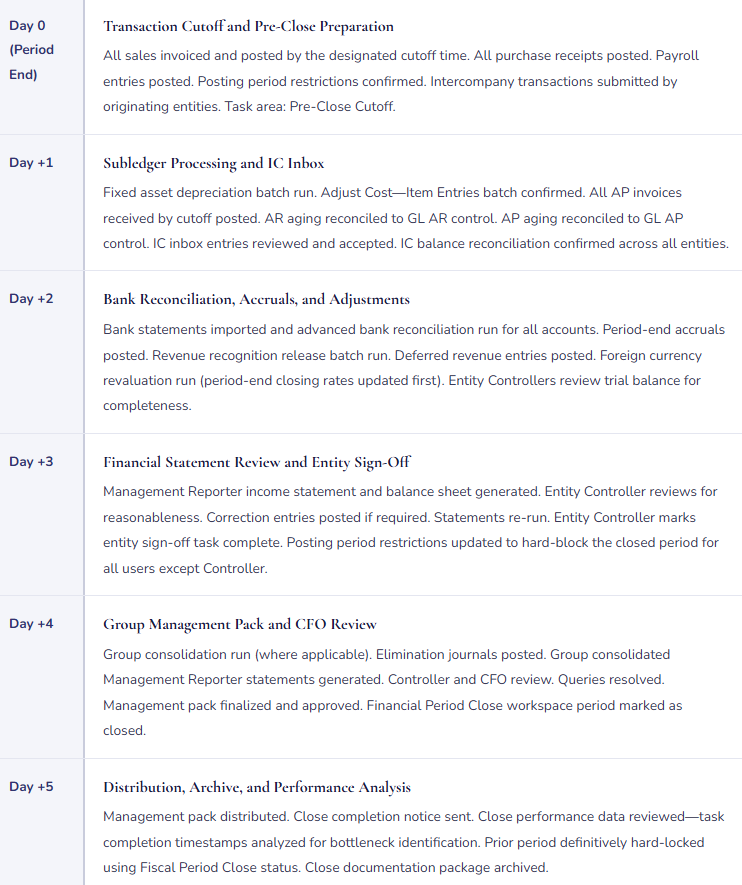
A Sample 5-Day Close Task Timeline
Using Workspace Completion Data to Drive Close-Time Reduction
The Financial Period Close workspace records a completion timestamp for every task when the task owner marks it done. Over three to six close cycles, these timestamps produce a dataset Finance can analyze to identify the critical-path bottleneck—the single task or task sequence whose compression would reduce the overall close timeline the most.
Critical Path Identification
Map the dependency chain from the first Day +1 task to the final period lock. The critical path is the longest chain of sequential tasks. Tasks on the critical path that run late extend the entire close. Tasks not on the critical path that run late have no effect on the final close date. Every optimization effort Finance makes should target a critical-path task.
Bottleneck Task Duration Trending
For each critical-path task, plot the actual duration across the past six closes. A task whose duration is increasing each month signals either growing transaction volume, accumulating data quality problems, or a process that is degrading without anyone noticing. Increasing-duration critical-path tasks are the highest-value optimization targets.
Wait-Time Analysis
The gap between a task’s completion and the start of its dependent task is wait time—capacity Finance has available that is not being used because a prerequisite has not been released. Large wait-time gaps between sequential tasks reveal opportunities to move deadlines earlier or restructure parallel workflows so more tasks run simultaneously.
Entity-Level Completion Comparison
In multi-entity environments, compare close completion timing across entities. If Entity A consistently completes Day +2 tasks by 2 p.m. and Entity B consistently completes the same tasks by 6 p.m., the difference is a staffing, process, or data quality gap in Entity B that the workspace makes visible. Without the workspace, the Group Controller has no objective data on which entity is the consolidation bottleneck.
Five Financial Period Close Governance Failures
⚠️ Workspace Configured With Five Generic Task Areas—Provides Status Theater Instead of Close Visibility
Finance implements the Financial Period Close workspace at go-live using a default template from the implementation partner: five high-level task areas covering AP, AR, GL, financial statements, and period lock. Each area has one task assigned to one Finance team member. At 2 p.m. on close day three, the Controller checks the workspace to understand close status. She sees that three of five areas are complete and two are still open. She cannot determine what specific work is remaining within the open areas, whether anything is blocked, or whether the incomplete areas are on the critical path for the financial statement deadline. The workspace has five status lights where the Controller needs a close management dashboard. She closes the browser and sends emails.
Fix: The workspace’s value scales with task granularity. Finance should build 30–50 specific task-level entries for a standard entity close. “Accounts Payable” becomes: (1) Confirm AP invoice cutoff—no invoices to post after 5 p.m. on Day 0; (2) Post all AP invoices received by cutoff; (3) Run AP aging report—confirm total agrees to AP GL control account within tolerance; (4) Confirm no AP invoices in approval workflow queue older than 48 hours. Four specific tasks replace one generic area, and the Controller can see at 10 a.m. on Day +1 exactly which of the four tasks is blocking AP close completion. The granularity investment is one day of template-building. The return is accurate close status visibility for every close cycle for the life of the implementation.
⚠️ No Task Dependencies Configured—Out-of-Sequence Completions Generate Rework
Finance configures the workspace with 40 specific tasks but does not configure links between them. Every task is independently available for completion from Day +1. On close day two, the AR coordinator posts the monthly revenue accrual and marks the accrual task complete. An hour later, the billing team posts a large credit memo for a return that arrived just before month-end cutoff. The credit memo changes the AR balance and the revenue figure. The AR aging reconciliation task—marked complete before the credit memo posted—is now wrong. The accrual entry, calculated off the pre-credit-memo revenue figures, may also need adjustment. Because dependencies were not configured, the workspace permitted both tasks to be marked complete out of the sequence that would have prevented the rework. The correction takes two hours on close day three.
Fix: Task dependencies encode the close sequence logic Finance already knows. The minimum viable dependency set for any entity close: all transaction cutoff tasks must precede all subledger reconciliations; all subledger reconciliations must precede all accrual postings that depend on subledger balances; all period-end entries must be posted before the trial balance review can be started; the trial balance review must be complete before the Management Reporter financial statement task can begin; the financial statement sign-off must be complete before the period lock task can proceed. These five dependency chains take two hours to configure as links in the workspace and prevent the out-of-sequence completion pattern that generates close rework.
⚠️ Posting Period Restrictions Not Updated as a Workspace Task—Prior-Period Entries Post After Close
Finance closes the period on Day +4. The Financial Period Close workspace period is marked closed. The workspace period-lock task was designed simply as “Mark period closed in workspace”—it did not include the parallel step of updating the D365 F&O posting period restrictions in User Setup for all Finance users. Three days after the close, the AP coordinator for one entity posts a vendor invoice with a posting date in the just-closed period because the vendor invoice was dated in the prior month. The prior period is not hard-locked in User Setup. The invoice posts into the closed period, changing the entity’s AP balance and income statement for a period the Group Controller has already reported as final. When the Group Controller reviews the following month’s comparative statements, the prior period column does not match what was distributed to the board.
Fix: The period-lock task in the workspace must include two documented sub-actions: (1) mark the Financial Period Close workspace period as closed; and (2) update D365 F&O’s posting period restrictions in System Administration → Users → User setup for all Finance users, setting Allow Posting From to the first day of the new period. Finance confirms the User Setup update is complete by attempting a test posting to a date in the closed period after the update—the test posting should be rejected. Finance also uses the Fiscal Period Close feature (General ledger → Ledger setup → Ledger) to apply a hard “On hold” or “Permanently closed” status to the period after all audit adjustments are final, providing a system-level lock independent of User Setup.
⚠️ Workspace Completion Data Never Analyzed—Same Bottleneck Repeats for 14 Months
Finance uses the Financial Period Close workspace to track close task status every month. Every task is marked complete by the end of each close. The Controller uses the workspace during the close as a status dashboard and then moves on. Nobody analyzes the completion timestamp data. After 14 close cycles, Finance has 14 months of task-level completion data showing that the bank reconciliation task for the main operating account consistently takes six hours on Day +2, blocking the accrual posting window by four hours and pushing the income statement from Day +3 morning to Day +3 afternoon—a delay that cascades to push the CFO review from Day +4 morning to Day +4 afternoon. The pattern is in the data. Nobody has looked at it. The same Day +5 close repeats 14 times while the data required to drive it to Day +4 sits in the workspace completion history unused.
Fix: Close performance analysis is a monthly Finance governance activity. After each close cycle, Finance exports the task completion timestamps from the workspace (or records them manually if the export capability is not available for the current workspace version) and records for each critical-path task: the target completion date, the actual completion date, and the duration. Finance plots these for the most recent three closes and identifies the task or task sequence that is consistently latest relative to target. For the bank reconciliation scenario, the diagnosis is immediate: the bank statement import runs at 8 a.m. on Day +2 and the matching process runs until 2 p.m. The fix—schedule the bank statement import for 6 p.m. on Day +1 and allow automated matching to run overnight—is visible in the data the day Finance decides to look at it.
⚠️ IC Reconciliation Not a Workspace Task—Consolidation Runs With IC Imbalances That Take Days to Untangle
Finance runs the group consolidation on Day +4 as the workspace schedule specifies. The consolidation runs. The Group Controller produces the consolidated income statement and balance sheet. The balance sheet shows a £560,000 net balance in the intercompany accounts after the elimination journals are posted—a residual IC imbalance the elimination did not clear. Investigation reveals that three IC transactions were accepted in the receiving entities at amounts different from the originating entities’ posted amounts, and one IC transaction in the French entity’s inbox was never accepted because the French Finance coordinator was absent on Day +1 and nobody processed her queue. The IC reconciliation that should have been a Day +1 workspace task was never configured as a task in the template—it was considered something Finance “just does.” The Group Controller spends Day +4 and most of Day +5 resolving the IC imbalances rather than preparing the management pack. The management pack is delivered on Day +6.
Fix: The IC balance reconciliation is a mandatory workspace task with a Day +1 target date, configured before the consolidation task area, with a link dependency that prevents consolidation from starting until the IC reconciliation is marked complete. The IC reconciliation task owner is the Group Controller or a designated IC reconciliation officer—it is not delegated to entity-level Finance coordinators who also own their inbox acceptance tasks. The task specification in the workspace notes: run the IC Balance by Partner report for all entities, confirm IC receivable and payable balances agree within zero tolerance, investigate any difference and resolve or escalate. The task cannot be marked complete with a known outstanding IC balance. The link dependency between IC reconciliation and consolidation is the structural control that makes this requirement stick.
Do This / Don’t Do This
Do This
- Build the closing template with 30–50 specific task-level entries before the first managed close—not five generic task areas
- Configure task links (dependencies) before the first live close—encode the sequence logic Finance already knows
- Configure the IC balance reconciliation as a mandatory workspace task with a Day +1 target and a link that blocks consolidation until it is complete
- Include posting period restriction updates as an explicit workspace task with attestation requirements—not just “mark period closed in workspace”
- Analyze task completion timestamps after every close and identify the critical-path bottleneck before investing in any optimization
- Use the Fiscal Period Close feature (General ledger → Ledger setup → Ledger) to apply a hard system-level lock after all audit adjustments are final
Don’t Do This
- Configure five generic task areas and consider the close governance problem solved
- Skip link (dependency) configuration—without it, out-of-sequence completions generate rework that costs more time than links would have prevented
- Use the workspace only as a status dashboard during the close without analyzing completion data for bottleneck identification
- Run consolidation without first confirming IC balances are reconciled across all entities
- Treat the workspace period-close action as sufficient without updating D365 F&O posting period restrictions for all users
- Invest in close optimization before identifying the critical path—optimizing a non-critical-path task produces zero close-time reduction
What’s Next:
The Financial Period Close workspace governs the close process across the organization. The next post addresses one of the most structurally complex Finance subledgers in D365 F&O—one that Finance teams frequently under-configure at implementation and then struggle to reconcile at audit: Fixed Asset Management at Enterprise Scale in D365 F&O—how D365 F&O’s multi-book fixed asset framework supports parallel depreciation under GAAP and tax, the asset lifecycle from acquisition through disposal, the asset revaluation and impairment process, and the five fixed asset configuration failures that produce depreciation errors Finance discovers at year-end.
— Bobbi
D365 Functional Architect · Recovering Controller
Thank you for reading!
If this post helped you solve a real problem, share it with a Finance colleague who is in the middle of an ERP implementation or a post-go-live optimization. If you have a topic that I haven’t covered, please reach out. There is always one more post worth writing.
Interested in learning more? Below are some of my latest posts:
Leave a Reply