

Which D365 F&O Copilot capabilities are genuinely ready for Finance workflows, which require explicit governance before Finance acts on their output, the data and configuration prerequisites that determine whether AI features deliver useful output, and the five Copilot governance failures that produce AI-assisted Finance decisions based on unreliable inputs.
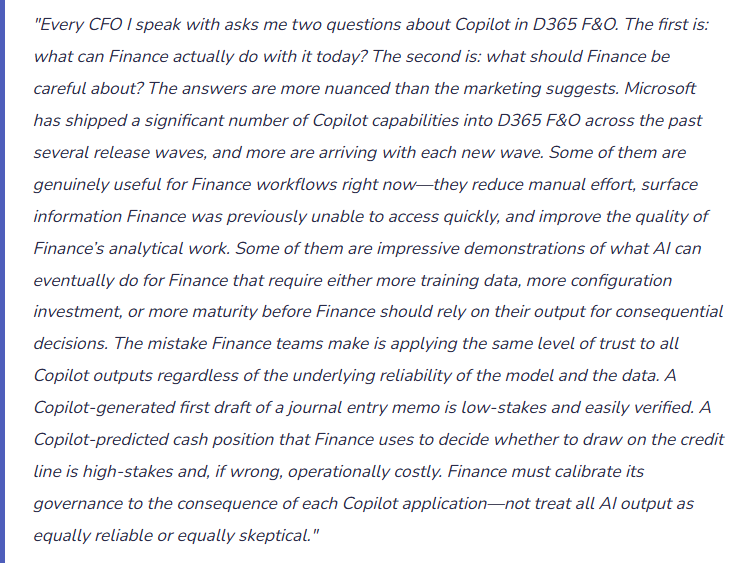
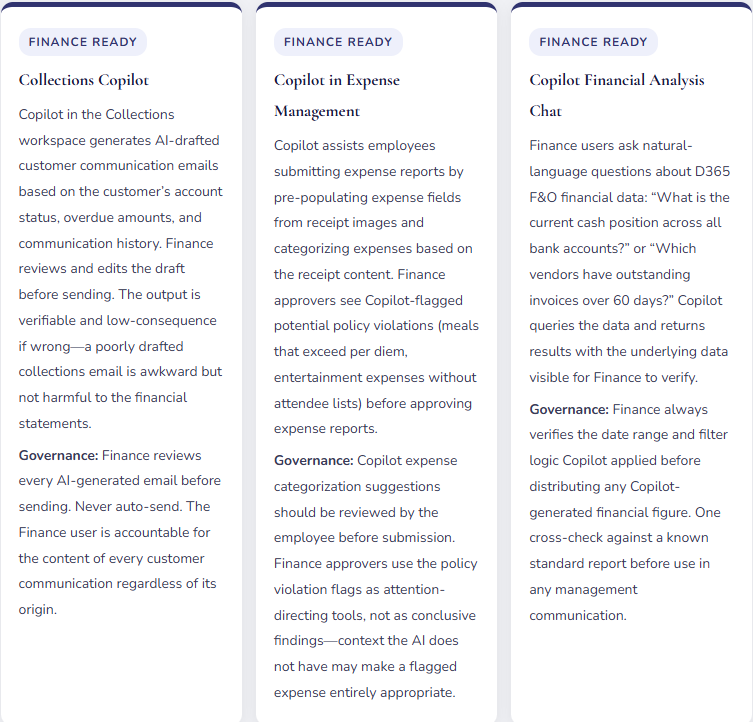
D365 F&O Copilot Capabilities—A Finance-Specific Assessment


The Finance Copilot Governance Framework—Five Controls Finance Must Establish Before Enabling Any AI Feature
Finance Copilot Governance Framework—Required Before Any Copilot Feature Is Enabled for Operational Use
- Data Privacy and Consent Review Before Any Copilot Feature Is Enabled
- D365 F&O Copilot features process financial data through Microsoft’s Azure OpenAI Service. Finance must confirm with Legal and IT: which data is sent to Azure OpenAI when each Copilot feature is used, whether the organization’s data processing agreements with Microsoft cover this use, whether the processing complies with the organization’s obligations under GDPR and applicable privacy regulations, and what data residency region the processing occurs in. Copilot features must not be enabled in production until this review is complete and documented. Finance is accountable for the data that leaves D365 F&O through Copilot channels.
- Prerequisite Verification Before Enabling Each Feature
- Each Finance Insights AI feature has data quality and volume prerequisites that determine whether the model produces reliable output. Finance verifies each prerequisite before enabling the feature for operational use: customer payment history volume for payment prediction (minimum 100 settled transactions, 12+ months), base cash flow forecast sources configured and validated for cash flow AI, GL history volume and consistency for budget proposals (2+ years of consistent account coding). Finance documents the prerequisite verification as the enablement record for each feature. An AI feature enabled without prerequisite verification produces output Finance cannot evaluate for reliability.
- No Copilot Output Affecting the GL Without Finance Review
- Every Copilot output that affects D365 F&O’s general ledger—match suggestions, journal entry drafts, expense categorizations—requires explicit Finance review and approval before the output is finalized. Auto-accept is not appropriate for any GL-affecting Copilot output regardless of the confidence level displayed. Finance is accountable for every entry in the GL; the accountability cannot be delegated to an AI model. The review step is the control that prevents Copilot errors from posting to the books.
- AI Output Accuracy Monitoring—Monthly Review by Feature
- Finance tracks the acceptance and rejection rate of Copilot suggestions by feature. For payment predictions: compare predicted payment timing to actual payment timing quarterly. For vendor invoice matching: track the percentage of Copilot match suggestions Finance accepts versus rejects. For cash flow AI: compare AI-enhanced forecasts to actual cash flows monthly. A declining acceptance rate or declining forecast accuracy signals that the model has encountered conditions outside its training data and Finance should reduce reliance on that feature’s output until the model retrains on new conditions or Finance identifies the root cause of the degradation.
- Release Wave Testing of Every Copilot Feature Finance Uses
- Microsoft updates D365 F&O Copilot features with each release wave. Finance includes every active Copilot feature in the pre-wave sandbox test script. For each feature, Finance tests a representative sample of its typical use case in the sandbox post-wave environment and confirms the feature behavior is consistent with the pre-wave behavior. Any change in Copilot feature behavior identified during sandbox testing is evaluated before the wave reaches production. Finance teams that discover Copilot behavioral changes during live Finance workflows—because they did not test in sandbox—create avoidable disruptions to the close cycle or management reporting process.
Five Copilot Governance Failures That Produce AI-Assisted Finance Mistakes
⚠️ Cash Flow AI Enabled Without Validating Base Forecast Sources—Finance Makes Credit Line Decision Based on Incomplete Forecast
Finance enables Finance Insights cash flow AI in D365 F&O. The AI-enhanced forecast shows consistent positive cash positions over the next 45 days. Finance decides not to draw on the revolving credit facility. On Day 32, the actual cash position falls $1.6 million below the forecast. Investigation reveals that the base cash flow forecast was not configured to include purchase orders—the organization’s largest category of near-term cash outflow. The AI enhanced an incomplete forecast, producing plausible-looking projections that excluded the most material outflow category. Finance had not validated the base forecast before enabling the AI layer. The credit line draw Finance deferred must now be processed at a short-notice premium rate.
Fix: Finance validates the base cash flow forecast against 30 days of actual cash flows before enabling the AI enhancement. The validation procedure: run the base forecast (without AI) for the prior 30 days and compare projected inflows and outflows to actual bank statement movements for the same period. Any systematic difference—projected AP payments that did not appear in the forecast, bank fees not forecasted, intercompany transfers not configured as sources—represents a missing forecast source that must be added before the AI layer is enabled. Finance must be able to explain every line item in the base forecast before trusting the AI-enhanced version for operational liquidity decisions.
⚠️ Payment Prediction Model Used Before Training Data Threshold Met—Collections Team Works the Wrong Accounts
D365 F&O goes live in March. Finance enables Finance Insights customer payment predictions in May—two months after go-live with fewer than 40 settled customer transaction records in D365 F&O. The model generates predictions for 280 open invoices. The collections team uses the predictions to prioritize the June call list. The predictions are based on insufficient training data and are essentially uncalibrated. The collections team calls the accounts the model predicts as high-risk while three genuinely high-risk accounts the model predicts as likely on-time receive no contact in June. All three reach 60 days past due by July. One becomes a significant bad debt write-off. The total bad debt exceeds the annualized cost of running the Finance Insights subscription by a factor of ten.
Fix: Finance verifies the training data threshold before enabling payment predictions for collections decisions: minimum 100 settled customer transactions (invoices fully paid) with both invoice date and payment receipt date recorded in D365 F&O, spanning at least 12 months. Finance runs the Customer Ledger Entries report filtered to closed entries and counts the settled records in D365 F&O to verify this threshold. If the threshold is not met, Finance uses the standard AR aging report for collections prioritization until sufficient history accumulates. Finance marks the date when the training data threshold is met and enables the feature only after that date, with a documented parallel validation period of at least one month where predictions are compared to actual payment outcomes before the collections team relies on them.
⚠️ Copilot Financial Analysis Chat Used for Management Pack Without Verification—Wrong Quarter Data Distributed to the Board
Finance uses D365 F&O’s Copilot financial analysis chat to produce the quarterly revenue by segment table for the board pack. The prompt is “Show me revenue by business segment for this quarter.” Copilot returns a table that Finance copies into the board presentation. The board pack is distributed. The next day, the CFO receives a call from a board member who notes that the segment revenue totals in the board pack do not match the consolidated revenue in the income statement attached to the same pack. Investigation reveals that Copilot interpreted “this quarter” as the most recently completed calendar quarter rather than the current fiscal quarter-to-date—a three-month difference. The board received prior-quarter segment data in a current-quarter board pack.
Fix: Copilot financial analysis output must always be verified against a known standard report before appearing in any document distributed to external parties or management. Finance establishes a verification habit: after any Copilot financial query, run the corresponding Management Reporter or standard D365 F&O report for the same scope and period, and confirm the totals agree. If they agree, the Copilot output is reliable for that query. If they differ, investigate before using the Copilot output. For management pack preparation specifically, Finance uses Management Reporter as the authoritative data source for all distributed figures. Copilot is appropriate for internal ad-hoc analysis and exploratory queries; it is not the authoritative source for financial statements distributed to the board, investors, or auditors.
⚠️ AI Budget Proposals Adopted Without Account-Level Review—Prior-Year Anomaly Propagates as Baseline
Finance uses Finance Insights budget proposals for the annual budget. The model generates proposals based on three years of GL history. Finance reviews the total budget at the category level—headcount costs look reasonable, facilities costs look reasonable, IT costs look reasonable. Finance imports the proposals to D365 F&O as the approved budget. Three months into the new year, the IT department is significantly over budget for software license costs. Investigation reveals that in the prior year, the organization renewed a three-year enterprise software contract and recognized the full three-year license fee in a single period. The AI model incorporated this one-time item into the baseline pattern and proposed a budget that includes the same amount as a recurring annual expense. Finance adopted the proposal without reviewing individual IT accounts. The budget is $340,000 overstated for a one-time item that does not recur.
Fix: Budget proposals require Finance review at the account level before adoption, not just at the category level. Finance reviews every account where the proposed budget differs from the normalized prior-year run rate by more than 15% and investigates the reason. For accounts where the difference is explained by a known one-time item in the training data, Finance overrides the proposal with the expected recurring amount. Finance documents the override rationale for each account where the proposal is modified—the documentation becomes the budget narrative supporting variance analysis during the year. The account-level review of a 300-account COA takes three to four hours for a Finance team that knows the accounts. The three to four hours is the investment that prevents the nine-month-long over-budget conversation Finance would otherwise have with the IT department.
⚠️ Data Privacy Review Skipped—Financial Data Sent to Azure OpenAI Without Legal Review
Finance enables Finance Insights customer payment predictions and the Copilot financial analysis chat feature in D365 F&O through the Feature Management page. The enablement dialogs include a consent step for sending data to Microsoft’s Azure OpenAI Service. Finance clicks through the consent without reading it or escalating it for Legal review. Six months later, the organization’s legal team is informed of the D365 F&O Copilot enablement during a routine vendor data processing review. Legal identifies that the data processing consent agreed to sending customer account data, invoice amounts, and bank-related data to Azure OpenAI for processing—which may be subject to contractual restrictions on sharing customer financial data with third parties that the organization agreed to in its customer contracts. Legal initiates a data processing compliance review. Finance disables the Copilot features while Legal completes the review. The features are offline for six weeks while Legal works with Microsoft to confirm the data processing configuration is compliant.
Fix: Any D365 F&O feature that sends financial data to an external service—including Microsoft’s Azure OpenAI Service—requires a Legal and IT review before Finance enables it in production. Finance initiates the review by identifying which data each Copilot feature sends to Azure OpenAI (this information is in the feature documentation and the consent dialog). Legal reviews the data processing configuration against the organization’s customer contracts, GDPR obligations, and data sovereignty requirements. IT confirms the Azure OpenAI data residency region and the Microsoft data processing agreement terms. Finance enables the feature in production only after the review is complete and the compliance determination is documented. This review typically takes one to two weeks—the same lead time Finance should be building into the release wave preparation process before any new Copilot feature is enabled.
Do This / Don’t Do This
Do This
- Complete the data privacy and consent review with Legal and IT before enabling any Copilot feature that processes financial data
- Verify training data prerequisites before enabling Finance Insights prediction features for operational use
- Validate AI-enhanced cash flow forecast accuracy against 30 days of actual history before using for operational liquidity decisions
- Require Finance review of every Copilot output that affects the GL—no auto-accept regardless of confidence level
- Verify Copilot financial analysis output against a known Management Reporter report before distributing any figure to management
- Monitor Copilot accuracy by feature monthly and investigate when acceptance rates or prediction accuracy declines
- Include all active Copilot features in the pre-wave sandbox test script
Don’t Do This
- Enable Copilot features that send financial data externally without Legal review of the data processing implications
- Enable payment predictions before the training data threshold is met and use them for collections decisions
- Enable cash flow AI before validating the base forecast sources are complete and accurate
- Use Copilot financial analysis chat as the authoritative data source for management pack or board pack figures
- Adopt AI budget proposals without account-level review for one-time prior-year items
- Treat all Copilot outputs as equally reliable—calibrate governance to the consequence of each application
What’s Next:
Copilot governance keeps Finance accountable for AI-assisted outputs. The next post steps back from module and feature depth to write the post I have been thinking about since the first post of this series: A Letter to the Finance Director Who Just Signed the D365 F&O Contract—everything this series has covered, distilled into what Finance most needs to hear in the first week of a D365 F&O implementation, written from the perspective of someone who has seen every mistake in this series made by smart, capable Finance teams who were given the wrong information or not enough information at the right moment.
— Bobbi
D365 Functional Architect · Recovering Controller
Thank you for reading!
If this post helped you solve a real problem, share it with a Finance colleague who is in the middle of an ERP implementation or a post-go-live optimization. If you have a topic that I haven’t covered, please reach out. There is always one more post worth writing.
Interested in learning more? Below are some of my latest posts –
Leave a Reply