
Post #017 – AI In Microsoft ERP
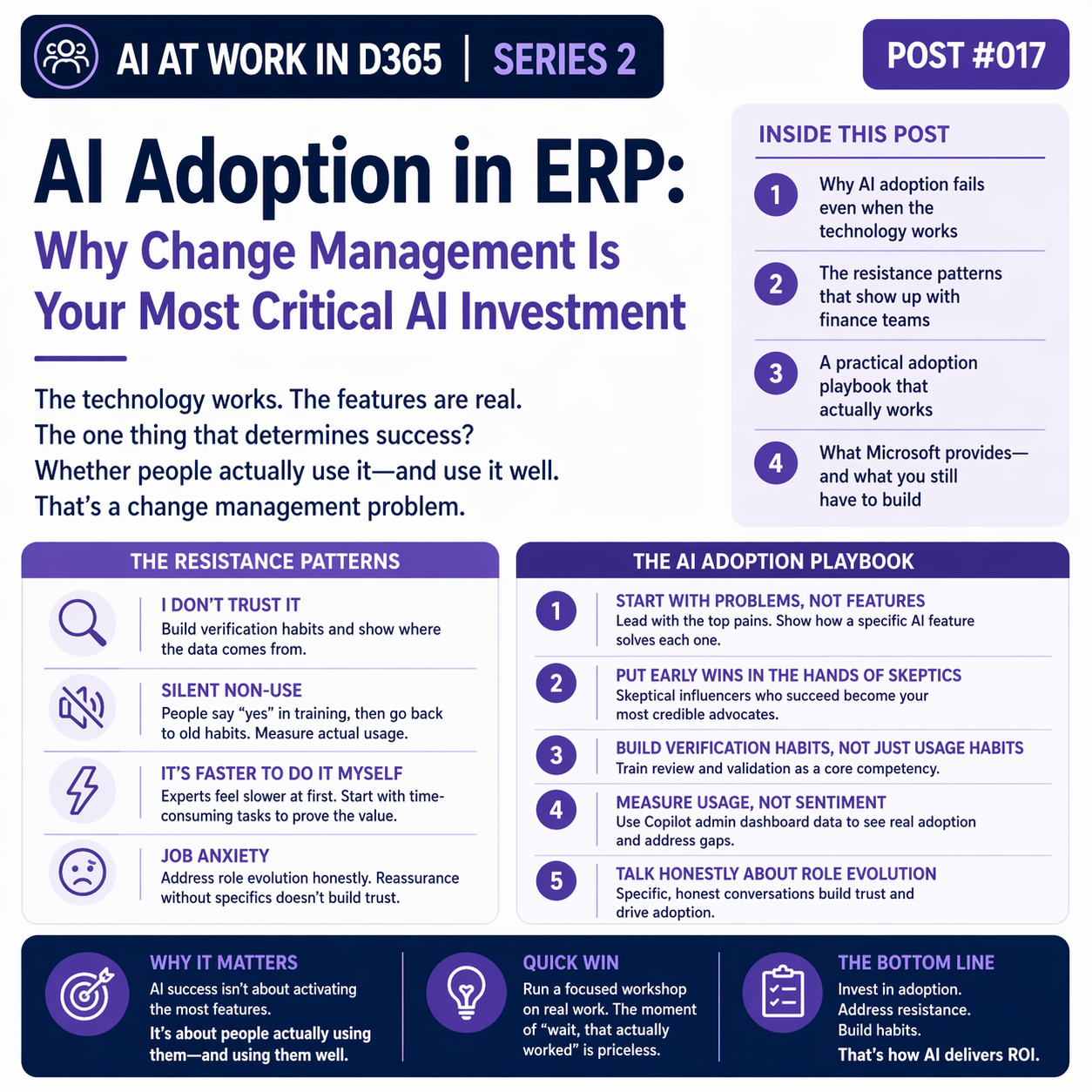
The technology works. The features are real. The one thing that consistently determines whether AI in ERP delivers value is whether people actually use it — and use it well. That’s a change management problem.
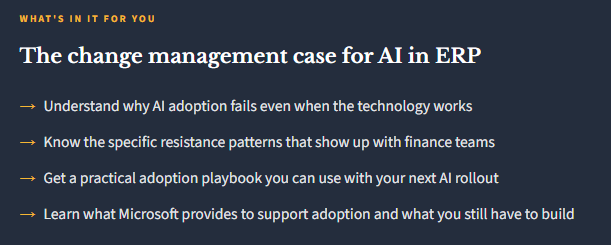
Why AI Adoption Is Different From Regular ERP Change Management
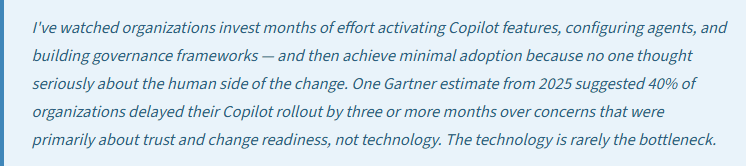
ERP implementations have a long tradition of change management — training, process documentation, go-live support, hypercare periods. Most organizations have a working model for it. AI adoption is different in a few ways that make the standard playbook insufficient.
First, AI features don’t come in a single go-live event. They accumulate over release waves, they arrive in different modules at different times, and some of them require users to develop entirely new interaction patterns (natural language prompting, reviewing AI-generated outputs) rather than just learning new screens. Managing AI adoption as a continuous program, not a project event, is genuinely different from how ERP changes have been handled historically.
Second, AI raises questions about role relevance that standard ERP change management doesn’t. When you implement a new journal entry workflow, nobody thinks their job is being eliminated. When you implement an AI agent that handles invoice processing, some people in the AP team do think exactly that — whether or not it’s accurate. Change management for AI has to address that anxiety directly, not sidestep it.
The Resistance Patterns That Show Up With Finance Teams
🔍 “I Don’t Trust It”
Finance professionals are trained to verify. An AI-generated output without visible sourcing violates every instinct that makes a good accountant. The response isn’t to dismiss the concern — it’s to show where the data comes from and build verification habits into the workflow from day one.
😶 Silent Non-Use
AI resistance rarely looks like open objection. It looks like people who say “yes” in training and then go back to their old workflow. Measure actual adoption (feature usage data in your Copilot admin dashboard) rather than self-reported adoption.
⚡ “It’s Faster to Do It Myself”
For experts, AI tools often feel slower initially because prompting requires thought that the expert used to skip. The productivity benefit accrues over time and at volume. Early wins with genuinely time-consuming tasks (bank rec, variance commentary) build the case faster than high-complexity tasks.
😟 Job Anxiety
Don’t underestimate this one. AP teams watching the Payables Agent demo are making calculations about their own role. Honest, specific conversations about how roles will change (more exception handling, more oversight, less data entry) are more effective than reassurances.

An AI Adoption Playbook That Actually Works
- Start with problems, not features
- Don’t lead with “here’s what Copilot can do.” Lead with “here are the three things in your current workflow that take the most time and feel like the least value.” Then show how a specific AI feature addresses each one. The feature becomes the solution to a known pain, not a technology demo.
- Put early wins in the hands of skeptics
- The most credible AI advocates are not technology enthusiasts — they’re respected domain experts who were initially skeptical and changed their minds after real experience. Identify your team’s influential skeptics and invest in getting them genuine early experience with the feature that’s most relevant to their specific work.
- Build verification habits, not just usage habits
- Finance teams that review AI output carefully before acting are doing exactly the right thing. Train review as a core competency, not as evidence of distrust. “Here’s how you validate what Copilot generated” is a more sustainable training investment than “here’s how you trust Copilot.”
- Measure usage, not sentiment
- Self-reported adoption surveys are unreliable. Microsoft’s Copilot admin dashboard provides actual usage data — which features are being used, by whom, and how frequently. Use this data to understand where adoption is real and where it’s performative, then address the gaps.
- Talk honestly about role evolution
- Teams that receive specific, honest information about how their role is changing tend to adapt faster than teams that receive reassuring generalities. “Your AP role will shift from processing to oversight and exception handling as the Payables Agent takes on routine invoices” is more useful than “AI is here to help, not replace you.”
What Microsoft Provides to Support Adoption
Microsoft has invested in adoption resources — the Copilot Scenario Library (scenarios.microsoft.com) provides a searchable database of real-world AI use cases organized by role and industry. The Microsoft 365 Copilot adoption hub provides training materials, communication templates, and program management guidance. For D365 specifically, the Microsoft Learn paths for each Copilot feature include end-user training content that can be adapted for your organization.
What Microsoft doesn’t provide is the organizational change management work — the stakeholder analysis, the resistance mapping, the manager enablement, the communication strategy tailored to your specific team’s concerns. That’s your work, or your partner’s work. The tools are there; the organizational engagement is not a technology problem.

📚 Go Deeper — Microsoft Resources
- Microsoft 365 Copilot Adoption Hub — training resources, scenario library, program guidance
- Copilot Scenario Library — searchable real-world AI use cases by role and industry
- D365 Copilot End-User Documentation — adaptable for internal training
The organizations that will look back on this period as an AI success story are not the ones that activated the most features fastest. They’re the ones that took adoption seriously — invested in the people side, addressed resistance directly, built verification habits, and measured actual use. The technology will keep improving regardless. The adoption work is what determines whether your organization benefits from it.
BB
Bobbi Bricker
ERP Capability Lead and D365 Functional Architect at Centric Consulting. Former controller. This series reflects fifteen + years in ERP (as an end user and a Consultant) and a genuine belief that AI, used thoughtfully, makes finance and operations teams more capable — not less. Reach out with questions, pushback, or war stories from your own organizations.
Thank you for reading!
Interested in learning more? Below are some of my latest posts:

Leave a Reply