

How D365 F&O’s Finance Insights module delivers machine-learning-powered cash flow forecasting, customer payment prediction, and AI-generated budget proposals—what Finance must configure before the models work, how to govern AI outputs before Finance acts on them, and the five Finance Insights failures that produce AI-assisted decisions based on unreliable predictions.
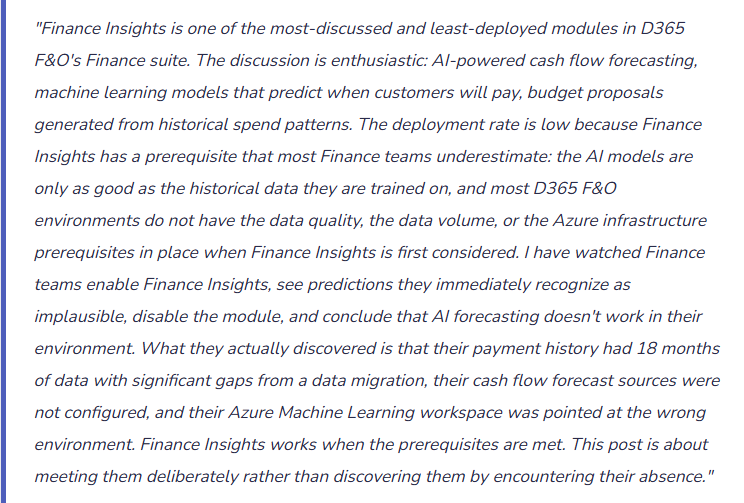
The Three Finance Insights Capabilities—What Each Does and What Each Requires
Customer Payment Predictions
- Machine learning models trained on the organization’s historical customer payment behavior predict whether each open invoice will be paid on time, late (1–30 days), or significantly late (30+ days). Finance uses the predictions to prioritize collections activity, adjust the allowance for doubtful accounts, and identify customers whose payment behavior has deteriorated.
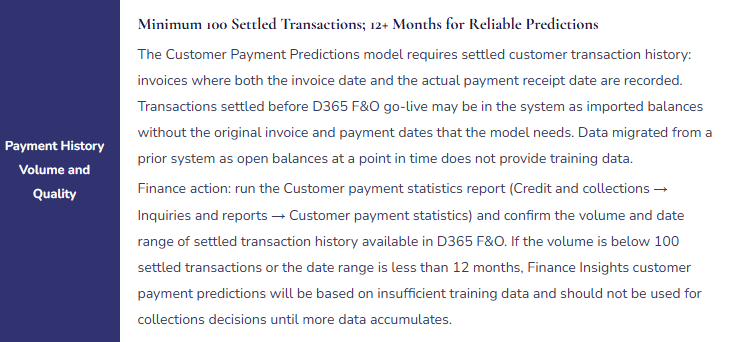
- Training data required: Minimum 100 settled customer transactions with payment dates recorded. Predictions improve significantly with 12–24 months of settled transaction history. Models are retrained periodically as new payment data accumulates.
- Prediction output: Each open invoice receives a probability distribution across the three payment timing buckets. Finance sees the predicted payment date range, not a single predicted date.
Intelligent Cash Flow Forecasting
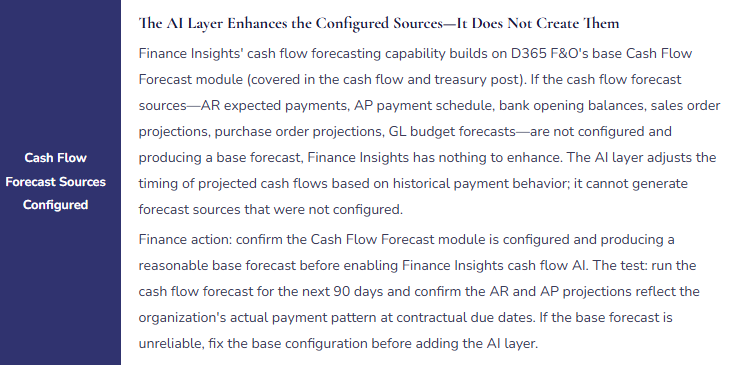
- AI-enhanced cash flow forecasting combines D365 F&O’s existing cash flow forecast sources (AR, AP, bank balances, sales orders, purchase orders, GL budgets) with machine learning models that adjust the projected amounts based on historical payment behavior patterns. The AI layer reduces the forecast error that comes from customers who consistently pay later than terms and vendors who consistently pay earlier than terms.
- Training data required: The same payment history that trains the Customer Payment Predictions model. The cash flow AI uses the payment timing predictions to adjust the AR cash inflow schedule from contractual due dates to expected payment dates based on historical patterns.
- Forecast output: Weekly and monthly cash position projections with confidence intervals. Finance sees the expected cash position and the range within which actual cash is likely to fall based on payment timing uncertainty.
Budget Proposals
- Machine learning models analyze historical GL expenditure patterns and generate budget proposals for the upcoming fiscal year. The model identifies seasonality, trend, and spend patterns by GL account and financial dimension, then generates proposed budget amounts Finance can review, adjust, and import into D365 F&O’s budget module as the starting point for the annual budget process.
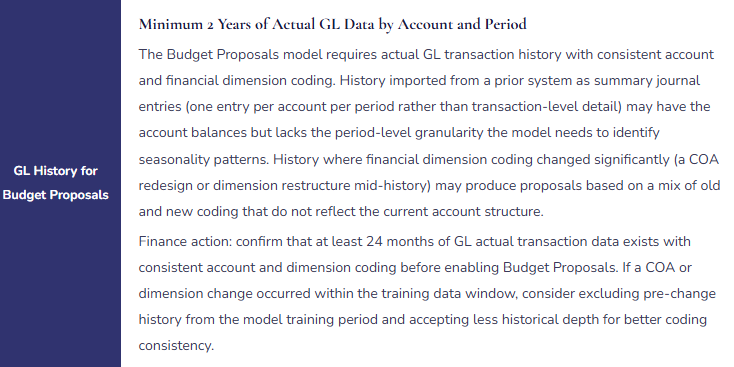
- Training data required: Minimum 2 years of historical GL actual transaction data by account and period. Models perform better with 3–5 years of history and are more accurate for accounts with stable, predictable spending patterns than for highly variable or discretionary accounts.
- Proposal output: Proposed budget amounts by account, period, and financial dimension in a format Finance can review in D365 F&O before importing to the budget module. Finance adjusts the proposals to reflect known business changes before the budget is finalized.
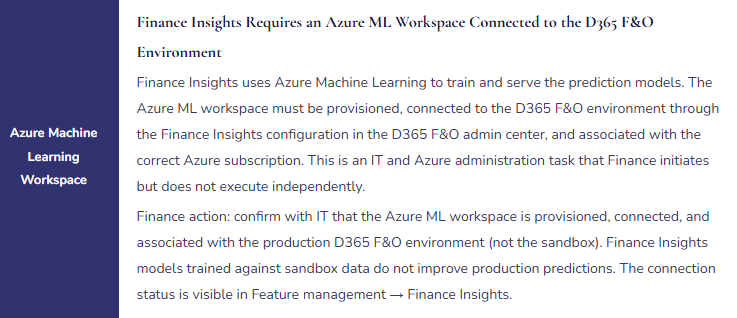
The Prerequisites Finance Must Meet Before Finance Insights Delivers Reliable Output
Governing Finance Insights Outputs—The AI Oversight Finance Must Maintain
Finance Insights predictions are probabilistic outputs from machine learning models, not deterministic calculations from accounting rules. Finance must govern how AI outputs are used in Finance decisions—not because the models are unreliable in principle, but because all machine learning models have conditions under which their predictions degrade, and Finance must recognize those conditions and adjust accordingly.
Model Accuracy Monitoring
Finance Insights provides model accuracy metrics: for Customer Payment Predictions, the percentage of predictions that matched actual payment timing in the most recent validation period. Finance reviews model accuracy monthly. If the accuracy rate drops below 60% for any payment timing bucket, the model has encountered conditions outside its training data (new customer segments, changed payment terms, economic disruption) and predictions should be weighted less heavily until the model retrains on the new conditions.
Prediction Confidence Intervals
Finance Insights surfaces confidence levels alongside predictions. A customer payment prediction with high confidence (80%+ probability in one bucket) is more actionable than a prediction where probability is spread evenly across the three buckets. Finance trains collections staff to interpret confidence levels: high-confidence late predictions warrant immediate collections contact; low-confidence predictions warrant monitoring but not escalation.
Known Business Changes
Machine learning models are trained on historical patterns and cannot incorporate knowledge of future business changes that Finance knows are coming. A new large customer with unknown payment behavior, a change in payment terms for a customer segment, or a new early payment discount program will all be outside the model’s training data. Finance must overlay known business changes on AI predictions—the model does not know what Finance knows about the business.
Budget Proposal Review Before Adoption
AI-generated budget proposals are starting points, not final budgets. Finance reviews every proposed account-level budget amount and adjusts for: known business changes not reflected in historical patterns (new business lines, discontinued products, headcount changes, real estate decisions), accounts where the AI model has insufficient history to be reliable (new accounts, restructured accounts), and accounts where the historical pattern is not a reasonable basis for the future year (one-time prior-year items, externally-driven cost changes).
Five Finance Insights Failures That Produce AI-Assisted Bad Decisions
⚠️ Finance Insights Enabled Before Prerequisites Met—Predictions Are Immediate and Immediately Wrong
Finance enables Finance Insights 90 days after D365 F&O go-live. The Customer Payment Predictions model trains on 90 days of settled transaction history—fewer than 100 settled transactions for a company with 30-day payment terms and moderate AR volume. The model generates predictions for all 847 open invoices. The collections team uses the predictions to prioritize their calls. Three weeks later, Finance reviews actual payment outcomes against predictions and finds the model accuracy is 41%—worse than random prediction of two categories. The collections team has been making prioritization decisions based on predictions that are less reliable than a coin flip. Two high-risk customers who should have received immediate calls were predicted as likely-on-time and were not contacted. Both balances are now 60 days past due.
Fix: Finance Insights has a minimum viable data threshold that Finance must verify before enabling predictions for operational use. The threshold for Customer Payment Predictions: minimum 100 settled transactions with both invoice and payment dates, spanning at least 12 months. Before enabling Finance Insights for collections prioritization, Finance reviews the Customer payment statistics report to confirm the training data volume meets the threshold. If it does not, Finance waits until the threshold is met and uses the standard aging-based collections process in the interim. Finance Insights is not a replacement for traditional collections analysis during the data accumulation period—it is a supplement that becomes meaningful only after sufficient history exists.
⚠️ AI Cash Flow Forecast Used for Liquidity Decisions Without Reviewing the Base Forecast Sources
Finance enables Finance Insights cash flow forecasting and begins using the AI-enhanced forecast for weekly liquidity decisions: when to draw on the credit line, when to accelerate vendor payments to capture early payment discounts, when to invest excess cash in short-term instruments. The AI-enhanced forecast shows consistent net positive cash positions over the next 60 days. Finance does not draw on the credit line and invests excess cash in a 60-day instrument. On Day 42, the actual cash position falls $1.4 million below the forecast. Investigation reveals that the base cash flow forecast was not configured to include open purchase orders—the AI enhanced an incomplete base forecast that was missing the organization’s largest category of cash outflows. The AI model cannot add purchase order cash flows that were not in the base; it can only refine the timing of cash flows that are in the base. Finance needs to draw on the credit line at a short-notice premium and liquidate the 60-day instrument at a penalty.
Fix: The base cash flow forecast must be reviewed and validated before Finance Insights AI enhancement is applied. Finance runs the base cash flow forecast (without AI enhancement) for a 30-day historical period and compares the forecast to actual cash flows for the same period. Any systematic difference between forecast and actual is a gap in the base configuration: missing purchase order cash flows, AR projected at wrong terms, bank fees not forecasted, intercompany transfers not configured as sources. Each gap must be resolved in the base configuration before the AI layer is enabled. The AI layer improves forecast accuracy by adjusting payment timing; it cannot compensate for missing cash flow sources. Finance should be able to explain every line item in the base forecast before relying on the AI-enhanced version for liquidity decisions.
⚠️ Budget Proposals Adopted Without Review—AI Perpetuates a Prior-Year Anomaly Into the Budget
Finance runs the Finance Insights Budget Proposals feature for the annual budget process. The proposals are generated in two hours—a process that previously required three weeks of manual spreadsheet work. Finance reviews the proposals at a high level, adjusts the top-line revenue and headcount accounts for known business changes, and imports the proposals into D365 F&O as the approved budget. Three months into the new fiscal year, Finance notices that the Facilities-Repairs and Maintenance account is significantly over budget every month. Investigation reveals that in the prior year, the organization had a major HVAC replacement ($180,000 one-time expense) in that account. The AI model, trained on three years of data including the anomalous prior year, incorporated the HVAC replacement into the baseline pattern and proposed a budget amount $60,000 higher than a reasonable ongoing run rate for facilities maintenance. Finance adopted the proposal without reviewing facility-level account detail. The budget is $60,000 too high for a recurring account, and Finance is not generating the underbudget variance flag that would normally signal operational efficiency.
Fix: Budget proposals require Finance review at the account level, not just at the category level. Finance should review every account where the proposed budget differs from the prior-year actual by more than 15% and investigate the reason for the difference. For the HVAC scenario, the proposal would show a significant increase over the two-year average that preceded the HVAC year—a signal Finance should investigate before adopting. The review process: sort the proposals by the percentage difference between the proposed amount and the average of the two years preceding the most recent year. Outliers at the top and bottom of that list are accounts where the AI model may have been influenced by anomalous history. Finance documents the investigation and adjustment rationale for each account where the proposal is modified. The documentation becomes the budget narrative that supports variance analysis during the year.
⚠️ Model Accuracy Degraded After Business Change—Finance Continues Using Predictions Without Recalibration
Finance has been using Customer Payment Predictions successfully for 18 months with model accuracy consistently above 70%. In October, the organization acquires a new business unit with 80 customer accounts that have materially different payment behavior than the existing customer base—shorter payment terms, higher on-time payment rates, and different industry-standard payment conventions. The Finance Insights model was trained on the existing customer base and has no history for the new accounts. Finance enables Finance Insights for the combined entity without reviewing model accuracy in the post-acquisition environment. For 6 months, Finance uses predictions for the 80 new accounts that are based on patterns from a different customer population. Collections prioritization systematically misidentifies risk in the new account base. Two significant overdue balances accumulate before Finance reviews the model accuracy report and discovers it has dropped to 52% for the combined entity.
Fix: Model accuracy review is a monthly Finance governance task, not a one-time post-enablement validation. Finance sets a calendar reminder for the first business day of each month to run the Finance Insights model accuracy report and confirm the accuracy rate for each prediction bucket has not dropped below the defined threshold (Finance typically sets this at 65%). Any drop below the threshold triggers a review: what changed in the business that the model has not yet incorporated? The most common triggers are new customer segments, changed payment terms, economic disruption affecting payment behavior, and seasonal patterns that fall outside the training data period. When model accuracy drops, Finance communicates the change to collections staff: predictions in the affected period should be treated as lower confidence and traditional aging analysis should carry more weight until the model retrains on the new conditions.
⚠️ Finance Insights Configured in Sandbox Environment—Models Never Connected to Production Data
IT provisions the Azure ML workspace and connects it to the D365 F&O sandbox environment for Finance Insights testing. Finance tests the predictions in sandbox and finds them reasonable. IT then enables Finance Insights in the production environment but does not update the Azure ML workspace connection to point to production data—the workspace is still pointed at the sandbox. The production Finance Insights workspace generates predictions, but those predictions are trained on sandbox transaction data (a subset of production data, often with test transactions that do not reflect real customer behavior). Finance uses the production Finance Insights workspace for collections prioritization without knowing that the models are trained on sandbox data rather than the full production history. The predictions are systematically less accurate than Finance expects and the root cause takes months to diagnose.
Fix: The Azure ML workspace environment connection must be explicitly verified after any Finance Insights migration from sandbox to production. Finance confirms with IT: (1) which D365 F&O environment is the Azure ML workspace connected to; (2) what is the training data cutoff date for the current production models; and (3) are the model training logs showing production-volume transaction counts or sandbox-volume transaction counts. Production models should show significantly higher transaction counts than sandbox models. Finance Insights configuration in production requires a separate Azure ML workspace connection than the sandbox configuration—they should never share a workspace. If they were sharing, Finance needs IT to provision a separate production workspace, connect it to the production environment, and retrain the models on production data before Finance Insights is used for operational decisions.
Do This / Don’t Do This
Do This
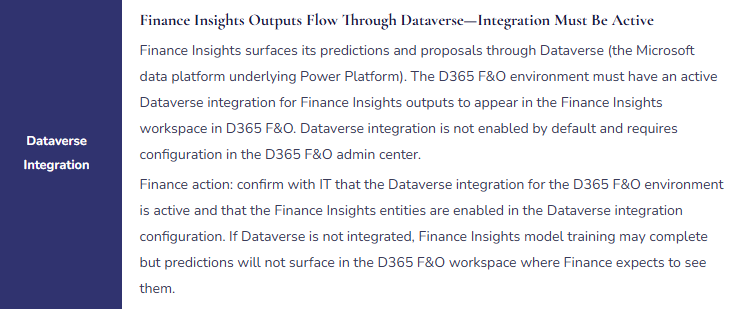
- Verify all prerequisites (Azure ML workspace, payment history volume, base cash flow forecast, Dataverse integration) before enabling Finance Insights for operational use
- Confirm the Azure ML workspace is connected to the production D365 F&O environment, not the sandbox
- Review model accuracy monthly and communicate accuracy changes to Finance staff who use predictions operationally
- Validate the base cash flow forecast against 30 days of actual history before relying on AI-enhanced forecasts for liquidity decisions
- Review budget proposals at the account level, not just category level—investigate accounts where proposals differ significantly from normalized historical averages
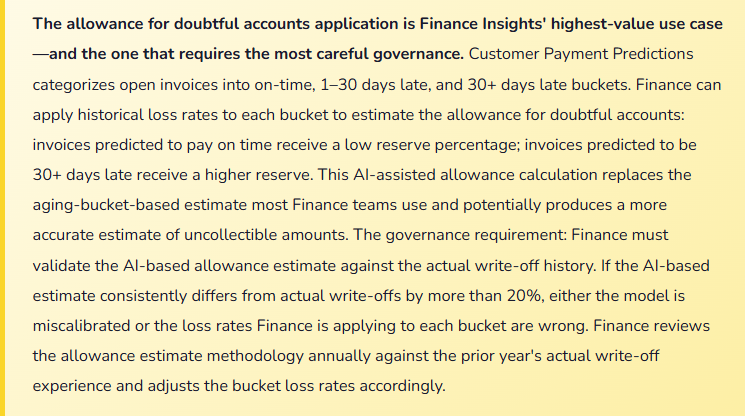
- Apply the allowance for doubtful accounts methodology using AI predictions as an input alongside aging analysis, not as a replacement for Finance judgment
Don’t Do This
- Enable Finance Insights predictions for collections decisions before the minimum training data threshold is met
- Use AI-enhanced cash flow forecasts for liquidity decisions without validating the base forecast sources are complete and accurate
- Adopt budget proposals without account-level review for anomalous prior-year history that should not propagate into future-year budgets
- Continue using predictions without reviewing model accuracy after significant business changes (acquisitions, new customer segments, changed payment terms)
- Share an Azure ML workspace between sandbox and production Finance Insights configurations
- Treat AI prediction outputs as deterministic calculations—they are probability distributions that Finance must interpret in the context of known business conditions
What’s Next:
Finance Insights brings AI into the Finance workflow. The next post addresses a structural Finance configuration challenge that multinational organizations face from their first day on D365 F&O: Dual Reporting—Parallel Accounting for IFRS and GAAP in D365 F&O—how D365 F&O’s additional reporting currency, parallel ledger, and posting layer configuration supports organizations that must maintain financial records under two accounting standards simultaneously, produce audited financial statements under both standards, and manage the permanent and temporary differences between the two GAAP presentations.
— Bobbi
D365 Functional Architect · Recovering Controller
Thank you for reading!
If this post helped you solve a real problem, share it with a Finance colleague who is in the middle of an ERP implementation or a post-go-live optimization. If you have a topic that I haven’t covered, please reach out. There is always one more post worth writing.
Interested in learning more? Here are some of my latest posts:
Leave a Reply