
AI in Microsoft ERP · Licensing Changes · Series 4 · #039
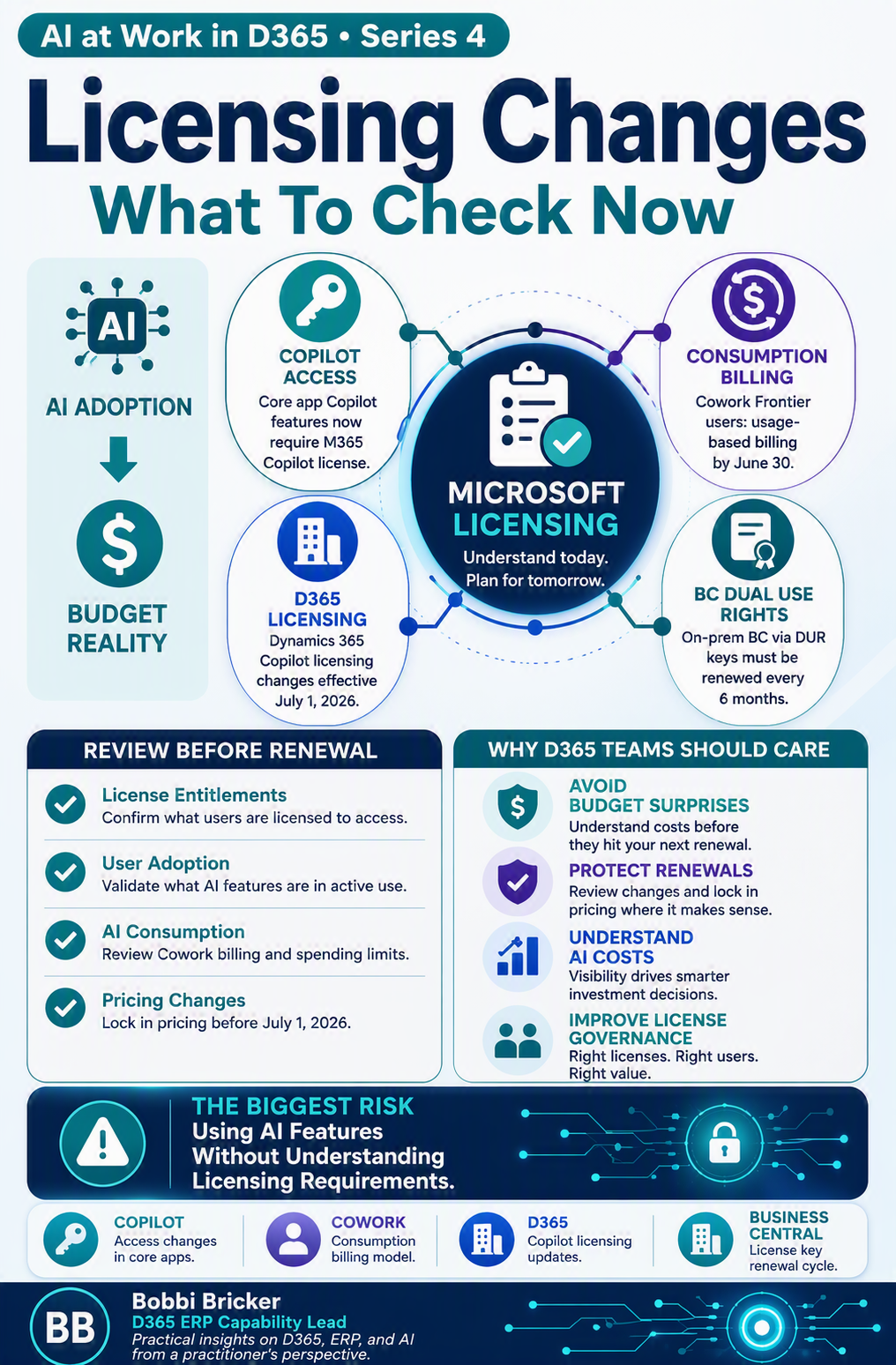
Less exciting than agents, more important to get right: Microsoft made real licensing and pricing changes effective July 1, 2026. Here’s what’s actually changing and what to verify before it hits your next renewal.
Every series I’ve written so far has touched on licensing in passing — Copilot features included with your existing license versus consumption-based agent billing versus additional M365 Copilot seats. This post is dedicated entirely to the practical licensing changes taking effect right now, because getting this wrong has real budget consequences, and the window to act on the most time-sensitive item is now.
The Time-Sensitive Item: Frontier Usage-Based Billing Deadline
If your organization has been participating in the Copilot Cowork Frontier preview program, there’s a specific deadline that already passed or is imminent depending on when you’re reading this: Frontier customers currently using Cowork needed to set up usage-based billing in the Microsoft 365 admin center by June 30, 2026, to continue using it without interruption. If your organization piloted Cowork under Frontier and hasn’t completed this billing setup, check immediately — this is not a “get to it eventually” item.
The Broader July 1 Licensing Changes
- 🔑Copilot Feature Licensing Tightens in Core Apps
- Microsoft has updated Copilot licensing so that Copilot features within Word, Excel, PowerPoint, and OneNote are now available only to users with a Microsoft 365 Copilot license. Users without that license can still use Copilot Chat through the app or web for general AI assistance, and Outlook Copilot features remain available – but the in-document AI assistance inside core Office apps is now gated more tightly than it was previously.
- If your organization has been relying on broader Copilot access without full Copilot licensing for all users, this is worth a headcount review.
- 💰Microsoft 365 Pricing and Packaging Updates
- Microsoft has signaled broader Microsoft 365 pricing and packaging changes coming in 2026, with explicit guidance to lock in current pricing by closing renewals before July 1.
- If your organization has a Microsoft 365 or D365 renewal coming up in the near term, accelerating that conversation with your Microsoft partner or account team before the deadline is a legitimate cost-management action worth taking seriously.
- 🏢Business Central On-Premises License Key Renewal Cycle
- Effective June 5, 2026, D365 Business Central online customers running on-premises deployments via Dual Use Rights (DUR) license keys must download and replace their license keys every six months to continue using the on-premises product.
- These keys prevent continued use beyond the subscription term’s end date plus a buffer period — meaning organizations on this licensing path need a recurring calendar reminder, not a “set it and forget it” assumption.
- 🤖Dynamics 365 Copilot Licensing Changes
- Independent analysis of the 2026 Dynamics 365 Copilot landscape specifically flags “new licensing changes effective July 1, 2026” tied to the shift from chat-based assistance to agentic AI capabilities across D365 modules.
- If your organization is budgeting for expanded D365 Copilot or agent usage, confirm current licensing structure with your Microsoft partner rather than relying on documentation that may predate this change.

A Pre-Renewal Checklist
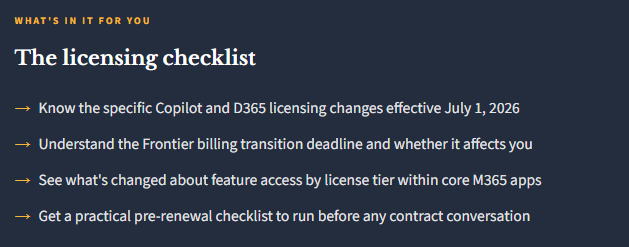
Before your next Microsoft 365 or Dynamics 365 contract conversation, walk through this list: confirm whether any users are relying on Copilot features in Word, Excel, PowerPoint, or OneNote without a full Copilot license, and budget accordingly if so. If you’re running BC on-premises via DUR, confirm someone owns the six-month license key renewal cycle and has it on a calendar. If you’ve been piloting Cowork under Frontier, confirm usage-based billing is configured and active. Ask your Microsoft account team directly about any pending Dynamics 365 Copilot licensing changes specific to your modules and user counts. And if a renewal is approaching, ask explicitly whether locking in current pricing before broader 2026 packaging changes makes financial sense for your situation.


📚 Go Deeper — Microsoft Resources
- Partner Center Announcements — June 2026 — the authoritative source for these changes
- What’s New in Microsoft 365 — June 2026 Licensing Summary
- Business Central Dual Use Rights — License Key Renewal Process
Licensing isn’t glamorous, but it’s where AI adoption strategy meets budget reality — and this month brought enough genuine change that a dedicated review is warranted regardless of where your organization stands on AI adoption. Post 40 closes this series with the most useful thing I can offer after covering an entire month of rapid change: a realistic, grounded look at what’s actually likely to matter for D365 organizations in the second half of 2026.
BB
Bobbi Bricker
ERP Capability Lead and D365 Functional Architect at Centric Consulting. Former controller. This series reflects fifteen + years in ERP (as an end user and a Consultant) and a genuine belief that AI, used thoughtfully, makes finance and operations teams more capable — not less. Reach out with questions, pushback, or war stories from your own organizations.
Thank you for reading!
Interested in learning more? Listed below are some of my latest posts:

Leave a Reply