
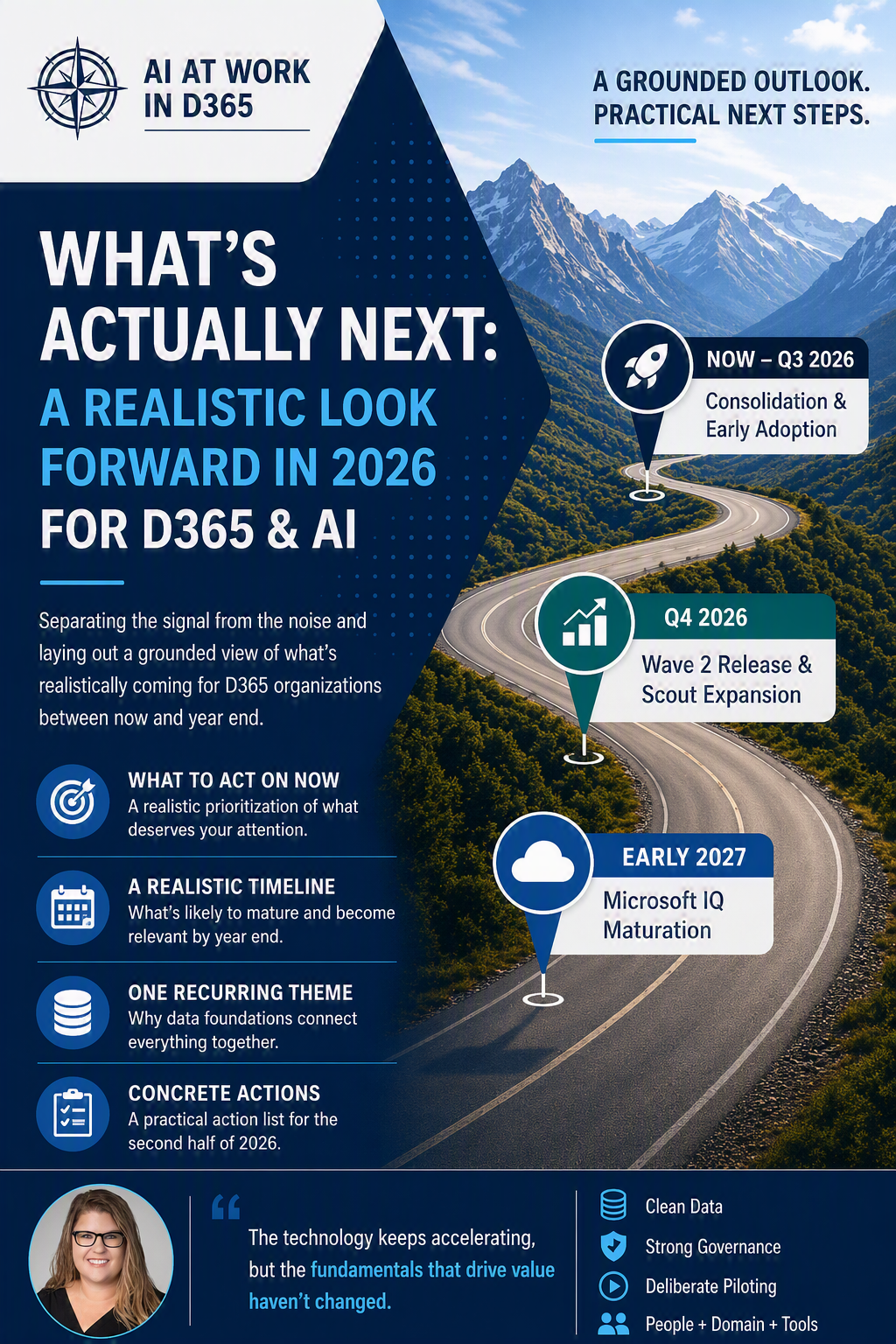
After six weeks of rapid build-driven change, let’s separate the signal from the noise and lay out a grounded view of what’s realistically coming for D365 organizations between now and year end.
Ten posts ago, I said this series would track what Microsoft actually shipped rather than the broader feature landscape we’d already covered in the previous series on AI in ERP. Having walked through Build 2026, Microsoft Scout, the Microsoft IQ layer, Cowork’s GA, model choice, Copilot Studio’s new capabilities, the D365 plugin connections, Agent 365’s expansion, and the licensing changes — I want to close by being honest about what I think actually matters going forward, separate from what generated the most headlines.
What’s in It For You? The grounded H2 2026 outlook
- Get a realistic prioritization of what to actually act on from this past month’s announcements
- See a reasonable timeline for what’s likely to mature and become broadly relevant by year end
- Understand the recurring theme connecting everything in this series back to data foundations
- Walk away with a concrete action list for the second half of 2026
What I’d Actually Prioritize Acting On Right Now
Of everything covered in this series, here’s my honest ranking of what deserves your team’s limited attention in the near term, versus what’s worth understanding but not yet acting on.
- Act now:
- The licensing review from my last post: This has real, near-term budget consequences and a clear deadline already in motion.
- The Agent 365 governance: Your agent surface has grown this month whether you’ve actively expanded it or not.
- The data foundation work that Microsoft IQ makes more strategically important, this has been the throughline of every series in this collection, and it just got more important, not less.
- Pilot carefully:
- Copilot Cowork, particularly if your organization runs D365 Sales or Customer Service where the plugins are most mature.
- The Claude Sonnet 4.5 model selection for any D365 ERP MCP agent builds
- This is a low-effort, well-documented configuration change worth making immediately for any agent project already underway.
- Understand but don’t chase yet:
- Microsoft Scout is genuinely interesting strategically, but gated, personal-productivity-focused, and not yet ERP-connected in any meaningful way.
- The newer Copilot Studio capabilities like voice and computer-using agents are powerful, but apply them to specific gaps you actually have rather than building agents looking for a use case.
A Realistic Timeline Through Year End
- Now – Q3 2026
- Consolidation and Early Adoption
- Organizations that move now will be testing Cowork D365 plugins, reviewing licensing, and tightening Agent 365 governance. The ERP-specific Cowork plugin documentation and validated prompt library will likely mature significantly during this window, based on the pattern of the Sales and Customer Service plugins maturing ahead of the ERP-specific ones.
- Consolidation and Early Adoption
- Q4 2026
- Wave 2 Release and Scout Expansion
- The 2026 Release Wave 2 (typically announced mid-year for an October-March rollout) will likely bring the next round of D365-specific agentic capability, building on the Wave 1 foundation covered throughout Series 2 and 3.
- Watch for whether Scout’s access gating loosens beyond Frontier as Microsoft gains confidence in the governance model — and whether any Scout-style “Autopilot” capability gets explicitly positioned for finance or operations workflows.
- Wave 2 Release and Scout Expansion
- Early 2027
- Microsoft IQ Maturation
- The Work IQ, Fabric IQ, and Foundry IQ components are early in their unification under the “Microsoft IQ” umbrella.
- Expect continued API expansion (following the June 16 Work IQ APIs GA) and deeper integration with D365’s existing MCP server infrastructure, making the connection between ERP data and the broader agent context layer more direct and less reliant on separate plugin development.
- Microsoft IQ Maturation
Every wave of Microsoft AI announcements eventually reduces to the same questions for D365 organizations:
- Is your data clean,
- Is your security model tight
- Is your governance structure ready to extend to whatever ships next?
Those questions haven’t changed across this blog series. Asking yourself (and your organization those questions, over and over again) is the most durable piece of advice I have to give.
The Honest Caveat on Everything
I want to close with the same caveat I’d want from anyone briefing me on fast-moving technology: a meaningful portion of what was announced at Build 2026 is preview, Frontier-gated, or freshly GA with limited real-world deployment history. Some of it will mature exactly as positioned. Some of it will be modified, delayed, or quietly deprioritized; that’s the normal pattern for ambitious platform announcements, and Microsoft’s own release plan documentation explicitly carries that disclaimer.
The right posture for D365 organizations isn’t to chase every announcement, and it isn’t to wait for everything to fully mature before engaging. It’s the posture this entire collection has argued for since the beginning:
- Build solid data
- Build a solid governance foundation
- Pilot deliberately with real use cases
- Measure what actually changes
- And finally, stay informed enough to recognize which new capabilities are worth your team’s attention when they do mature.
📚 The Master Resource List
- Introducing Microsoft Scout
- What’s New in Copilot Cowork
- Microsoft Copilot Studio Blog — monthly update cadence
- Microsoft 365 Copilot Release Notes
- Partner Center Announcements — June 2026
- Microsoft 365 Roadmap — the ongoing source of truth
The conclusion I keep arriving at is the same one I started with: the technology keeps accelerating, but the fundamentals that determine whether any of it delivers value for your organization haven’t changed. Clean data, sound governance, deliberate piloting, honest measurement, and people who understand both the domain and the tools.
BB
Bobbi Bricker
ERP Capability Lead and D365 Functional Architect at Centric Consulting. Former controller. This series reflects fifteen + years in ERP (as an end user and a Consultant) and a genuine belief that AI, used thoughtfully, makes finance and operations teams more capable — not less. Reach out with questions, pushback, or war stories from your own organizations.
Thank you for reading!
Interested in learning more? Here are some of my latest posts:

Leave a Reply