

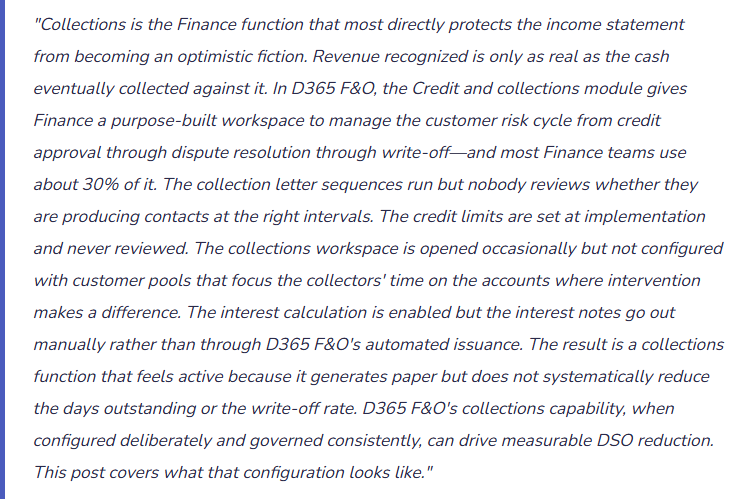
The D365 F&O collections workspace and how Finance configures it for maximum collections effectiveness, the credit scoring and credit limit framework, collection letter sequences and interest calculation, write-off procedures and bad debt reserve governance, and the five credit and collections failures that allow collectible receivables to become uncollectible ones.
The D365 F&O Credit and Collections Architecture—Four Integrated Capabilities
Credit and Collections Module—Four Capabilities Finance Configures and Owns
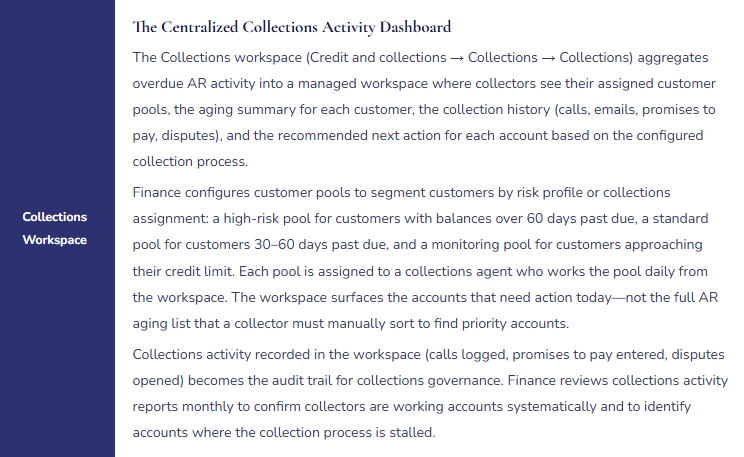
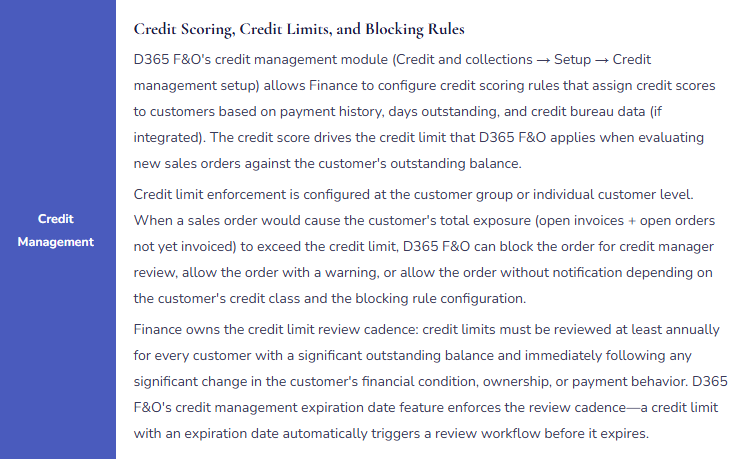
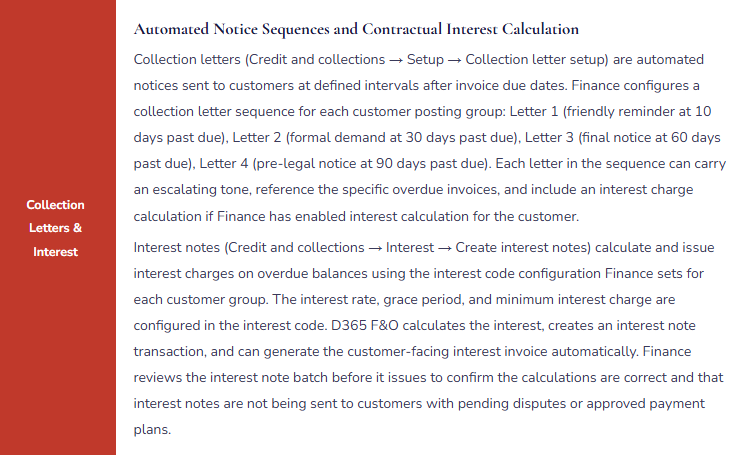
The Collection Letter Sequence—Calibrating the Escalation Timing Finance Must Own
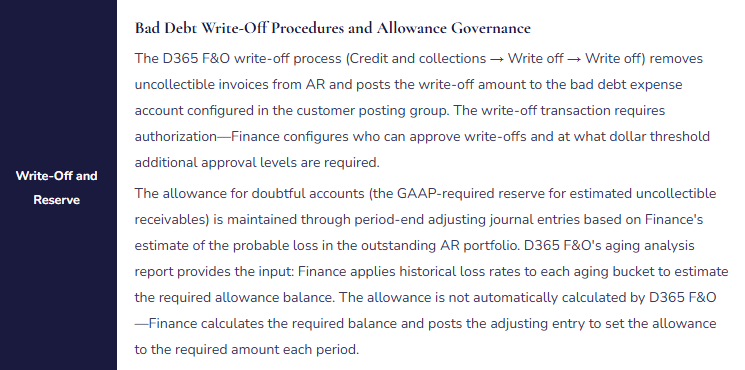
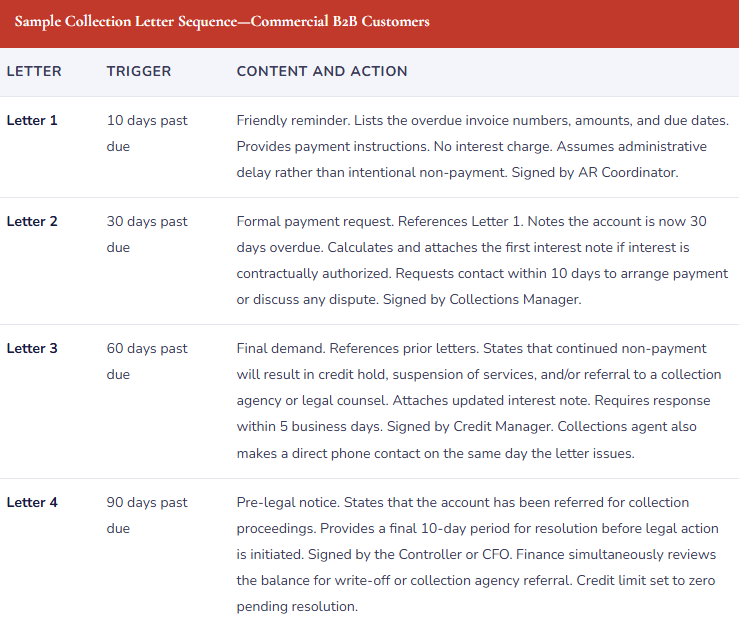
The collection letter sequence is the operational policy of the collections function encoded in D365 F&O. Finance must calibrate the sequence timing based on the organization’s customer base, the industry’s payment culture, and the legal requirements for collections in the relevant jurisdictions. A sequence calibrated for one customer type may be wrong for another—Finance should configure separate sequences for different customer posting groups.
Five Credit and Collections Failures That Turn Collectible Receivables Uncollectible
⚠️ Credit Limits Set at Go-Live and Never Reviewed—Customer Exposure Grows Without Risk Assessment
Credit limits for all customers were set during D365 F&O implementation based on initial credit applications and the prior system’s credit history. Eighteen months post-go-live, no credit limits have been reviewed or updated. Three customers whose payment behavior has deteriorated significantly—consistently paying 45–60 days late over the past six months—still have credit limits that reflect their initial creditworthiness at go-live. The sales team continues booking orders against these customers because D365 F&O’s credit check shows available credit. The outstanding balance for the three customers grows to $840,000. When one of the three files for bankruptcy, Finance has $280,000 of receivables that are substantially uncollectible. A credit limit review three months earlier would have reduced the exposure to $60,000 by flagging the deteriorating payment behavior and tightening the credit limit.
Fix: Credit limit reviews are a Finance governance process with a defined annual cadence and an event-triggered review process. Annual reviews: Finance runs the Customer credit management report at fiscal year-end and reviews the credit limit for every customer whose outstanding balance exceeds 30% of their credit limit. Event-triggered reviews: any customer whose payment behavior meets a defined deterioration trigger (three consecutive months of 30+ days late, a single payment more than 60 days late on a balance over $50,000, a public report of financial distress) receives an immediate credit limit review. D365 F&O’s credit management expiration date feature supports the annual cadence—Finance sets a 12-month expiration on every credit limit at the time it is set or last reviewed, and the system generates a review task when the expiration approaches. The review task routes to the Credit Manager with the customer’s payment history, current outstanding balance, and the new recommended limit.
⚠️ Collection Letters Running But Not Reviewed Before Issue—Letters Sent to Disputed Accounts
Finance runs the Create collection letters batch weekly on Monday morning. The batch identifies all customers with overdue balances and generates the appropriate letter in the sequence. The letters are issued automatically without Finance review. In the same week, a customer with $125,000 in overdue invoices has an active dispute logged in the collections workspace—they claim three of the invoices duplicate prior payments that the AR team has not yet investigated. The collection letter batch does not check for active disputes and issues Letter 3 (final demand, 60 days past due) to the disputed customer. The customer’s CFO calls the organization’s CFO to complain about receiving a formal collection demand while an active dispute is unresolved. The relationship deteriorates. The investigation of the dispute takes two weeks; Finance determines the customer was correct, the three invoices were duplicates, and the actual overdue balance is $18,000. The collection letter process escalated a billing error into a relationship crisis.
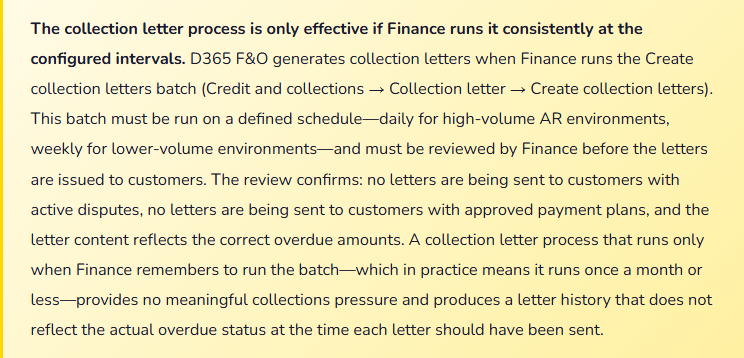
Fix: The collection letter batch must be reviewed by Finance before letters are issued to customers. D365 F&O allows Finance to generate the collection letter batch to a review queue rather than to immediate issuance. Finance reviews the queue and removes any customer with an active dispute, an active payment arrangement, or a pending credit adjustment before approving the batch for issuance. The review takes 10–20 minutes weekly for a standard AR environment and prevents the dispute-escalation scenario. The collections workspace provides the active case list that Finance checks against the letter batch queue—any customer on the active dispute list should not receive a collection letter until the dispute is resolved. Configure the D365 F&O dispute status on customer accounts to flag them as excluded from the collection letter batch when a dispute is marked as open.
⚠️ Collections Workspace Configured but Collectors Not Assigned to Customer Pools—Collections Activity Is Unmanaged
Finance enables the collections workspace and configures customer pools. Three collectors are named in D365 F&O as collections agents. However, the customer-to-collector assignment was never completed—no customers are assigned to any collector’s pool. The collectors open the workspace and see the full aging list across all customers rather than their assigned pool. Each collector works the list differently: one focuses on the largest balance accounts regardless of days outstanding, one focuses on accounts that called in that week, one works alphabetically. There is no coverage pattern, no prioritization logic, and no visibility to the Credit Manager of whether any specific account is being actively worked. A $95,000 balance reaches 120 days past due without any collections contact because no collector claimed the account and none noticed it was uncovered in the unassigned pool.
Fix: Customer pool assignment is not a set-and-forget configuration—it is an active management task that Finance reviews monthly. Every customer with an outstanding balance above the defined threshold must be assigned to a collector’s pool. Finance reviews the pool assignments monthly and reassigns accounts when: a collector leaves and their pool becomes unassigned, a new large customer is added to AR and not yet assigned, an account is escalated from a standard pool to the high-risk pool requiring more senior attention. The Credit Manager runs the collections activity report weekly to confirm that every account in a priority pool received at least one documented contact in the prior seven days. Accounts with no documented contact in 14 days are escalated to the Credit Manager’s direct attention. The workspace supports this oversight only if the pool assignments are current and complete.
⚠️ Bad Debt Write-Off Requires No Approval—Write-Offs Are Posted Directly by the AR Coordinator
D365 F&O’s write-off function was configured at implementation with no approval requirement—any user with access to the write-off menu item can post a write-off directly to the bad debt expense account without authorization. The AR coordinator uses the write-off function to clean up small balances that have been open for a long time: a $1,200 balance from a customer who went out of business two years ago, a $340 balance that has been disputed for 18 months without resolution, a $780 balance that nobody can explain. Over two years, the AR coordinator has posted 34 write-offs totaling $28,400 without any Finance management review. Three of the write-offs were for balances that were actually collectible—one had a payment in transit, one had a credit card payment pending processing, and one was a customer Finance was actively pursuing. The AR coordinator did not know any of this and wrote off the balances because they appeared to be stale.
Fix: Write-offs require a tiered approval process configured in D365 F&O before any write-off is processed. Finance configures: AR Coordinator can initiate write-off requests for balances under $500 with Collections Manager approval required. Collections Manager can approve write-offs between $500 and $5,000 with Controller notification. Controller approval required for write-offs between $5,000 and $25,000. CFO approval required for write-offs over $25,000. The approval workflow is configured in D365 F&O’s workflow module and enforced at the write-off transaction level—the system will not post the write-off journal until all required approvals are obtained. Finance also maintains a write-off policy that defines what conditions justify a write-off: confirmed customer insolvency, balance over 180 days with documented unsuccessful collection attempts, balance under minimum collection cost threshold with documented write-off recommendation from the collections team. Write-offs that do not meet the policy conditions require Controller exception approval with documented rationale.
⚠️ Allowance for Doubtful Accounts Never Reviewed—Write-Offs in Excess of Reserve Produce Income Statement Surprise
The organization established an allowance for doubtful accounts at go-live using a 1% of total AR reserve rate—a standard starting point from a prior accounting policy. For three years, Finance posts a monthly journal entry to maintain the allowance at approximately 1% of month-end AR. No analysis is performed to determine whether 1% is appropriate based on actual collection experience. In year four, a concentrated collection of write-offs hits: two customer bankruptcies and three long-disputed balances finally written off total $640,000. The allowance balance at the time the write-offs are posted is $180,000 (1% of $18 million in AR). The write-offs exceed the allowance by $460,000, which flows directly to bad debt expense in the quarter. The income statement shows a $460,000 expense line that management did not anticipate and cannot explain as a reserve adjustment—because no reserve was built for the known risk that materialized. The external auditors cite the allowance methodology as inadequate given the organization’s actual loss experience.
Fix: The allowance for doubtful accounts methodology must be calibrated to the organization’s actual write-off experience, reviewed annually, and updated when the AR risk profile changes. Finance runs the following analysis annually: (1) calculate the actual write-off percentage by aging bucket over the trailing three years (what percentage of balances 30–60 days past due were eventually written off? 60–90 days? 90+ days?); (2) apply those historical loss rates to the current aging buckets to estimate the required allowance; (3) compare the required allowance to the current allowance balance and post an adjusting entry for the difference. This aging-bucket-specific approach produces a more accurate allowance estimate than a flat percentage of total AR and builds the reserve in advance of known concentration risks. When Finance Insights customer payment predictions are available, the prediction-based allowance calculation (applying historical loss rates to AI payment timing buckets) can supplement or replace the aging-bucket approach for organizations with sufficient prediction model accuracy.
Do This / Don’t Do This
Do This
- Assign every customer with a significant outstanding balance to a specific collector’s pool—review and update pool assignments monthly
- Review the collection letter batch queue before letters are issued and remove accounts with active disputes or payment arrangements
- Configure credit limit expiration dates to enforce annual review cadence for all significant customer accounts
- Implement event-triggered credit limit reviews for customers showing payment behavior deterioration
- Require tiered approval for write-offs—no write-off should be posted without at least one level of management authorization above the initiator
- Calibrate the allowance for doubtful accounts to actual historical write-off rates by aging bucket, reviewed annually
- Run the collections activity report weekly to confirm all priority pool accounts received documented contact
Don’t Do This
- Set credit limits at go-live and consider the task complete—credit limits that are never reviewed become meaningless risk controls
- Issue collection letters automatically without Finance review—the batch will send formal demands to disputed accounts
- Enable the collections workspace without completing customer pool assignments—unassigned pools produce unmanaged accounts
- Allow write-offs without a documented approval workflow—the risk is both operational (premature write-off of collectible balances) and control (unauthorized expense creation)
- Maintain a flat-percentage allowance methodology without annual calibration to actual write-off experience
- Treat collection letter issuance as the collections process—letters without documented follow-up calls and dispute resolution are not collections management, they are collections theater
What’s Next:
Credit and collections management protects recognized revenue from becoming permanent losses. The next post addresses the master data foundation that Finance must own to ensure every transaction is accurately attributed, allocated, and reported: Master Data Governance—The Vendor, Customer, and Chart of Accounts Finance Must Own in D365 F&O—how data quality in the vendor master, customer master, and chart of accounts determines the accuracy of every financial report Finance produces, the governance framework Finance must enforce to maintain master data integrity, and the five master data failures that produce financial statement errors Finance traces back to a single field entered incorrectly at setup.
— Bobbi
D365 Functional Architect · Recovering Controller
Thank you for reading!
If this post helped you solve a real problem, share it with a Finance colleague who is in the middle of an ERP implementation or a post-go-live optimization. If you have a topic that I haven’t covered, please reach out. There is always one more post worth writing.
If you are interested in learning more, below are some of my latest posts:
Leave a Reply