

Post #007 – AI In Microsoft ERP
“Agentic AI” is the phrase of the moment in ERP. But what does it actually change — and for whom, and when? Let’s decode it.

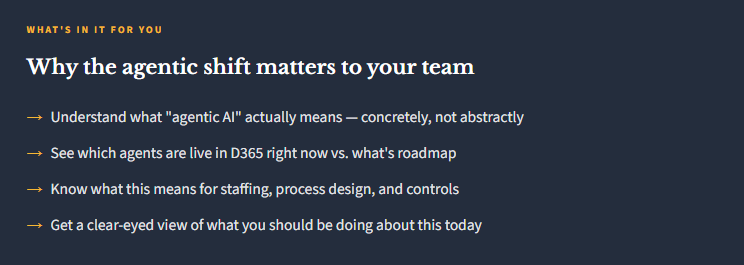
What “Agentic” Actually Means
Here’s the cleanest definition I can give you: a Copilot feature answers questions and makes suggestions. An AI agent takes actions. An agent doesn’t just tell you that an invoice needs to be matched to a PO — it matches it, prepares it, and queues it for approval. An agent doesn’t just summarize your workflow queue — it executes the steps in the workflow on your behalf, within defined parameters.
This is a qualitative shift from AI as an assistant to AI as an autonomous actor in your business process. And that shift has real implications for how you design processes, how you structure controls, and how you think about the work your team does.
How We Got Here
Pre-2023: Rules-Based Automation – Workflows, RPA, scheduled jobs
Automation in ERP was rigid — if this, then that. It worked well for predictable scenarios and broke on exceptions.
2023–2024: Copilot as Assistant – Suggestions, summaries, in-app help
AI entered ERP as a helper — surfacing information, drafting communications, answering questions. Still reactive; user initiates, AI responds.
2025–2026: Agents Execute – We are here
AI moves from suggesting to doing. Agents handle multi-step workflows end to end. Human oversight stays, but the preparation work is largely automated.
2027+: Interconnected Agent Networks – Roadmap direction
Agents that span systems, coordinate with each other, and handle exception escalation autonomously. The “agentic ERP” vision Microsoft is building toward.
What Agents Are Live Right Now
Microsoft has been careful to roll out agentic capabilities in stages, starting with well-defined workflows where the risk of an agent error is containable. Here’s where things stand in the D365 ecosystem as of mid-2026:
D365 Business Central
- Payables Agent
- Reads incoming invoices, matches to vendors and accounts, prepares for approval. Human approval required before posting. GA in Wave 1 2026.
- Sales Order Agent
- Processes natural language or email-based order requests into structured sales documents. Still maturing; early GA in Wave 1.
D365 Finance (M365 Copilot)
- Finance Agent
- Handles reconciliation, variance analysis, and Excel preparation in Outlook and Teams. Works alongside F&O data. Requires M365 Copilot license.
- Immersive Home (F&O)
- AI-powered landing workspace that surfaces agent activity, pending actions, and workflow status. Not an agent itself — the management layer for agents.

What This Actually Changes for Your Team
The most significant change that agents bring to finance and operations teams is this: the work shifts from execution to exception handling and oversight. Instead of your AP clerk processing every invoice, they’re reviewing the exceptions that the agent flagged and approving the batches the agent prepared. That’s a real change in what the role looks like day to day.
It’s worth being clear-eyed about what that means. For some roles, it means higher-level work — more time on analysis, exception judgment, process improvement, and oversight. For others, it will mean fewer headcount over time as transaction volume scales without proportional staff growth. That’s a real workforce planning question that organizations need to engage with honestly.

The Infrastructure That Makes It Work
One of the things I want to flag from the 2026 Wave 1 announcements is the Model Context Protocol (MCP) server enhancements. MCP is the technical infrastructure that allows agents to connect to ERP data and take actions within it. The BC MCP server got five significant upgrades in Wave 1: configuration validation, environment portability, broader host support, embedded live data access, and telemetry for audit.
This matters because it signals that Microsoft is building the plumbing for an agentic ecosystem — not just releasing individual agent features. The agent runtime framework in BC, which enforces company boundaries, permission models, multi-step memory, and human-in-the-loop governance, is the infrastructure that future agents will be built on. Understanding this layer helps you plan for what’s coming.

What You Should Be Doing Right Now
If you’re a finance or operations leader at an organization running D365, here’s my practical advice for engaging with the agentic shift: Start with the available agents, in limited scope. The BC Payables Agent is a good candidate for a pilot — pick a vendor category with a defined PO structure and run it in parallel with your existing process for a month. Measure the exception rate and the time savings. That data is worth more than any vendor claim.
Simultaneously, make sure your underlying data hygiene can support agent performance. Clean vendor master data, consistent PO workflows, and complete goods receipts are the prerequisites for AP agent performance. Agents surface exceptions; if everything is an exception because your data is messy, you haven’t automated anything.
And begin the internal conversation about what agentic automation means for your team’s structure and skill set. That conversation is easier to have now, before the changes are imminent, than after.
📚 Go Deeper — Microsoft Resources
- 2026 Release Wave 1 Blog — D365 & Agents
- BC 2026 Wave 1 Release Plan — Agent details
- Agents & Copilot Across D365 Apps — master overview of what’s live
Bottom Line
Agentic ERP is not a future state — the first wave of it is available now, and the infrastructure for much more is being built in real time. Organizations that engage with this shift thoughtfully — starting small, measuring what works, building governance before they need it — will be in a stronger position than those who wait for the technology to be “done.” It won’t be done. It will keep evolving. The question is whether your organization evolves with it.
Post 8 takes up the question that naturally follows from all of this: what governance do you need when AI is making decisions in your financial systems?
BB
Bobbi Bricker
ERP Capability Lead & D365 Functional Architect at Centric Consulting. Former controller. Practical by nature, curious by default. Writing about D365 F&O, Business Central, and now AI in ERP — because someone has to translate the tech into something finance teams can actually use.
Thank you for reading!
Interested in learning more? Below are some of my latest posts:

Leave a Reply