
Post #020 – AI In Microsoft ERP
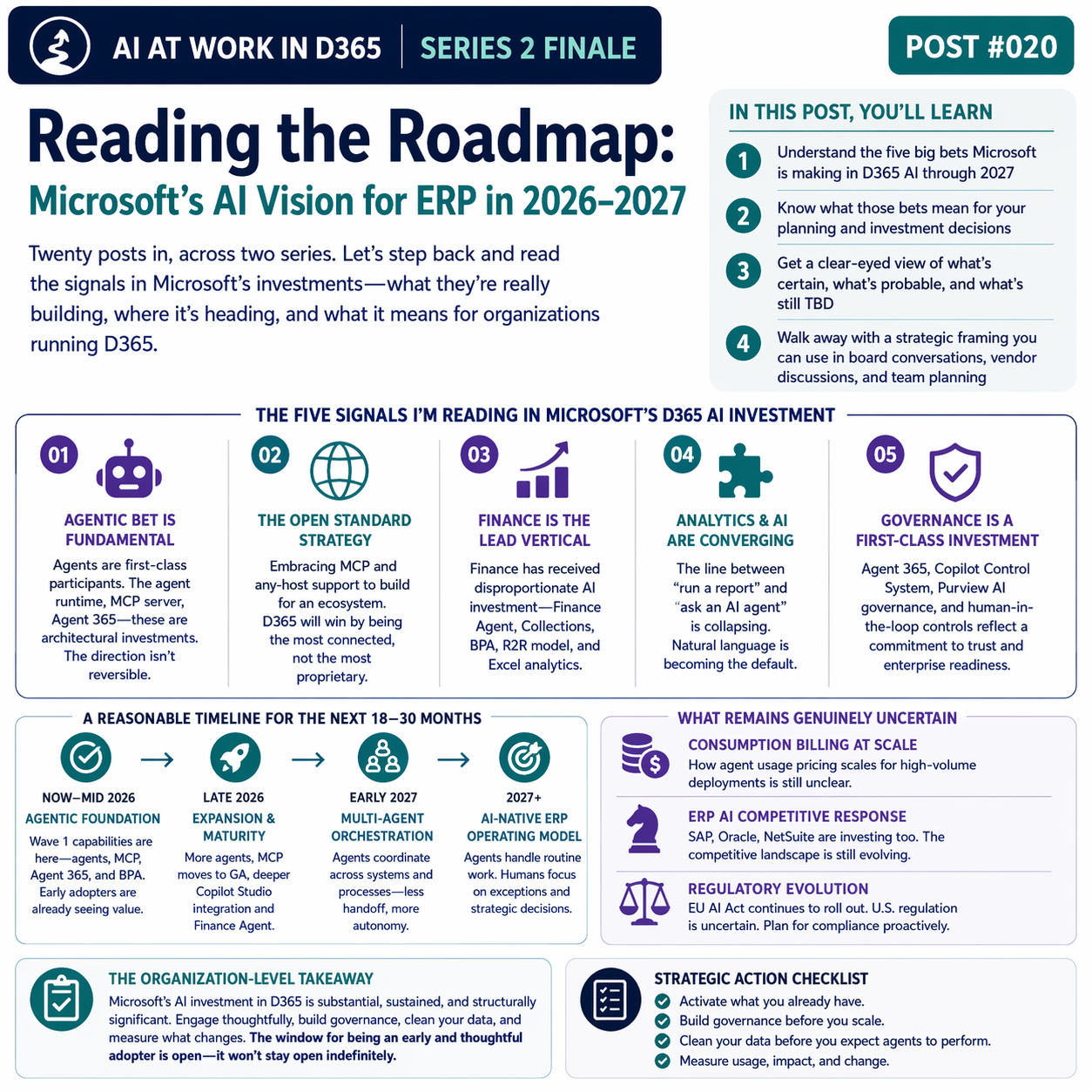
Twenty posts in, across two series. Let’s step back and read the signals in Microsoft’s investments — what they’re really building, where it’s heading, and what it means for organizations running D365.

The Five Signals I’m Reading in Microsoft’s D365 AI Investment
- The Agentic Bet Is Fundamental, Not Incremental
- Microsoft isn’t adding agents as a feature layer on top of ERP. They’re rebuilding the ERP interaction model around agents as first-class participants. The agent runtime in BC, the MCP server in F&O, Agent 365 as the governance plane — these are architectural investments. The direction isn’t reversible, and the pace is accelerating with every wave.
- The Open Standard Strategy
- Microsoft’s embrace of MCP (an open standard originally from Anthropic) and its commitment to “any-host” MCP client support signals that they’re building for an ecosystem, not a monoculture. The bet is that organizations will use multiple AI tools, and D365 will win by being the most connected, not the most proprietary.
- Finance Is the Lead Vertical
- Across the release waves, finance has received disproportionate AI investment — Finance Agent, Collections Coordinator, BPA, the Record-to-Report model, variance analysis in Excel. Microsoft has clearly identified finance teams as the highest-value AI adoption audience within the D365 installed base.
- The Analytics and AI Layers Are Merging
- The distinction between “run a report” and “ask an AI agent” is collapsing. BPA + ERP Analytics MCP + natural language queries represent a direct path from ERP data to conversational analytics. The report navigation paradigm has a shorter runway than most organizations realize.
- Governance Is a First-Class Investment
- Agent 365, Copilot Control System, Purview AI governance, mandatory human-in-the-loop for financial agents — Microsoft has built governance infrastructure in parallel with capability infrastructure. This reflects hard lessons from early AI deployments and a recognition that enterprise trust requires governance parity with capability.
- The Mid-Market Is a Strategic Priority
- BC’s pace of AI feature delivery, the inclusion of Copilot in the base BC license, the Agent Designer GA, the four embedded Power BI apps — Microsoft is making a deliberate strategic push to win the AI-native ERP conversation for mid-market organizations before competitors establish a narrative.

What Remains Genuinely Uncertain
I want to be honest about the things the roadmap doesn’t clarify:
Consumption billing at scale. As agents handle more transactions, the consumption-based pricing model for agents becomes a material budget consideration. Microsoft has been relatively quiet about how this pricing scales for high-volume production deployments. Organizations building business cases need to model this carefully, and the numbers are not fully transparent yet.
ERP AI competitive response. SAP, Oracle, and NetSuite are all investing in AI. Microsoft’s current mid-market advantage in BC is real, but the competitive landscape for AI-native ERP is early and will evolve. The Microsoft ecosystem advantage (M365 integration, Copilot Studio, Azure) is durable — but it’s not the only value proposition in the market.
Regulatory evolution. The EU AI Act’s requirements continue to roll out through 2027. US AI regulation is uncertain. For organizations in regulated industries, the intersection of agentic AI and evolving regulatory requirements is a genuine risk that needs proactive management.
The Organization-Level Takeaway
After twenty posts across two series, here’s the distilled strategic view I’d leave you with: Microsoft’s AI investment in D365 is substantial, sustained, and structurally significant. The organizations that will look back on this period as a competitive advantage inflection point are the ones that engaged thoughtfully — not the ones that moved fastest or waited longest.
The practical answer to “what should we be doing?” hasn’t changed from what I said in Post 10: activate what you have, build governance before you scale, clean your data before you expect agents to perform, and measure what changes. What has changed from ten posts ago is the scope of “what you have.” The agentic capabilities, the MCP connectivity, the Agent 365 governance layer, the BPA analytics foundation — these have all matured significantly in the months since we started this series.
The window for being an early and thoughtful adopter is open. It won’t stay open indefinitely.
📚 Master Reference List — Series 2
- D365 Release Plans — All Waves — the authoritative source for what’s coming
- 2026 Wave 1 Blog — Microsoft — the strategic framing behind the release
- Build Agents with D365 ERP MCP — where to start on custom agent builds
- Business Performance Analytics — the analytics platform in your license
- Copilot Studio 2026 Wave 1 — the agent-building platform roadmap
- Microsoft 365 Copilot Adoption Hub — change management resources
- Copilot Control System — enterprise AI governance
Thank you for following this series across twenty posts. The questions and real-world scenarios I hear from clients keep getting more sophisticated — which tells me the conversation is maturing in a healthy direction. If you’re working through any of these topics in your own organization and want to think through it together, you know where to find me.
BB
Bobbi Bricker
D365 Functional Architect at Centric Consulting. Former controller. Two series in and still finding new angles on AI in ERP — because the technology keeps giving us new material. Reach out with questions, challenges, or war stories from your own implementations.
Thank you for reading!
If you are interested in learning more, please check out my recent posts:


Leave a Reply