

AI in Microsoft ERP · Month-End Close · Series 3 · Post #027
Accruals are where close gets messy — late invoices, incomplete data, estimates that require judgment. Here’s how AI is changing what’s possible for the accrual workflow without eliminating the judgment that makes accruals defensible.

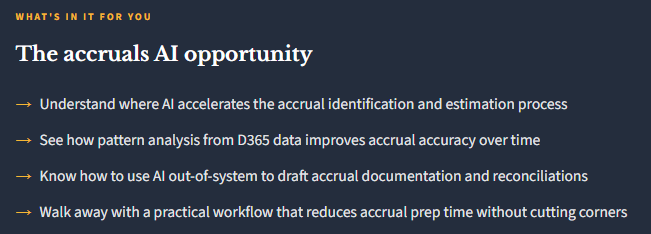
Why Accruals Are a Legitimate AI Target
Accruals have a specific structure that makes them amenable to AI assistance: many accruals recur every period with predictable amounts (prepaid amortization, lease payments, insurance premiums), some are estimates based on pattern analysis (utilities, professional services, commissions), and a relatively small number require genuine judgment because they’re irregular, material, or uncertain. AI handles the first two categories well. The third still needs the controller.
Where AI Specifically Helps in Accruals
- 📅 Recurring Accrual Schedule Management: For accruals that recur on a fixed schedule — prepaid amortization, subscription fees, insurance premiums, maintenance contracts — D365’s periodic journal functionality already handles the automation. What AI adds is the ability to review the accrual schedule in natural language, surface prepaid balances nearing expiration, and flag contracts that should have an accrual entry but don’t based on purchase order pattern analysis.
- 📊 Accrual Estimate Support Using Historical Patterns: For variable accruals — utilities, professional services, commissions, bonuses — the estimate is often based on prior period patterns adjusted for known changes. AI tools can analyze the historical run rate in D365, apply a known factor (seasonal adjustment, volume change), and generate a first-estimate for each accrual line. The controller reviews and adjusts; AI provides the starting analysis. That’s an hour of spreadsheet work compressed to minutes.
- 🔍 Uninvoiced Receipt Review: D365’s goods received/not invoiced (GRNI) balance is one of the best data sources for accrual identification — it tells you what has physically arrived but hasn’t been invoiced. Copilot’s natural language query capability can surface GRNI balances by vendor, by date, and by amount in a way that makes accrual identification much faster than running aging reports manually.
- ✍️ Accrual Documentation and JE Narratives: Every material accrual should have a documentation narrative explaining the basis for the estimate, the support for the amount, and the methodology used. This is where Claude is particularly valuable — paste your accrual schedule, describe the estimation methodology, and ask Claude to draft the documentation memo. It’s the kind of structured writing that takes 30 minutes to do well from scratch and 5 minutes to review and refine from a solid first draft.
- 📋Reversing Entry Completeness Check: Accruals that reverse in the following period need to be tracked carefully to ensure the reversal actually posts. AI can help check the prior period accrual schedule against current-period reversals and flag any that appear to have been missed — a common source of small but persistent balance sheet errors.

What Still Requires Controller Judgment in Accruals
The accruals that require genuine judgment are the ones where: the amount is material and uncertain (legal settlements, warranty reserves, earn-out calculations), the methodology is non-standard (cost-to-complete estimates on long-term contracts), or the timing of recognition is in question (service period that spans a period end). These are exactly the cases where a defensible memo documenting the estimate methodology and the supporting data matters most — and where AI can help with the documentation work even though it can’t provide the professional judgment.


📚 Go Deeper — Microsoft Resources
- Accruals Overview in D365 Finance
- Accruals in Accounts Payable — D365 Finance
- Copilot in D365 Finance — Natural Language Data Access
Accruals reward the finance professionals who know their business well enough to estimate accurately — and AI accelerates that professional’s ability to cover more ground in less time. The judgment remains human; the preparation and documentation work is increasingly AI-assisted.
BB
Bobbi Bricker
ERP Capability Lead and D365 Functional Architect at Centric Consulting. Former controller. This series reflects fifteen + years in ERP (as an end user and a Consultant) and a genuine belief that AI, used thoughtfully, makes finance and operations teams more capable — not less. Reach out with questions, pushback, or war stories from your own organizations.
Thank you for reading!
Interested in learning more? Below are some of my latest posts:



Leave a Reply