
Post #015 – AI In Microsoft ERP
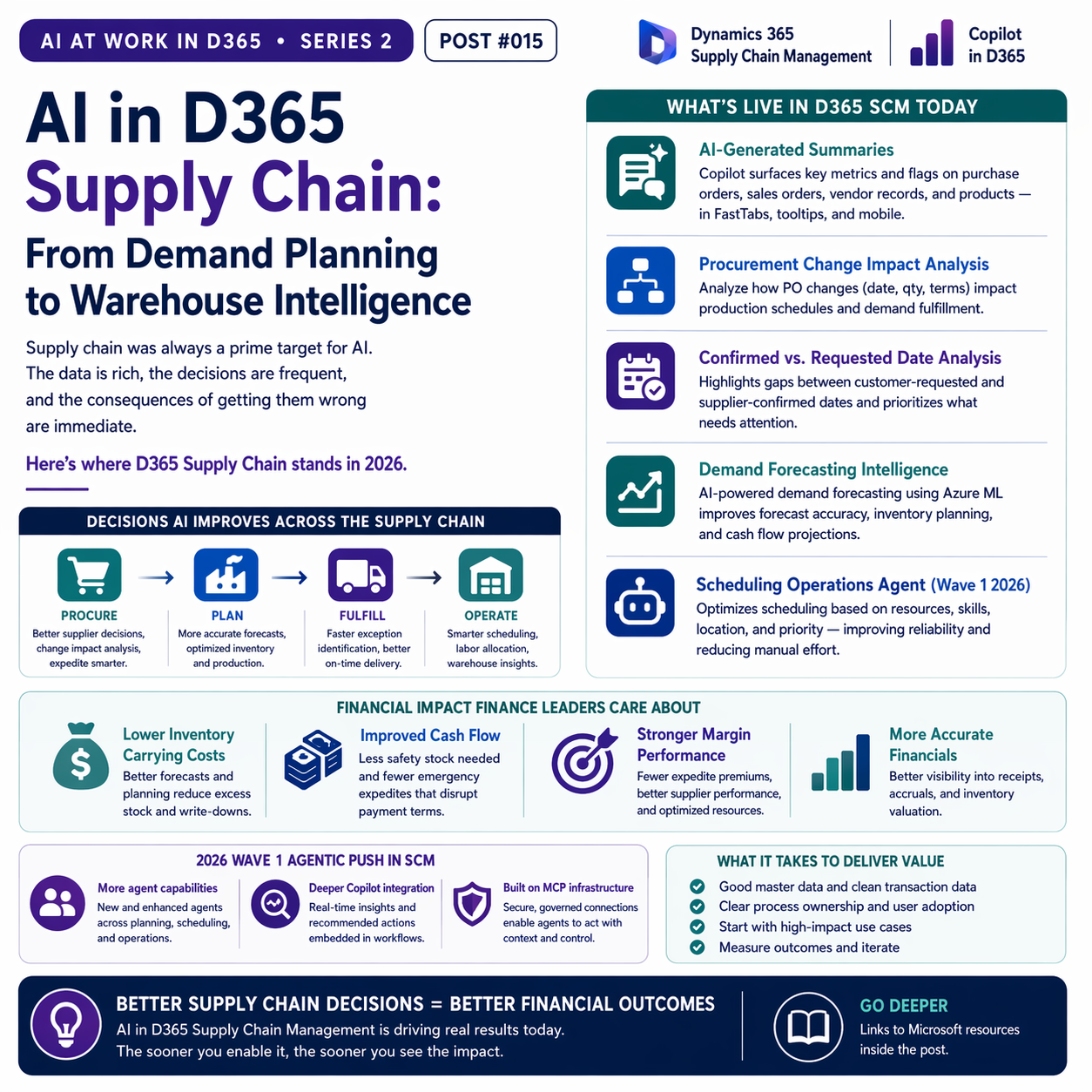
Supply chain was always a prime target for AI. The data is rich, the decisions are frequent, and the consequences of getting them wrong are immediate. Here’s where D365 Supply Chain Management stands in 2026.
The AI Opportunity in Supply Chain
Supply chain processes are a natural fit for AI for a specific reason: they generate massive volumes of structured, timestamped data — purchase orders, receipts, inventory movements, supplier performance records, demand signals — and the decisions that need to be made against that data are frequent and often time-sensitive. A buyer deciding whether to expedite a shipment, a planner deciding how much safety stock to carry, a warehouse supervisor deciding how to allocate labor — all of these decisions benefit from AI that can surface the right information at the right moment.
D365 Supply Chain Management has been building Copilot capabilities into the platform across several release waves. What follows is a practical overview of what’s available now.
What’s Live in D365 SCM Today
📋 AI-Generated Summaries Across Key Pages
Copilot provides context-aware AI summaries on purchase orders, sales orders, vendor records, and product pages — surfacing the most relevant metrics and flags without requiring the user to drill through multiple screens. Summaries appear as FastTabs, hover tooltips, and in the mobile app, making them accessible across workflows.
🏭 Procurement Change Impact Analysis
When a purchase order changes — date, quantity, terms — Copilot can analyze the downstream impact on production schedules and demand fulfillment. This directly addresses one of the most time-consuming manual analysis tasks for buyers and planners: figuring out what a supplier change actually means for the production floor.
📦 Confirmed vs. Requested Delivery Date Analysis
Copilot highlights gaps between what customers requested and what suppliers confirmed, prioritizing which discrepancies need attention based on business impact. This is the kind of exception surfacing that previously required running reports and then manually triaging the results.
🔮 Demand Forecasting Intelligence
D365 Supply Chain includes AI-powered demand forecasting that uses Azure Machine Learning to generate statistical forecasts from historical demand data. Finance teams benefit directly: better demand forecasts mean better inventory planning, better cash flow projections, and fewer write-downs for excess or obsolete inventory.
🗓️ Scheduling Operations Agent (Wave 1 2026)
A new agent introduced in Wave 1 aims to improve scheduling reliability in Field Service and operations scenarios. The agent optimizes scheduling decisions based on resource availability, skills, location, and priority — reducing the manual scheduling workload for operations teams.
The Finance Connection: Why This Is Your Business Too
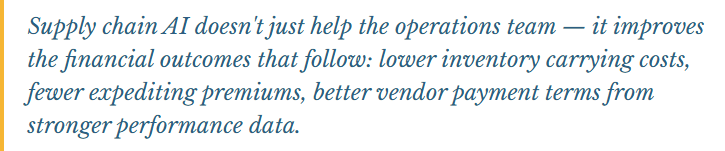
I want to spend a moment making the finance case for supply chain AI, because I’ve seen finance teams treat it as someone else’s problem right up until the inventory write-down conversation. Better demand forecasting directly impacts the accuracy of your inventory reserve calculations. Procurement change analysis affects accrual accuracy for goods in transit. Vendor performance data in D365 SCM is the same data that should inform your AP team’s early payment discount decisions.
For controllers and finance architects, the valuable question is not “what is the SCM team doing with AI?” but “what SCM data can we connect to our financial analysis, and what AI capabilities help us act on it faster?”

What Still Requires Human Judgment in SCM
Supply chain is a domain where AI has real value and real limits. The AI capabilities in D365 SCM are excellent at surfacing information, flagging exceptions, and analyzing impact. They’re significantly less reliable for the judgment calls that require understanding your specific business context — a new product launch, a key customer relationship, a geopolitical supply risk that isn’t reflected in historical data yet. Those calls still belong to experienced supply chain professionals who know the full picture.
The realistic framing: AI in D365 SCM gets your team to the decision faster and with better information. It doesn’t replace the decision-maker.

📚 Go Deeper — Microsoft Resources
- Copilot in D365 Supply Chain Management — Overview
- Demand Forecasting in D365 SCM — AI-powered statistical forecasting setup
- 2026 Wave 1 — Supply Chain and Operations AI Updates
- D365 Supply Chain 2026 Wave 1 Release Plan
AI in D365 Supply Chain Management has moved well beyond demo-ware. The summaries, the change impact analysis, and the demand forecasting capabilities are production-ready and delivering real value for operations teams — and by extension, real financial impact for the organizations they serve. If you’re in a D365 F&SCM environment and haven’t activated Copilot for your supply chain users, that conversation needs to happen soon.
BB
Bobbi Bricker
ERP Capability Lead and D365 Functional Architect at Centric Consulting. Former controller. This series reflects fifteen + years in ERP (as an end user and a Consultant) and a genuine belief that AI, used thoughtfully, makes finance and operations teams more capable — not less. Reach out with questions, pushback, or war stories from your own organizations.
Thank you for reading!
Interested in learning more? Check out some of my latest posts:


Leave a Reply