

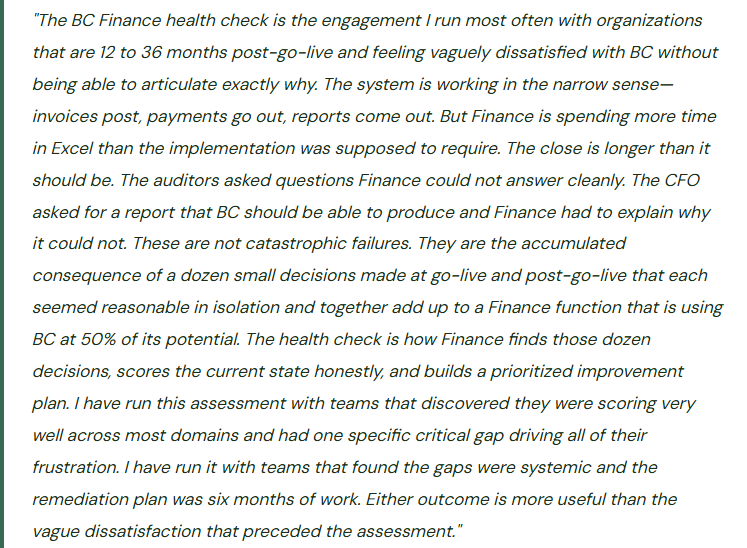
The self-assessment Finance runs to identify configuration gaps that have accumulated since go-live, the reconciliation evidence that reveals whether BC’s subledgers are reliable, the governance cadences that reveal whether Finance owns BC or BC owns Finance, and a scoring framework for prioritizing the improvements that will have the most impact on Finance’s output from BC.
How to Use This Health Check
This health check is organized into six domains that cover the Finance function’s relationship with BC. For each item in each domain, Finance conducts the specified review and assigns the score indicated. Total the scores at the end of each domain and use the scoring guide to identify priority improvements. The assessment should be conducted by the Controller or a senior Finance manager with sufficient BC knowledge to evaluate each item honestly—this is not a checklist to complete in an afternoon; it is a diagnostic that may take two to three days to conduct thoroughly.
The health check is most useful when it is conducted annually and when the results are documented, acted upon, and compared to the prior year’s results. Improvement over time is the measure of Finance’s growing ownership of BC as a Finance platform.
The Six-Domain BC Finance Health Check
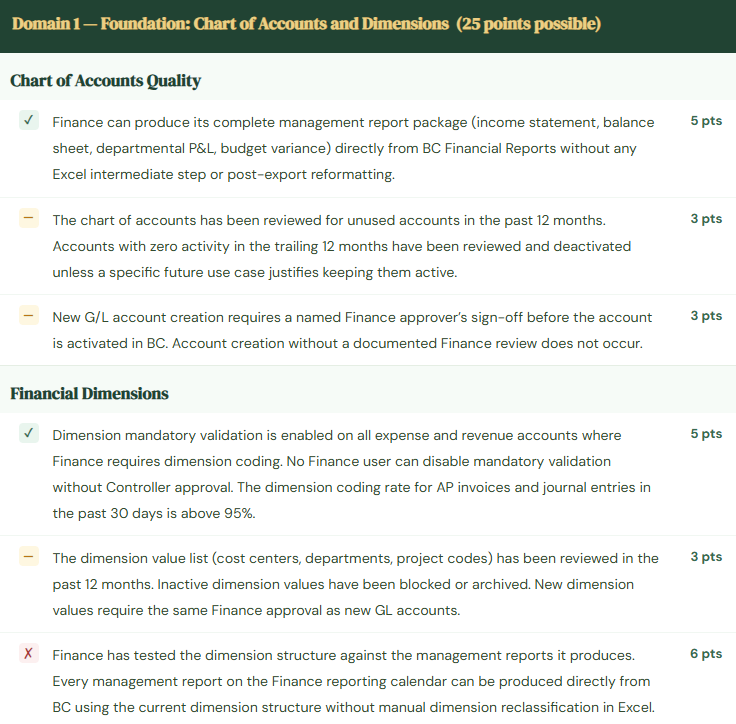
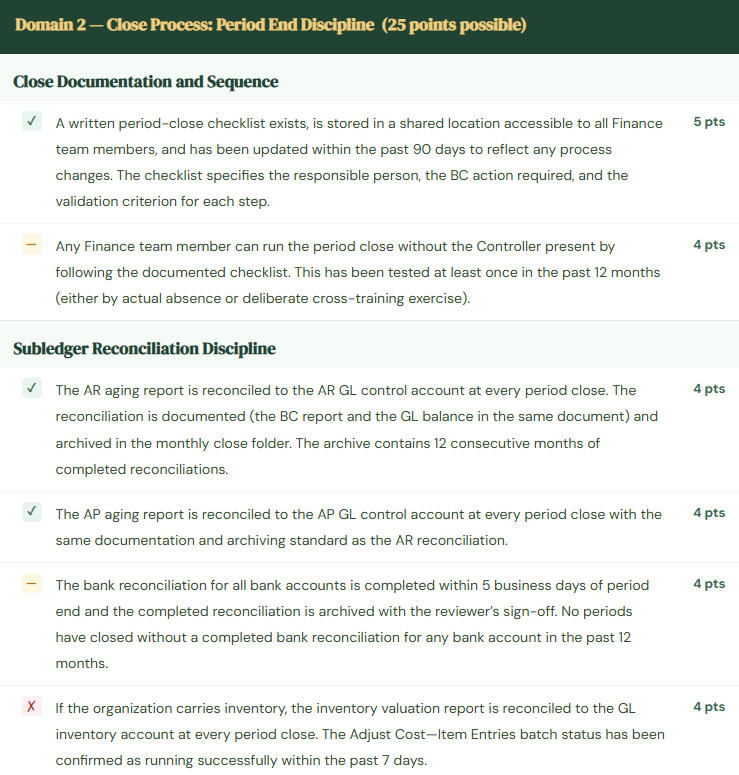
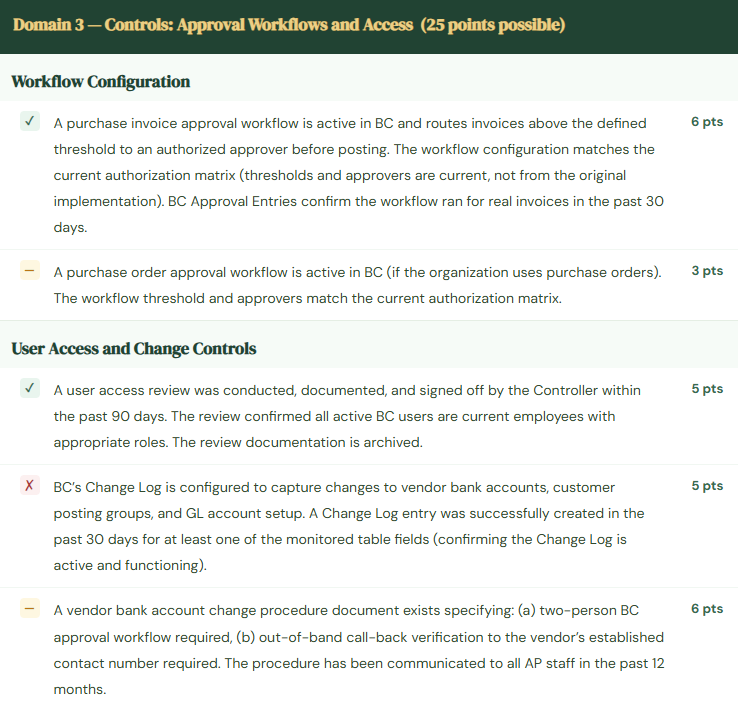
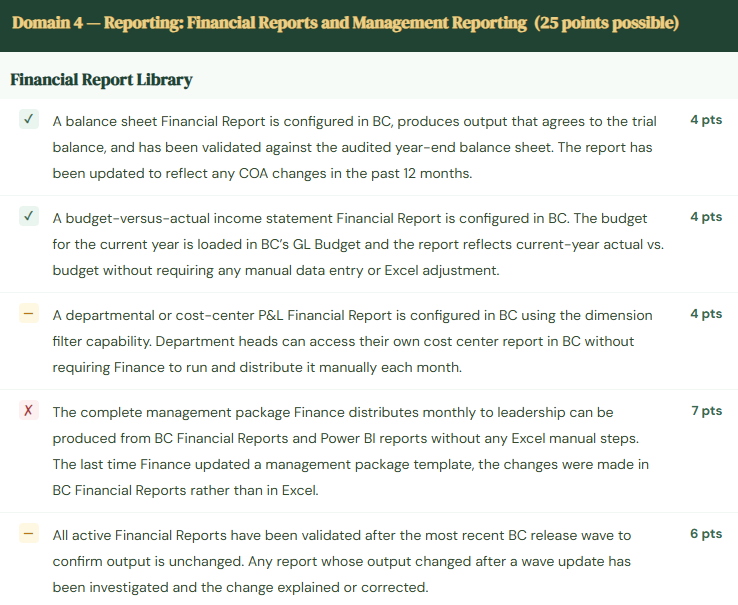
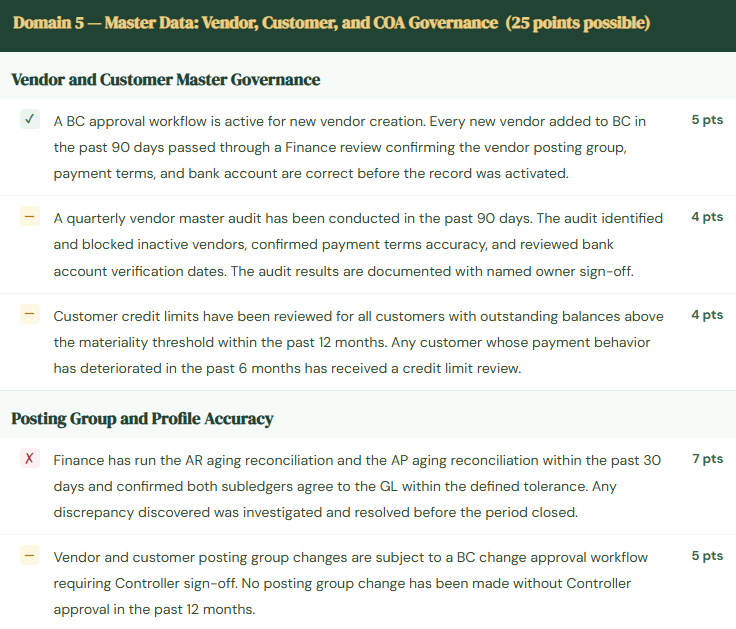

Scoring Guide
Total the points earned across all six domains. The maximum possible score is 150 points (25 per domain). Use the scoring guide below to interpret your results and prioritize the improvement plan.
A
125–150 points
Finance owns BC. Configuration is current, governance is active, and reporting is reliable. Focus on incremental optimization and emerging capabilities.
B
95–124 points
Finance uses BC well with identifiable gaps. The gaps are addressable in 1–3 months of focused effort. Prioritize the highest-point items not scoring.
C
65–94 points
Significant configuration and governance gaps. Finance is operating below BC’s capability. A structured 3–6 month improvement plan is needed.
D
Below 65 points
BC is being used as a transaction processor rather than a Finance platform. A comprehensive remediation engagement is warranted. Start with the domain scoring lowest.
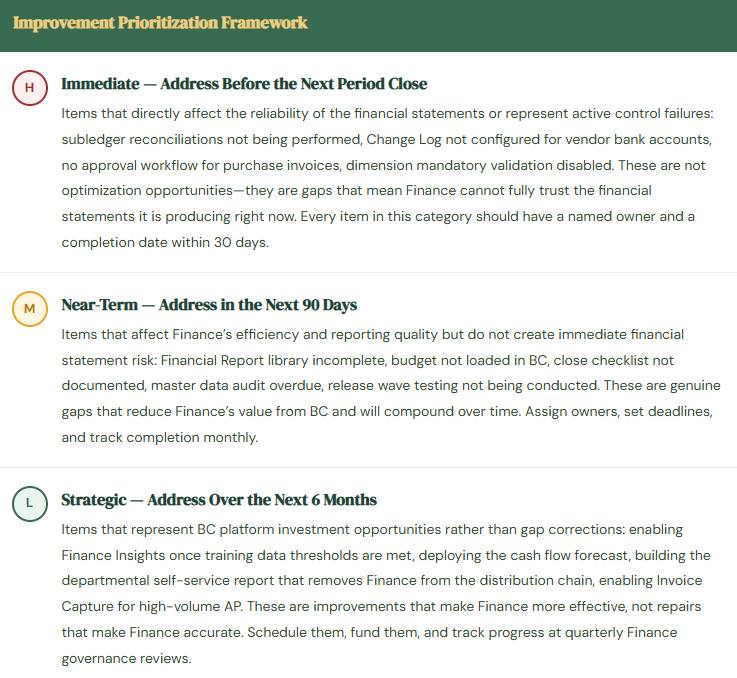
Building the Improvement Plan—Prioritization Framework
After completing the health check, Finance identifies the items that did not score and prioritizes them for remediation using a simple three-tier framework: impact on financial statement reliability, effort to remediate, and governance risk.

Up Next:
The health check reveals where Finance stands with BC. The next post addresses a topic that BC Finance teams frequently ask about once they have gotten their arms around the Finance modules: BC Integration Architecture—What Finance Must Know About Connecting BC to the Rest of the Stack—how BC connects to Power Platform, Azure, Dataverse, and third-party systems; what Finance must understand about each integration type before the integration is built; why Finance needs a seat at the integration architecture table; and the five integration decisions Finance discovers too late that affect the reliability of Finance data flowing into and out of BC.
— Bobbi
D365 Functional Architect · Recovering Controller
Thank you for reading!
If this post helped you solve a real problem, share it with a Finance colleague who is in the middle of an ERP implementation or a post-go-live optimization. If you have a topic that I haven’t covered, please reach out. There is always one more post worth writing.
Interested in learning more? Below are some of my latest posts:
Leave a Reply