
AI in Microsoft ERP · GP Migration · Series 3 · Post #029
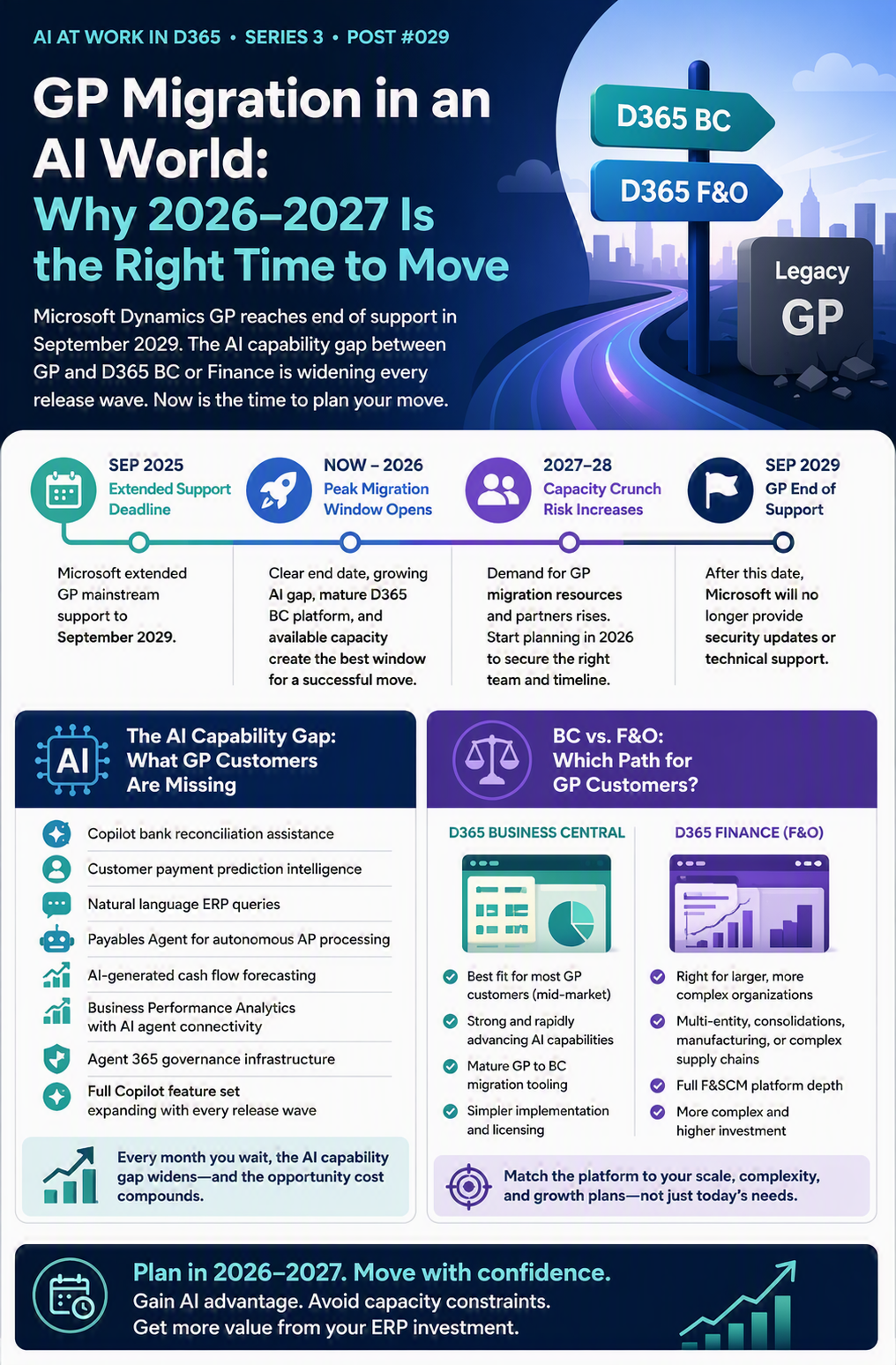
Microsoft Dynamics GP reaches end of support in September 2029. The AI capability gap between GP and D365 BC or Finance is widening every release wave.
I have worked on many GP migrations, along with being an end user who went through the upgrade process. I’ve watched the “should we move now?” conversation evolve significantly over the past two years. What used to be a discussion primarily about support timelines and modernization has a new dimension now: the AI capability gap. Every quarter that passes, D365 BC and D365 Finance get additional AI capabilities that GP will never have. That gap is now a legitimate part of the migration business case.
The GP Timeline — Where Things Stand

The AI Capability Gap: What GP Customers Are Missing
This is the argument that’s changed the migration conversation in the past 18 months. GP was a good system when it was built, and it still runs the general ledger reliably for thousands of organizations. One of my biggest arguments for GP is that it is very stable and that’s why users hesitate moving away from it. However, it was designed in an era before cloud-native AI, and the architecture decisions that made GP stable in 2005 are the same ones that make it impossible to add the AI capabilities that D365 BC and Finance have been delivering since 2023.
What a typical GP customer cannot access that a D365 BC or Finance customer has available today: Copilot bank reconciliation assistance. Customer payment prediction intelligence. Natural language ERP queries. The Payables Agent for autonomous AP processing. AI-generated cash flow forecasting. Business Performance Analytics with AI agent connectivity. Agent 365 governance infrastructure. The complete Copilot feature set that is expanding with every release wave. Every post in this series has been describing capabilities that are simply not available on GP.

BC vs. F&O: Which Path for GP Customers
For most GP customers, D365 Business Central is the natural migration target. The scale, complexity, and feature match are well-suited to the mid-market organizations that make up most of the GP install base. BC’s AI capabilities are strong and improving rapidly, the migration tooling from GP to BC has matured, and the licensing model is straightforward.
D365 Finance (F&O) is the right target for GP customers who are at the larger end of the scale — multi-entity organizations with complex financial consolidation requirements, significant manufacturing or complex supply chain operations, or organizations that have outgrown BC’s design boundaries. The implementation is more complex and more expensive, but the platform depth is meaningfully greater.
A key question in the BC vs. F&O decision: are you primarily a financial and distribution business, or do you have substantial manufacturing, project accounting, or complex global operations that require the full F&SCM feature set? BC handles the former well. F&O is designed for the latter.
What AI Means for the Migration Project Itself
One more angle worth covering: AI tools are changing how GP migrations are executed, not just what you migrate to. Claude can accelerate GP data analysis work — mapping GP account structures to D365 chart of accounts frameworks, analyzing historical transaction patterns to inform D365 configuration decisions, drafting data migration specifications and validation criteria. These are tasks that used to take significant hours of senior consultant time and can now be done faster with AI assistance.
The migration itself is still a significant project. But the data analysis, documentation, and specification work that surrounds it is meaningfully faster in 2026 than it was in 2022. Organizations starting a migration now benefit from both a more mature D365 platform and more AI-assisted implementation tooling.


📚 Go Deeper — Microsoft Resources
- Migrate Data to D365 Business Central — migration options and tools
- Migrating from Dynamics GP to Business Central — the dedicated GP migration path
- Dynamics GP End of Support Information
The GP migration conversation has always been about “when,” not “whether.” The AI capability gap has sharpened the “when” answer significantly. Organizations that plan a 2026–2027 migration timeline are making a choice that compounds AI benefit access over the remaining useful life of their ERP investment. Those that wait until 2028–2029 face capacity constraints, compressed timelines, and three fewer years of AI-enabled financial operations.
BB
Bobbi Bricker
ERP Capability Lead and D365 Functional Architect at Centric Consulting. Former controller. This series reflects fifteen + years in ERP (as an end user and a Consultant) and a genuine belief that AI, used thoughtfully, makes finance and operations teams more capable — not less. Reach out with questions, pushback, or war stories from your own organizations.
Thank you for reading!
Interested in learning more? Check out some of my latest posts:

Leave a Reply