
AI in Microsoft ERP · Series 3 Finale Post · #030
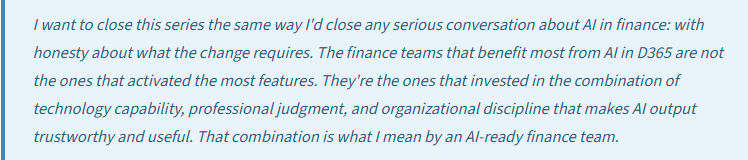
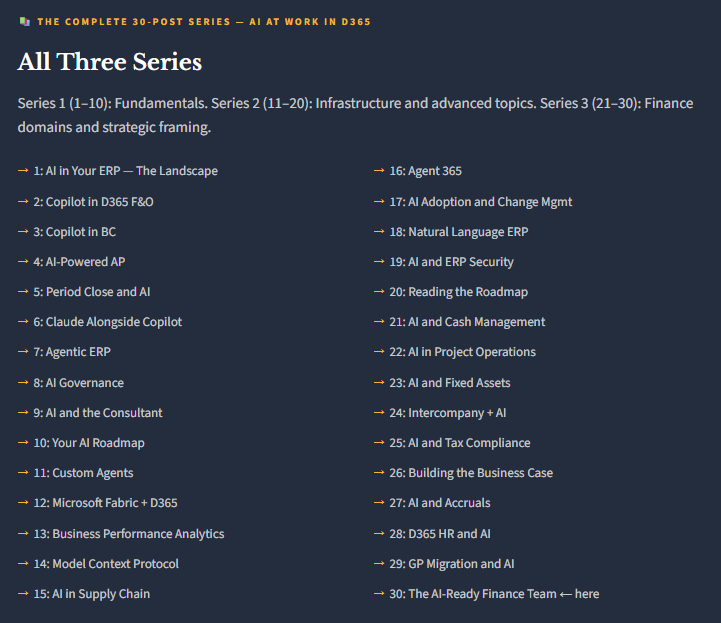
Thirty posts. Three series. The throughline across all of it is that AI doesn’t replace the finance professional — it raises the standard for what finance professionals need to know and be able to do. Here’s what the AI-ready finance team actually looks like.
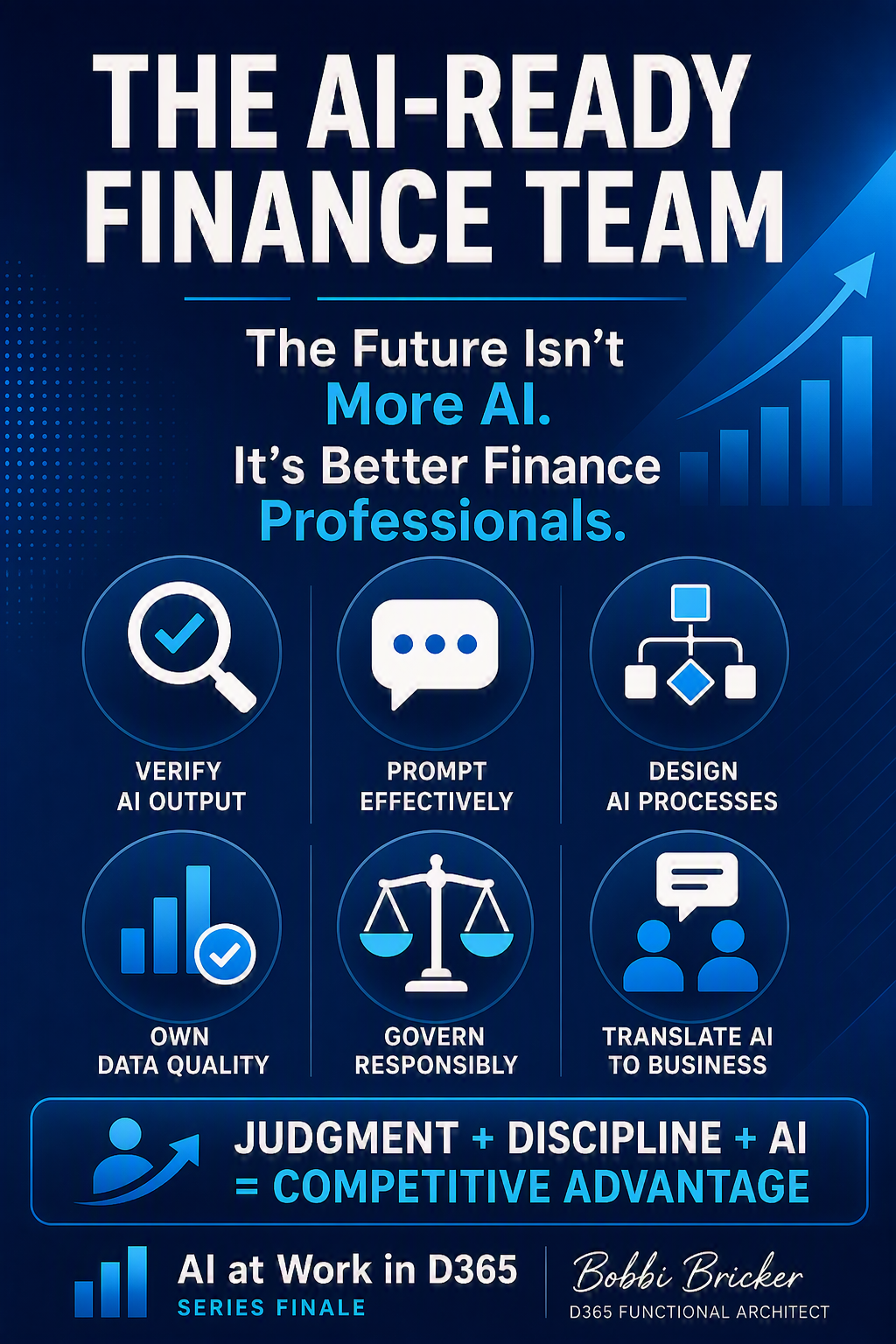
The Skills That Define an AI-Ready Finance Professional
- 🔍Intelligent Verification Habits
- The most important skill for working with AI output is knowing what to verify, how to verify it, and when to override it. AI tools generate plausible-sounding output that can be wrong in non-obvious ways. Finance professionals who develop systematic verification habits — checking the numbers against source data, reviewing the methodology, confirming the assumptions — are the ones who get durable value from AI without generating errors that erode trust.
- 💬Effective Prompting and AI Communication
- Getting good output from AI tools requires knowing how to ask well. This is a learnable skill — being specific about the task, providing relevant context, specifying the format you need, and iterating when the first output isn’t right. Finance professionals who invest in this skill get dramatically better results from AI tools than those who use vague prompts and declare AI “not useful.”
- 🏗️Process Design for AI-Augmented Workflows
- When AI enters a workflow, the workflow design changes. Where does AI output get reviewed? What triggers human intervention? How are AI decisions documented for audit purposes? Finance professionals who can think through these process design questions — not just use the AI feature in isolation — are the ones who build durable, auditable AI-augmented processes.
- 📊Data Literacy and Quality Ownership
- Every AI capability in this series performs better on clean, current, consistently maintained data. Finance professionals who understand the relationship between data quality and AI output quality — and who take ownership of that relationship rather than blaming the technology — are better positioned to get value from AI tools and to diagnose why they’re not performing as expected.
- ⚖️AI Governance and Controls Thinking
- Who is accountable when an AI-assisted financial output is wrong? What audit trail exists for AI-generated journal entries? How does your organization’s AI usage policy apply to general-purpose tools in the close process? Finance professionals who can engage seriously with these questions are increasingly valuable to organizations navigating AI adoption responsibly.
- 🗣️Cross-Functional AI Translation
- Finance professionals who can explain AI capabilities and limitations to non-technical stakeholders — what the Payables Agent actually does, what “the AI flagged this” means in an audit context, what the difference between AI-assisted and AI-generated output is — are filling a real gap in most organizations right now. This is a communication and domain expertise skill, not a technical one.
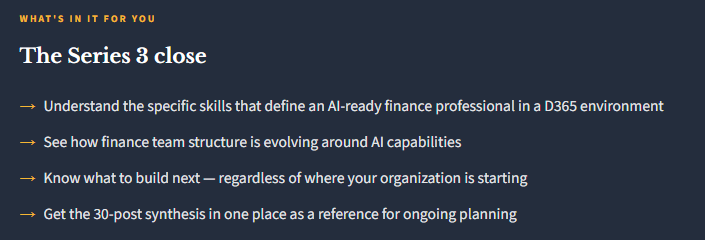
How Finance Team Structure Is Evolving
The structural changes I’m seeing in finance teams at organizations that are seriously adopting AI follow a recognizable pattern. Transaction processing roles (AP clerks, AR specialists, bank reconciliation staff) are shifting from high-volume data entry toward exception handling, oversight, and vendor relationship management. The transaction volumes haven’t changed — the AI agents handle the routine cases, and the humans handle the exceptions that require judgment.
Analytical and reporting roles are spending less time on data assembly and more time on interpretation and communication. The BPA dashboard produces the numbers; the controller explains what they mean and what the business should do about them. That shift concentrates finance team time on the high-value work.
A new function is emerging at forward-thinking organizations that I’d describe as the AI Finance Coordinator — a finance professional with both domain expertise and AI tool fluency who owns the team’s AI governance, maintains the AI usage policies, monitors agent performance, and manages the ongoing relationship with IT and implementation partners on AI topics. This role doesn’t need to be a full-time position in every organization, but the responsibilities need to live somewhere.

What to Build Next — A Final Prioritization
After thirty posts, here’s my honest final prioritization for finance and operations leaders building an AI-ready D365 environment:
If you haven’t started: Activate what’s already in your license. Finance Insights, bank reconciliation assist (BC), Copilot in-app guidance, Collections Coordinator. These cost nothing extra and provide immediate visible value. Start measuring baselines before you turn them on so you can demonstrate the impact.
If you’re in early adoption: Pilot the Payables Agent (BC) or develop your Finance Insights payment prediction model (F&O). Build your AI governance policy. Train your team on verification habits, not just feature usage. Start the Agent 365 governance conversation with IT.
If you’re scaling AI use: Evaluate custom agent development via Copilot Studio and the ERP MCP server for your organization-specific workflows. Invest in BPA activation and the analytics layer. Build out the AI Finance Coordinator function. Engage your external auditor proactively about AI in your financial processes.
If you’re still on GP: Start the migration planning conversation now. The AI capability gap is real and widening. The 2026–2027 migration window gives you the best combination of planning time, implementation capacity, and years of AI-enabled operations before GP’s 2029 end of support.
📚 The Master Resource List — Series 3
- Finance Insights — Cash Flow and Payment Predictions
- Copilot in D365 Project Operations
- Migrate Data to D365 Business Central
- D365 Human Resources — Admin Overview
- D365 2026 Wave 1 — Complete Release Plan
- Microsoft Copilot Adoption Hub — ongoing training and scenario resources
Thirty posts, three series, and what I hope has been a consistent thread throughout: AI in D365 is real, it’s here, it’s valuable, and it rewards the finance teams and consultants who engage with it seriously – not with hype, not with fear, but with the same professional rigor they bring to everything else. The technology will keep changing. The need for judgment, discipline, and domain expertise won’t. That combination is the durable competitive advantage for anyone in this space.
Thank you for following this series. I’d genuinely like to hear what you’re seeing in your own organizations — what’s working, what isn’t, what questions all of this has raised that a fourth series might address. The conversation continues.
BB
Bobbi Bricker
ERP Capability Lead and D365 Functional Architect at Centric Consulting. Former controller. This series reflects fifteen + years in ERP (as an end user and a Consultant) and a genuine belief that AI, used thoughtfully, makes finance and operations teams more capable — not less. Reach out with questions, pushback, or war stories from your own organizations.
Thank you for reading!
Interested in learning more? Below are links to my latest posts:


Leave a Reply