

How D365 F&O’s intercompany framework automates cross-entity transactions, the transfer pricing setup Finance must own to ensure arm’s-length compliance, how intercompany eliminations flow from subsidiary ledgers to the consolidated entity, and the five intercompany accounting failures that create audit exposure across multi-entity organizations.
The D365 F&O Intercompany Architecture—Three Layers Finance Must Understand
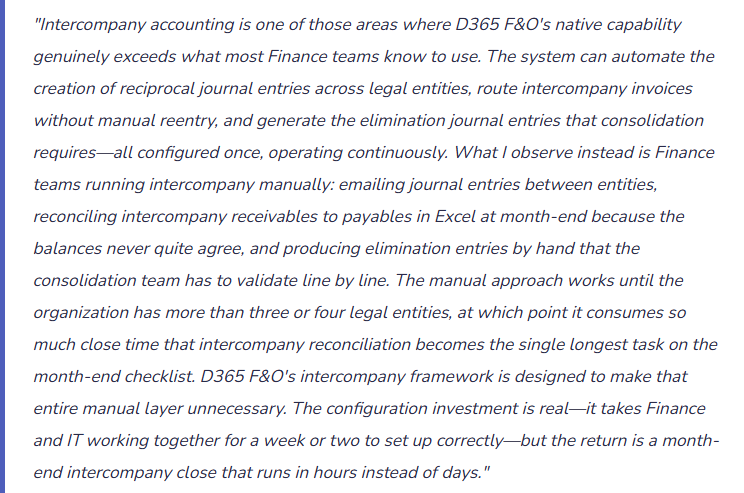
D365 F&O’s intercompany functionality operates across three distinct layers that Finance must understand separately before configuring any of them. Conflating the layers is the source of most intercompany configuration errors.
Layer 1—Intercompany Trade: The sales-and-purchase layer. When Legal Entity A sells goods or services to Legal Entity B, D365 F&O can automatically create the purchase order in Legal Entity B when the sales order is created in Legal Entity A, and automatically post the intercompany purchase invoice in Legal Entity B when Legal Entity A posts the intercompany sales invoice. This layer is configured via Intercompany Trading Relationships (Accounts receivable → Setup → Customers → Intercompany) and requires that each legal entity’s customer and vendor records for the counterpart entities are flagged as intercompany.
Layer 2—Intercompany Accounting (Journal Entries): The GL-to-GL layer for non-trade transactions: cost allocations, cash pooling, management fee charges, royalty allocations. D365 F&O’s intercompany accounting feature allows a journal entry posted in Legal Entity A to automatically generate the offsetting entry in Legal Entity B in the same posting action. This layer is configured via Intercompany Accounting (General ledger → Posting setup → Intercompany accounting) and requires defining the originating and destination company pairs, the accounts used for intercompany receivables and payables in each direction, and whether the destination entry requires approval before posting.
Layer 3—Consolidation and Elimination: The reporting layer that removes intercompany transactions from the consolidated financial statements. Legal Entity A’s intercompany revenue and Legal Entity B’s intercompany cost must net to zero at the consolidated group level. D365 F&O handles this through the Consolidation company—a dedicated legal entity that pulls balances from subsidiary companies and where Finance posts elimination entries to remove intercompany activity from the consolidated balance sheet and income statement.
Transfer Pricing—The Finance Configuration Decision With Tax Audit Consequences
Transfer pricing—the price at which Legal Entity A charges Legal Entity B for goods, services, or intellectual property—is an accounting policy decision with tax audit consequences. Tax authorities in virtually every jurisdiction require that intercompany transactions occur at arm’s-length prices: the price that unrelated parties would agree to in an open market. D365 F&O supports transfer pricing through its intercompany trade pricing setup, but the system enforces whatever prices Finance configures—it does not validate whether those prices satisfy the arm’s-length standard. That validation is Finance’s responsibility.
| Transfer Pricing Method | How It Works | D365 F&O Configuration | Finance Documentation Required |
|---|---|---|---|
| Cost Plus | Intercompany price = manufacturing or service cost + a defined markup percentage. The markup is the arm’s-length profit margin supported by benchmarking analysis. | Intercompany trade relationship → Price/discount → configure the markup percentage or the cost basis formula. D365 F&O will calculate the intercompany price from the item’s cost at the time of transaction. | Transfer pricing study documenting the cost-plus markup percentage, the comparable transactions benchmark, and the economic analysis supporting the selected margin. Updated at least every three years or when the business model changes materially. |
| Resale Price | Intercompany price = resale price to the external customer minus a gross margin. The distributor entity retains the gross margin; the manufacturing entity receives the remainder. | Intercompany trade relationship pricing formula referencing the customer-facing sales price less a configured discount percentage representing the distributor’s margin. | Transfer pricing study supporting the gross margin percentage retained by the distribution entity. Requires comparability analysis of independent distributor margins in the same industry. |
| Comparable Uncontrolled Price (CUP) | Intercompany price = the price charged in comparable transactions with unrelated parties. The most straightforward method when comparable external transactions exist. | Fixed price or price list maintained in the intercompany trade relationship, updated to match the external comparable price when it changes. | Documentation of the comparable transactions, the comparability adjustments made, and the source of the benchmark price. Most defensible method when genuine comparable transactions exist. |
| Management Fee / Service Charge | Parent entity charges subsidiaries for shared services (IT, HR, Finance, Legal) based on an allocation key (headcount, revenue, transaction count). The charge is the parent’s cost of the service plus a markup for coordinating the service. | Periodic journal entries via the Intercompany Accounting layer (Layer 2), not the trade layer. The allocation calculation is typically done outside D365 F&O and entered as a recurring journal. | Intercompany service agreement describing the services, the allocation methodology, the markup percentage, and the invoicing frequency. Signed by authorized representatives of both entities. Reviewed and updated annually. |
Configuring the Intercompany Accounting Layer—The Setup Finance Owns
Intercompany Accounting Setup Sequence—Finance Configuration Steps
- Define Intercompany Account Pairs for Each Entity Relationship
- For each pair of legal entities that will exchange intercompany journal entries, define the intercompany receivable account in the originating entity (the account that records the amount owed to the originating entity by the destination entity) and the intercompany payable account in the destination entity (the account that records the amount owed by the destination entity to the originating entity). These account pairs are configured in General ledger → Posting setup → Intercompany accounting. The account pair must be defined in both directions—Entity A to Entity B, and Entity B to Entity A—even if the flow is typically one-directional. If a journal entry ever originates from Entity B, D365 F&O needs the account pair defined for that direction or it will error.
- Assign Chart of Accounts and Posting Layer
- The intercompany accounting setup references the shared chart of accounts (if the entity group uses a shared COA) or the entity-specific COA accounts. For each account pair, specify the posting layer (Current for operational transactions, Operations for management reporting adjustments, Tax for tax-basis entries). Most intercompany journal entries post to the Current layer. Confirm that the intercompany receivable and payable accounts are designated as balance sheet accounts in the COA and are not dimension-mandatory—intercompany entries may not carry all required financial dimensions, and a mandatory dimension on an intercompany account will block the automated entry.
- Configure Destination Company Posting Options
- For each intercompany accounting relationship, configure whether the destination entry posts automatically when the originating entry is posted (Auto-post) or requires review and approval in the destination entity before posting (Post with approval). Auto-post is appropriate for high-volume, low-risk allocations like monthly management fee charges where the amounts are formula-driven and both entities have agreed on the methodology. Post with approval is appropriate for material ad hoc entries where the destination entity’s Finance team should review the entry before it affects their books. The approval requirement can be enforced through a D365 workflow assigned to the intercompany journal batch.
- Define the Intercompany Elimination Accounts in the Consolidation Entity
- In the Consolidation entity, define the GL accounts used for intercompany elimination entries. Typically: Intercompany Revenue Elimination (contra-revenue), Intercompany Cost Elimination (contra-expense), Intercompany Receivable Elimination (contra-asset), and Intercompany Payable Elimination (contra-liability). These accounts appear only in the consolidation entity and carry zero balance after the elimination entries are posted—they exist solely to remove the intercompany activity from the consolidated statements. The elimination accounts must be excluded from the consolidation entity’s standard financial reports (income statement, balance sheet) and visible only in the elimination analysis report Finance uses to confirm all intercompany activity has been removed.
- Configure Intercompany Customer and Vendor Records
- For intercompany trade (Layer 1), each legal entity’s intercompany counterparts must have customer and vendor records flagged as intercompany. In Accounts Receivable → Customers, open the customer record for the counterpart entity and enable Intercompany → Active. Configure the intercompany trading relationship: which legal entity the customer record represents, the originating company, and the purchase order creation rule (whether a purchase order is automatically created in the destination entity when a sales order is created in the originating entity). Repeat for the corresponding vendor records. Test the setup by creating a test sales order in the originating entity and confirming that the purchase order automatically appears in the destination entity.
The Period-End Intercompany Reconciliation—What Finance Confirms Before Consolidation
Before the consolidation entity pulls subsidiary balances and produces the consolidated financial statements, Finance must confirm that intercompany balances are in agreement—that Entity A’s intercompany receivable from Entity B equals Entity B’s intercompany payable to Entity A, and that intercompany revenue and expense balances net to zero across the group. Imbalances at consolidation produce elimination journals that do not fully offset, leaving residual intercompany balances in the consolidated statements.
Intercompany Balance Reconciliation
Pull the intercompany receivable balance from each originating entity and the intercompany payable balance from each destination entity. Confirm they agree within the defined tolerance (typically zero for month-end, materiality threshold for interim periods). Document any imbalance, identify its source transaction, and post a correcting entry in the appropriate entity before running consolidation.
Intercompany Revenue/Expense Match
Total intercompany revenue across all subsidiary entities must equal total intercompany cost or expense. Use the D365 F&O Intercompany Transactions report filtered to the current period to list all intercompany trade transactions. Confirm the sum of intercompany sales invoices in originating entities equals the sum of intercompany purchase invoices in destination entities for the same period.
Currency Translation Differences
When intercompany transactions occur in a currency different from either entity’s functional currency, exchange rate differences between the transaction date rate and the period-end rate create translation differences. These differences are legitimate and expected—they should be documented as intercompany translation adjustments rather than treated as reconciling errors requiring correction.
Timing Differences from Unposted Transactions
An intercompany invoice posted in the originating entity on the last day of the period may not have generated the destination entity entry if the destination entity uses an approval workflow. Unposted destination entries create apparent intercompany imbalances that resolve when the approvals are processed. Finance must distinguish genuine imbalances (different amounts in the two entities) from timing differences (same amount, one entity not yet posted).
Five Intercompany Accounting Failures That Create Audit Exposur
⚠️ Intercompany Agreements Don’t Exist—Transfer Pricing Has No Documentation
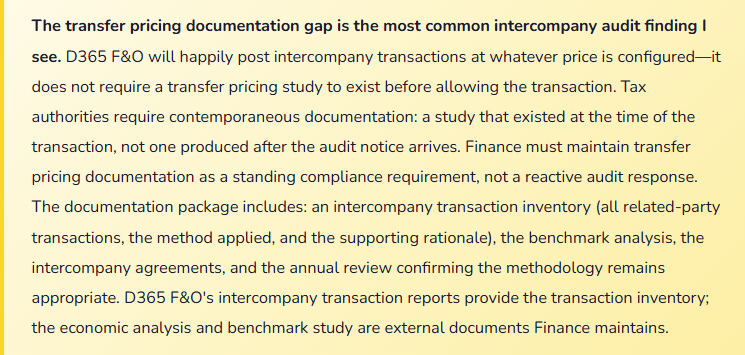
The organization has operated a cost-plus management fee arrangement between the parent entity and four subsidiaries for six years. The monthly management fee entries have been posted faithfully every period. No intercompany service agreement has ever been signed. No transfer pricing study documents the cost-plus markup. The parent entity’s Finance team developed the allocation methodology in year one and it has not been reviewed since. Tax authority audit notice arrives in year seven. The auditor asks for the intercompany agreements and the transfer pricing documentation. Finance produces the recurring journal entries. The auditor notes that the transactions lack contemporaneous documentation and that the markup percentage cannot be substantiated. The organization faces potential transfer pricing adjustments across six years of returns—significantly exceeding the cost of a transfer pricing study that could have been prepared in year one for $15,000–$30,000.
Fix: Intercompany agreements and transfer pricing documentation are non-negotiable compliance requirements, not optional Finance governance aspirations. For every recurring intercompany transaction—management fees, royalties, intercompany loans, service charges, cost allocations—Finance must maintain: a signed intercompany agreement describing the transaction, the pricing methodology, and the invoicing terms; and a transfer pricing analysis supporting the pricing methodology. These documents must exist before the transactions begin, not after an audit notice. Engage tax counsel to review the documentation package and confirm it satisfies the requirements in each jurisdiction where the group operates. Review and update the documentation annually.
⚠️ Intercompany Receivables and Payables Don’t Agree at Month-End—Consolidation Is Delayed Every Close
The group has eight legal entities with intercompany activity. The consolidation team runs the consolidation at month-end and finds that intercompany receivables and payables differ by $340,000. Investigation reveals that three intercompany invoices were posted in the originating entities during the last two days of the month but the destination entity approval workflow was not processed before month-end. Two entities have different transaction dates on the same intercompany transaction because one entity entered the date manually and used the wrong month. One entity posted an intercompany entry to the wrong account, creating an imbalance that appears as an elimination shortfall in the consolidated balance sheet. The consolidation team spends four days investigating the discrepancies before the consolidated financial statements can be produced. This pattern repeats every month.
Fix: The intercompany balance reconciliation is a close prerequisite, run before consolidation begins. Establish a firm period-end cutoff for intercompany transactions: all intercompany invoices for the period must be posted and all destination entity approval workflows must be cleared by a defined date (typically two business days before consolidation runs). Publish the cutoff calendar to all entities at the start of each fiscal year. For auto-posted intercompany entries, confirm the account configuration is correct (the right intercompany accounts in both entities) by running the intercompany reconciliation report the day after any configuration change. For manually entered intercompany journal entries, require both entities to use the same transaction date, confirmed by the originating entity’s Finance team when the entry is initiated.
⚠️ Intercompany Profit on Inventory Not Eliminated—Consolidated Gross Margin Is Overstated
The manufacturing entity sells finished goods to the distribution entity at cost plus 25%. The distribution entity sells to external customers at market price. The 25% markup is intercompany profit that exists in the distribution entity’s inventory value when goods have been transferred but not yet sold externally. At the consolidated level, this intercompany profit on unsold inventory overstates consolidated inventory (the balance sheet shows the inventory at the distribution entity’s cost, which includes the manufacturing entity’s 25% profit) and overstates consolidated gross margin for the period the goods were transferred. The elimination journal must remove the intercompany profit from both inventory and cost of goods sold. Finance has been running the elimination journals for four years but eliminated only the intercompany revenue and expense from the income statement. The inventory elimination—removing the 25% intercompany profit from ending inventory—has never been done. Consolidated inventory is overstated by the cumulative intercompany profit on all goods in the distribution entity’s inventory that originated from the manufacturing entity.
Fix: Intercompany profit elimination on transferred inventory requires two sets of elimination entries: the income statement elimination (remove intercompany revenue in the selling entity, remove intercompany cost in the buying entity) and the balance sheet elimination (reduce consolidated inventory by the unrealized intercompany profit on goods still held in the buying entity’s inventory at period end, with the offset reducing consolidated retained earnings or COGS depending on the timing). The balance sheet elimination requires knowing the quantity of transferred goods still in inventory at period end and the intercompany profit per unit. D365 F&O’s inventory reports by item origin can support this calculation. Finance must run both eliminations at every consolidation—income statement only is incomplete. If the organization uses D365 F&O’s consolidation entity and the intercompany profit amounts are material, consider whether the elimination journals can be automated through a recurring journal template.
⚠️ Transfer Price Changed Without Updating D365 F&O Configuration or Tax Documentation
The parent entity’s Finance team decides in October to change the management fee allocation from a headcount-based methodology to a revenue-based methodology. The change is implemented by adjusting the Excel spreadsheet used to calculate the monthly fee. The D365 F&O intercompany accounting recurring journal template is updated with the new amounts. The intercompany agreement still references the headcount methodology. The transfer pricing documentation references the headcount methodology. The tax return for the current year will show management fees calculated using revenue methodology while the documentation on file describes headcount methodology. This discrepancy—between the transactions actually recorded and the documentation maintained—is a transfer pricing documentation failure that the auditor will identify when comparing the fee calculation to the documented methodology.
Fix: Transfer pricing methodology changes require three simultaneous actions: (1) update the intercompany agreement to reflect the new methodology with an effective date; (2) update or supplement the transfer pricing study to document the rationale for the methodology change and confirm the new methodology still produces an arm’s-length result; (3) update D365 F&O to implement the new pricing. All three must occur before the first transaction using the new methodology is posted. Finance should treat a transfer pricing methodology change as a controlled accounting policy change with documentation, approval, and effective date—not as a calculation adjustment in a spreadsheet. If the organization has external tax advisors involved in transfer pricing compliance, notify them of the methodology change before it is implemented.
⚠️ Intercompany Loans Without Interest—Imputed Interest Creates Unexpected Tax Exposure
The parent entity has advanced $4.2 million to a subsidiary over three years through intercompany cash transfers recorded as intercompany loans. The advances were recorded in D365 F&O as intercompany receivables in the parent and intercompany payables in the subsidiary. No interest has been charged. No loan agreement exists. Tax law in most jurisdictions requires that intercompany loans carry a market-rate interest charge—the arm’s-length rate that unrelated lenders would charge for a similar loan. Without a documented interest rate and actual interest charges, the tax authority will impute an interest income in the parent (taxing income the parent never received) and potentially deny the interest deduction in the subsidiary. The tax exposure is three years of imputed interest at the applicable market rate—plus penalties for failure to charge arm’s-length interest.
Fix: Every intercompany cash advance that is recorded as a loan—not as equity—must have a written intercompany loan agreement with a defined principal, an arm’s-length interest rate, a repayment schedule, and appropriate legal formalities. The interest must be charged periodically (monthly or quarterly at minimum) and recorded in D365 F&O as intercompany interest income in the lending entity and intercompany interest expense in the borrowing entity. The interest rate must be supportable as an arm’s-length rate—typically benchmarked against credit ratings and comparable third-party lending rates for similar loan terms. Finance should review the intercompany receivable and payable balances at least annually to identify any intercompany cash transfers that have been recorded as non-interest-bearing loans and either formalize them with a loan agreement and appropriate interest or reclassify them as equity contributions.
Do This / Don’t Do This
Do This
- Maintain signed intercompany agreements for every recurring intercompany transaction before the first transaction posts
- Prepare contemporaneous transfer pricing documentation—a study that exists when the transactions occur, not when the audit notice arrives
- Run the intercompany balance reconciliation as a close prerequisite before consolidation begins
- Establish a firm period-end cutoff for intercompany transaction posting and destination approval workflows
- Eliminate both the income statement intercompany activity and the intercompany profit on unsold inventory at each consolidation
- Charge market-rate interest on all intercompany loans and document the rate basis annually
- Update intercompany agreements, transfer pricing documentation, and D365 F&O configuration simultaneously when transfer pricing methodology changes
Don’t Do This
- Assume D365 F&O’s intercompany configuration validates transfer pricing compliance—the system enforces whatever Finance configures, correct or not
- Run only income statement eliminations without addressing intercompany profit on unsold inventory
- Let intercompany loans accumulate without a loan agreement and interest charges
- Change transfer pricing methodology by updating the spreadsheet calculation without updating the intercompany agreement and documentation
- Begin the consolidation run before confirming that intercompany receivables and payables agree across all entities
- Treat intercompany documentation as an audit response task rather than a real-time compliance requirement
What’s Next:
Intercompany accounting and transfer pricing address how Finance manages the transactions between legal entities. The next post addresses one of the most structurally complex modules in D365 F&O’s Finance suite: Revenue Recognition Under ASC 606 and IFRS 15 in D365 F&O—how D365 F&O’s Revenue Recognition module implements the five-step recognition model, how to configure contracts with multiple performance obligations, variable consideration and constraint assessment, contract modifications, and the five revenue recognition configuration failures that produce financial statement errors Finance discovers at audit.
— Bobbi
D365 Functional Architect · Recovering Controller
Thank you for reading!
If this post helped you solve a real problem, share it with a Finance colleague who is in the middle of an ERP implementation or a post-go-live optimization. If you have a topic that I haven’t covered, please reach out. There is always one more post worth writing.
Interested in learning more about D365? Here are some of my latest posts –
Leave a Reply