
AI in Microsoft ERP · Human Resources · Series 3 · Post #028
HR is getting its own agentic push in the 2026 wave. Here’s what’s actually changing in D365 Human Resources — and why it matters to finance and operations leaders, not just HR teams.

What D365 HR Is Investing in for 2026
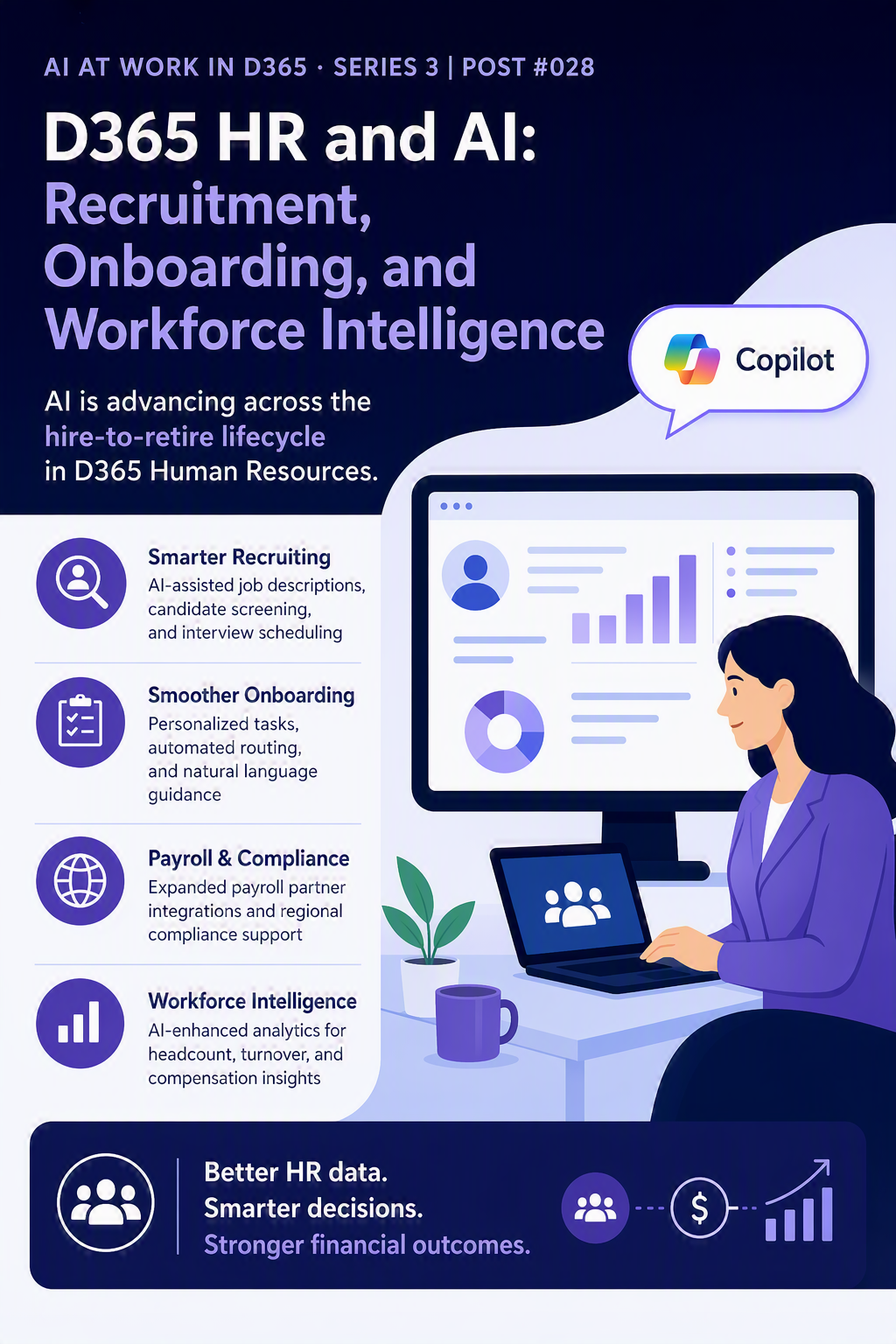
Microsoft’s 2026 Wave 1 release specifically calls out D365 Human Resources investments in recruitment, onboarding, reporting, and integrated workforce management. The broader framing is “merging enhanced user experiences with broader ecosystem integration and expanding regional payroll collaborations” — which translates to: better AI-assisted hiring workflows, improved employee self-service, stronger payroll partner integrations, and more actionable workforce analytics.
- Recruitment and Hiring Intelligence
- AI-assisted job description generation, candidate screening pattern analysis, and interview scheduling automation are the front-line changes in D365 HR recruiting. Copilot can help hiring managers create role descriptions and competency frameworks faster, and can surface patterns in candidate progression through the hiring funnel.
- Onboarding Automation
- The onboarding workflow in D365 HR is getting AI-assisted improvements — personalized task checklists, automated document routing, and natural language guidance for new employees navigating HR processes. Microsoft Teams integration surfaces onboarding tasks directly in the productivity tool employees are already using.
- Payroll Integration and Regional Compliance
- D365 HR’s payroll story is primarily integration-based — Microsoft partners with Ceridian Dayforce, ADP, and others rather than running a full native payroll engine. The 2026 investments include expanded regional payroll collaborations, which is particularly relevant for multinational organizations managing payroll compliance across jurisdictions.
- Workforce Analytics and Reporting
- AI-enhanced workforce analytics in D365 HR surfaces insights about headcount trends, turnover patterns, span of control, and compensation equity. These analytics connect to the BPA infrastructure covered in Post 13, meaning organizations that have invested in the analytics layer get better HR data alongside their financial data.
The Finance Team’s Stake in HR AI
I want to make the finance case for HR AI explicitly, because it’s often missed in conversations that treat HR as a separate domain. Labor is typically the largest or second-largest cost line for most organizations. The accuracy of labor cost reporting, the reliability of workforce planning inputs for the budget, and the timeliness of compensation change data flowing into finance systems all directly affect financial reporting quality.
When D365 HR AI improves the quality and currency of position and compensation data, finance teams get better inputs for FTE budget versus actual analysis, headcount forecasting, and compensation accrual accuracy. The connection is direct, even if the user interface experience is on the HR side.

The Self-Service Dimension
One of the most tangible AI improvements in D365 HR is employee and manager self-service via Copilot. Employees can ask HR process questions in natural language (“how do I update my beneficiary?” “when does my PTO reset?” “how many vacation days do I have available?”) and get accurate, personalized answers without calling HR. Managers can access headcount and compensation data for their teams through natural language queries.
This is the kind of feature that HR teams love because it reduces routine inquiry volume, and employees appreciate because they get immediate answers. The adoption curve is also gentler than ERP feature adoption — asking a question in natural language is intuitive in a way that navigating an HR system often isn’t.

📚 Go Deeper — Microsoft Resources
- D365 Human Resources Admin Overview
- D365 HR 2026 Wave 1 Release Plan
- D365 Human Resources Product Overview
D365 HR AI is advancing across the hire-to-retire lifecycle with a 2026 focus on recruitment, onboarding, self-service, and analytics. For finance and operations leaders, the connective tissue between HR and Finance in D365 means HR data quality directly affects financial reporting quality — and HR AI investments that improve that quality are worth understanding and supporting.
BB
Bobbi Bricker
ERP Capability Lead and D365 Functional Architect at Centric Consulting. Former controller. This series reflects fifteen + years in ERP (as an end user and a Consultant) and a genuine belief that AI, used thoughtfully, makes finance and operations teams more capable — not less. Reach out with questions, pushback, or war stories from your own organizations.
Thank you for reading!
Interested in learning more? Check out some of my latest posts:

Leave a Reply