

AI in Microsoft ERP · Microsoft Build 2026 · Series 4: This Month in AI · Post #031
Build 2026 happened June 2–3 and reframed Microsoft’s entire AI strategy around always-on agents. This series unpacks what shipped, what’s still preview, and what it means specifically for organizations running D365. Starting with the big picture.
The Headline: Microsoft’s Strategy Just Shifted
Build 2026, held June 2–3 in San Francisco, was organized around one central idea: autonomous agents are becoming the new application model. Previous Build events positioned Copilot primarily as a productivity assistant — something that responds when you prompt it. This year’s announcements introduced infrastructure for agents that operate continuously, take action without being prompted each time, and learn from your organization’s own data and workflows over time. Microsoft is calling this category “Autopilots.”
That’s a meaningful framing shift, and it’s worth understanding even if you’re not ready to deploy any of it yet, because it tells you where Microsoft’s investment is going for the next several years.
The Five Things That Actually Matter From Build
- 🧭Microsoft Scout — the first “Autopilot”
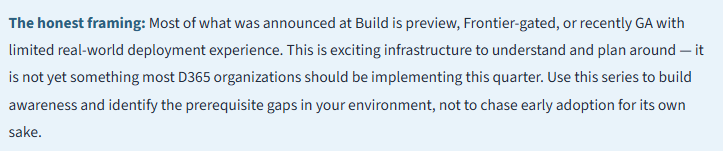
- An always-on personal agent that operates in the background across Teams, Outlook, OneDrive, and SharePoint, handling meeting prep, scheduling, and task tracking without being asked each time. Built on the open-source OpenClaw framework. Currently in Frontier preview — not broadly available yet.
- 🧠Microsoft IQ — the unifying context layer
- A new umbrella term covering Work IQ, Fabric IQ, Foundry IQ, and the newly introduced Web IQ. Together these give agents a shared semantic understanding of your business data — your CRM, your ERP, your communications — so agents can ground their actions in actual organizational context rather than guessing.
- 🛡️Agent 365 — governance for the agent era
- The centralized control plane for managing every agent in your tenant, extending Entra, Defender, and Purview into a single observability and governance layer. This is the infrastructure that makes deploying multiple agents across an organization actually manageable. Reached GA alongside Build.
- ⚙️Work IQ APIs — generally available June 16
- A set of just 10 APIs that collapse what would otherwise require hundreds of data-specific tools, running at roughly twice the speed of prior alternatives with significantly fewer tokens consumed. This is developer-facing infrastructure, but it’s the plumbing that makes faster, cheaper agent-to-data connections possible across the Microsoft stack — including D365.
- 🤝Open-source commitment to OpenClaw
- Microsoft is contributing policy conformance directly upstream to the OpenClaw open-source project — notable because it signals Microsoft building with, not just on top of, the open agent ecosystem. Organizations running OpenClaw independently will be able to validate their environment against security and compliance requirements using Microsoft’s contributed tooling.
What This Means for D365 Specifically
Build is technically a Microsoft 365 and developer-focused event, but the infrastructure announced there is shared across Microsoft’s entire stack — including Dynamics 365. The most direct connection: Work IQ’s stated purpose is giving agents “a semantic understanding of activity across your business, including what is happening in your CRM, your ERP, and your communication tools.” That’s an explicit statement that D365 data is meant to be part of this unified context layer going forward.
For organizations that have already invested in the MCP server infrastructure covered in Post 14, this is good news — it means the connective tissue between D365 and the broader Microsoft AI ecosystem is getting more capable and more standardized, not replaced by something incompatible.
The Prerequisite Reality Check
Before any organization gets excited about Scout, Agent 365, or the broader Microsoft IQ vision, there’s a sobering prerequisite list worth knowing. Independent analysis of the Build announcements has flagged four specific readiness gaps that block organizations from acting on the most significant announcements: current and consistently applied Entra ID configuration (Scout, Agent 365, and related tools depend on it), full Intune device management coverage (the Build 2026 agent model is Intune-enforced end to end), clean and well-structured organizational data (Microsoft IQ’s usefulness is directly proportional to data quality — fragmented records limit what agents can learn), and current Copilot/Frontier licensing review (several capabilities require specific tiers that many organizations haven’t recently audited).
If your organization hasn’t reviewed these four areas recently, that’s the actual starting point — not which Autopilot to deploy first.

📚 Go Deeper — Microsoft Resources
- Introducing Microsoft Scout — Official Announcement
- Microsoft 365 Copilot Release Notes — the authoritative changelog
- Microsoft 365 Roadmap — track what’s rolling out and when
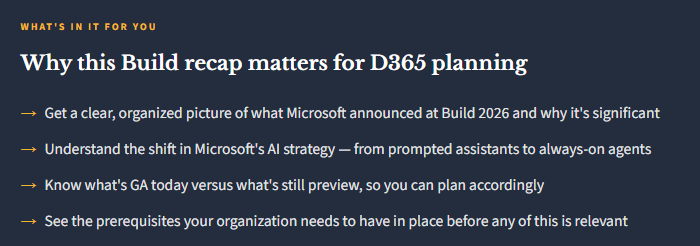
Build 2026 set the direction for the next phase of Microsoft’s AI strategy: from prompted assistants to governed, always-on agents grounded in real organizational context. For D365 organizations, the relevant question isn’t whether to adopt Scout tomorrow — it’s whether your foundational infrastructure (identity, device management, data quality, licensing) is ready for what’s coming.
BB
Bobbi Bricker
ERP Capability Lead and D365 Functional Architect at Centric Consulting. Former controller. This series reflects fifteen + years in ERP (as an end user and a Consultant) and a genuine belief that AI, used thoughtfully, makes finance and operations teams more capable — not less. Reach out with questions, pushback, or war stories from your own organizations.
Thank you for reading!
Interested in learning more? Here are some of my latest posts:


Leave a Reply