
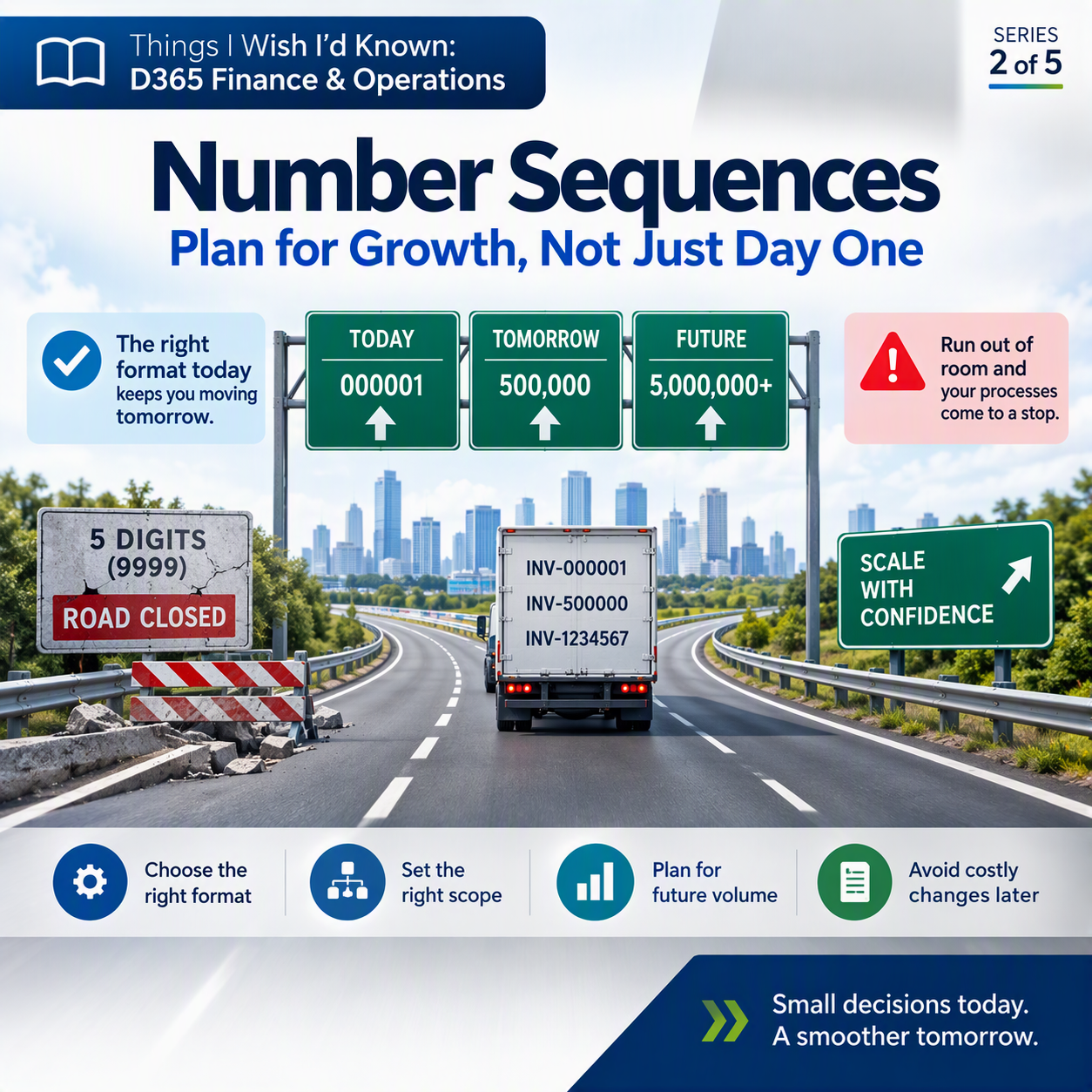
Quick question: how many digits does your invoice number need? If you just shrugged, you’re in good company. Most people don’t think twice about number sequences during implementation. They get set up fast, near the end of a busy configuration sprint, and nobody looks at them again until something breaks.
I’ve watched this exact mistake play out more than once, usually a year or two after go-live, when it’s much harder to fix.
Here’s a real life example – The IT department helps the implementation team do the initial configuration, they don’t spend much time thinking about number sequences – “use best practice” is what they say, so we do. Then, after a month or two after Go-Live the sales team sees that when invoices are created they start with INV-0000001, their invoices have always said “COMPANY-0001.” Can we fix it? Of course, but those invoices that have posted will have the alternative numbering sequence that was initially created.
The idea in one minute
Number sequences are the automatic numbering system behind D365 Finance and Operations. Every voucher, invoice, purchase order, customer account, and dozens of other records get their ID from one. They’re quick to configure and easy to overlook, which is exactly why they cause trouble later. The format you pick determines how many records you can create before you run out of room, how things look across multiple legal entities and years, and how painful it is to change your mind once transactions are live. Think it through now, before it’s a “quiet fix in production” problem.
What a number sequence actually is
In plain English, a number sequence is a template that tells D365 how to build an ID automatically, so nobody has to type “INV-000001” by hand and hope they didn’t duplicate it. You build the format out of segments: constant text that never changes (a prefix like “INV-“), and alphanumeric segments that increment, using # for numbers and & for letters. A sequence needs at least one alphanumeric segment, since that’s the part that actually counts up.
You also decide the scope. A sequence can be shared across your whole organization, or set at the legal entity, company, or operating unit level. And you choose whether it’s continuous (no gaps, generally reserved for places where regulators care about gap-free numbering) or noncontinuous (may have small gaps, but performs better day to day). Noncontinuous is the right default for most sequences unless you have a specific compliance reason otherwise.
Where it goes wrong
The failure I see most often is a format that’s too short. Someone sets a five digit sequence (#####) during a design workshop that feels generous at the time. Fast forward a few years of real transaction volume and that sequence is closing in on 99999 faster than anyone expected. When a sequence hits its ceiling, it simply cannot generate a new number, which means the process depending on it stops cold.
The second issue is scale across legal entities and years. If you’re running multiple legal entities, or planning to add more down the road, a sequence scoped too narrowly (or too broadly) can create confusing overlaps or force awkward workarounds later. Some organizations bake the year into the format so numbering resets on a schedule and stays readable. Others need continuity that spans years for audit reasons. There isn’t one right answer, but it needs to be a decision, not a default.
The third, and honestly the most expensive, is changing a sequence after it’s already been used on live transactions. Switching a sequence from noncontinuous to continuous after go-live is specifically flagged as something to avoid, since it can cause duplicate key errors and data integrity problems. Format changes carry their own risk too: once numbers are out on posted invoices, vouchers, and customer records, you can’t reformat history to match. You end up supporting two formats side by side, or running a cleanup project nobody budgeted for.
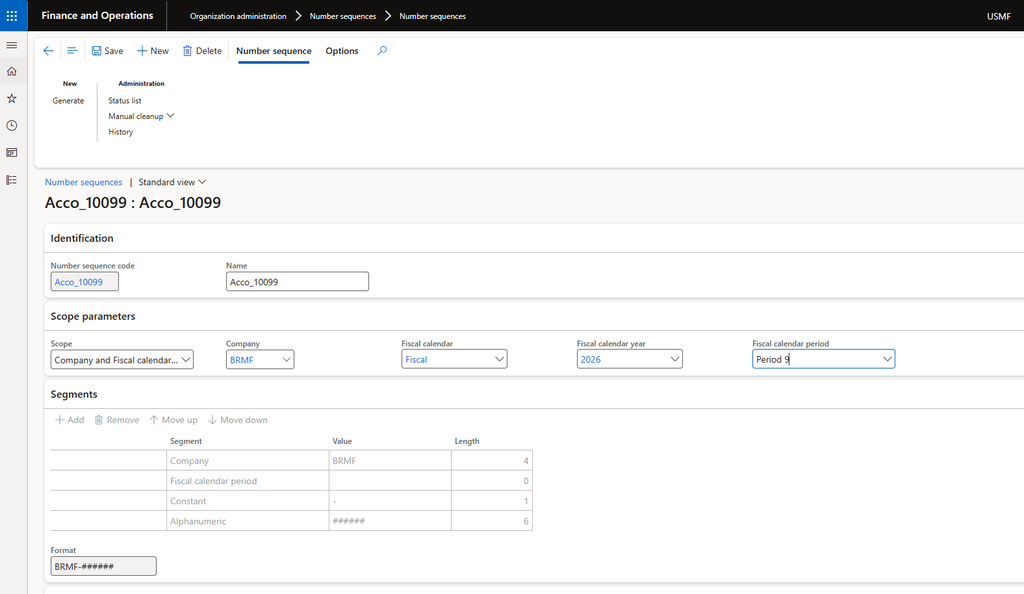
What to think through before you finalize a format ✅
Before you click save on a number sequence, walk through this with your team:
- How many records could this realistically generate over the life of the system? Then pad your digit count well beyond that number.
- Does this sequence need to work across multiple legal entities, and if so, should it be shared, or scoped separately per entity?
- Do you need the year baked into the format, or does the business need continuity that spans years?
- Is there an actual regulatory reason for continuous numbering, or is noncontinuous the better performing choice?
- Who owns this decision, and has finance or internal audit weighed in on formats tied to financial documents?
None of this takes long to think through. It takes a lot longer to unwind once the format is live and thousands of transactions are already pointing to it.
Thank you for reading!
This is post two in my “Things I Wish I’d Known” series on D365 Finance and Operations. Last time we covered Chart of Accounts & Dimensions: Get the Foundation Right Before Go-Live, the setup decision that shapes everything downstream. Next up: “Security Roles Are a Starting Point, Not a Finished Product,” where I’ll get into why the roles you configure during implementation are really just day one, not the finish line. 📒
Sources
- Number sequence overview – Finance & Operations
- Set up number sequences on an individual basis – Finance & Operations





Leave a Reply