
Quick gut check: if I asked you right now for a complete, up-to-date view of one of your key suppliers, meaning every legal entity they’re set up in, every certification on file, how they performed on their last review, and whether their W-9 is actually current, could you pull that together in five minutes? Or would you be pinging three people, digging through email threads, and cross-referencing spreadsheets from two different divisions?
If it’s the second one, you’re not alone. Supplier information in most organizations lives everywhere and nowhere: duplicate vendor records across entities, onboarding paperwork buried in inboxes, and no single source of truth for who’s actually qualified to do business with you. Microsoft’s newest addition to Dynamics 365 Supply Chain Management (D365 SCM, the ERP module that manages procurement, inventory, warehousing, and manufacturing) is aimed squarely at that mess.
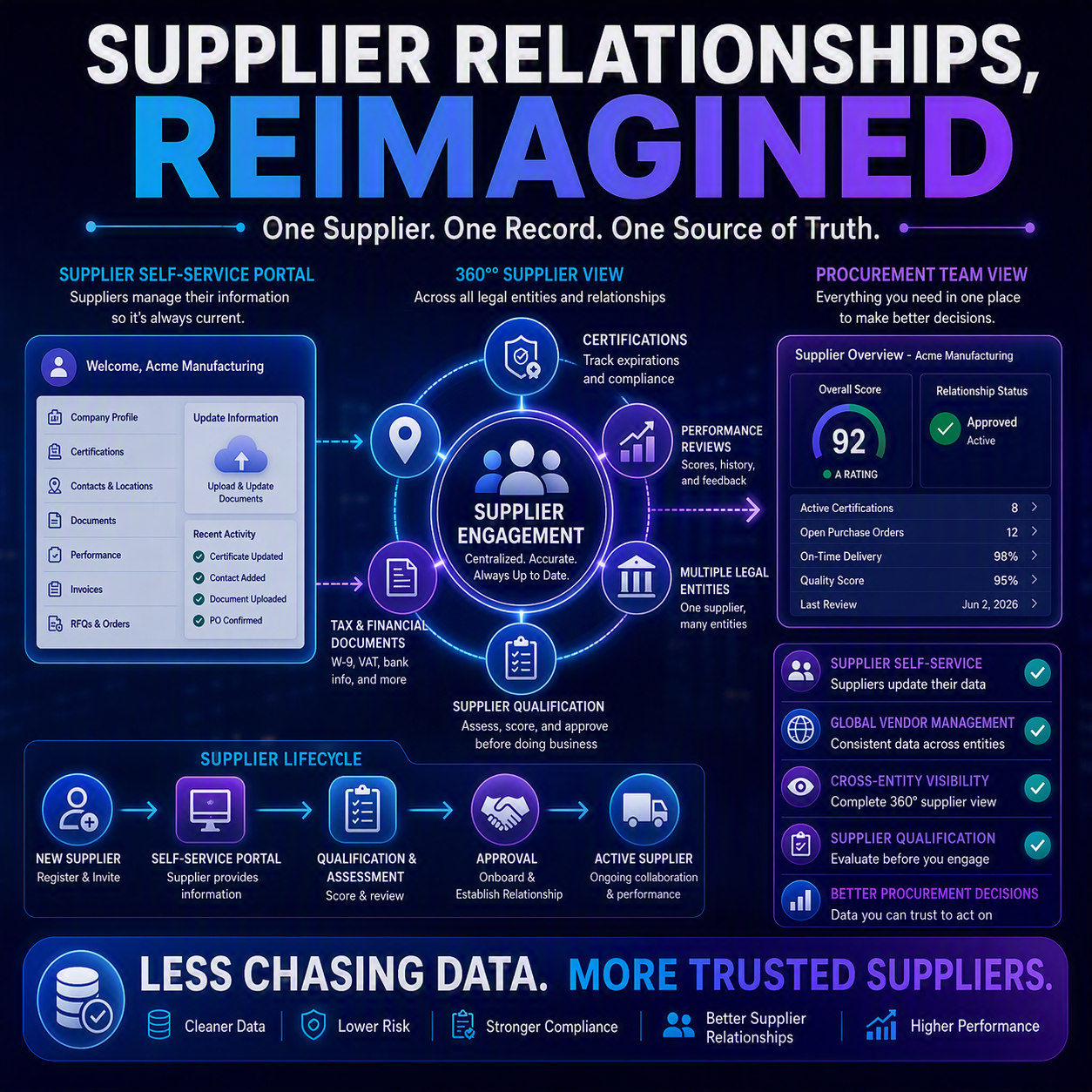
The idea in one minute: D365 SCM is introducing Supplier Engagement, a new workspace that gives suppliers a self-service portal to manage their own information and gives your procurement team one consolidated, cross-entity view of every supplier relationship, plus the tools to formally qualify and evaluate suppliers before you trust them with your business. Think less email chasing and duplicate data entry, more confidence in who you’re actually working with.
Meet the Supplier Portal 🤝
Right now, if you’re like most finance and procurement teams, communicating with suppliers means a patchwork of email, phone calls, and maybe a clunky vendor portal bolted onto your ERP. The new Supplier Portal changes that by giving suppliers a dedicated self-service space, built on Microsoft Power Pages. Suppliers can register themselves, respond to requests for quotation (RFQs), review and confirm purchase orders, propose delivery date changes, submit invoices, and keep their own certifications and contact details up to date, instead of emailing your team a PDF and hoping someone updates the system.
For your team, that means less time spent as a human relay between paperwork and the ERP, and more accurate data because the supplier is the one keeping it current.

One Supplier, One True Record 🔎
Here’s the scenario that will feel painfully familiar if you’ve ever worked at a company with multiple legal entities: the same supplier gets set up three different times, by three different people, with three slightly different addresses and contact names. Nobody’s sure which one is “right,” and when a certification expires, it might only get caught in one of the three records.
Supplier Engagement addresses this with what Microsoft describes as global vendor management: a shared supplier record maintained centrally and made visible across all the legal entities that work with that supplier. One profile, with consistent contacts, addresses, certifications, and capabilities, synchronized between Microsoft Dataverse and your D365 SCM environment. Procurement professionals get a genuine 360-degree view: performance history, active certifications, and relationship status, all in one workspace, without hunting across divisions.
Vetting Suppliers Before You Trust Them ✅
Onboarding a new supplier shouldn’t be a leap of faith. The Supplier Engagement app supports structured supplier qualification, including configurable self-assessment questions that your team can build out to standardize how prospective suppliers are evaluated before you commit. Questions can be organized by area (supply chain, quality management, HR, ESG, production) and set up as text responses or simple yes/no answers, so you’re comparing suppliers on the same criteria instead of relying on gut feel or whoever filled out the intake form most thoroughly.
Combined with the ability to register and guide prospective suppliers through onboarding, even before they’re fully set up in your system, procurement teams get a real qualification and approval process rather than a data-entry exercise.
What This Means for Your Team 💡
None of this replaces your procurement or accounts payable staff. It gives them a system that actually holds accurate, current supplier data, instead of one they have to fight with. Fewer duplicate vendor records means cleaner AP processing and fewer payment errors. A real qualification process means fewer surprises when a supplier turns out not to meet the standards you assumed they did, and a self-service portal means less time spent as a data-entry clerk for information the supplier already has.
Supplier Engagement is in public preview now, with general availability expected in March 2027. If supplier data quality has been a headache for your organization, this is one to watch. As with anything in preview, capabilities may shift before general release, so keep an eye on the official documentation as it matures.
Thank you for reading!
That wraps up “The Future of D365 Finance & Supply Chain,” five posts covering AI and automation across the platform, including last time’s look at how warehouses are getting an AI upgrade in “Warehouses Get an AI Upgrade.” If you missed any post in the series, go back and catch up. And if you’re a Business Central user, our companion series, “The Future of D365 Business Central,” covers similar ground built for BC.
Sources
- Manage supplier relationships with Supplier Engagement: Microsoft Learn Release Plan
- Overview of Dynamics 365 Supply Chain Management 2026 release wave 1: Microsoft Learn
- Introducing Supplier Engagement for Dynamics 365 SCM: Microsoft Dynamics 365 Blog
- Supplier Engagement in Dynamics 365 SCM for AI-Powered Procurement: Microsoft Dynamics 365 Blog
- Configure self-assessment questions (preview): Microsoft Learn
Interested in learning more? Below are some of my latest posts:

Leave a Reply