
Picture your typical Tuesday: a purchase order is three days late, the vendor hasn’t replied to your email from Friday, and you’re digging through your inbox trying to remember which PO number goes with which back-and-forth. Multiply that by twenty suppliers and that’s basically your whole week.
That’s the kind of work AI agents are starting to take off your plate inside Dynamics 365 Finance & Supply Chain Management (F&SC), and it’s a big enough shift that we’re spending a whole series on it. Welcome to post one of “The Future of D365 Finance & Supply Chain.”
The idea in one minute 💡
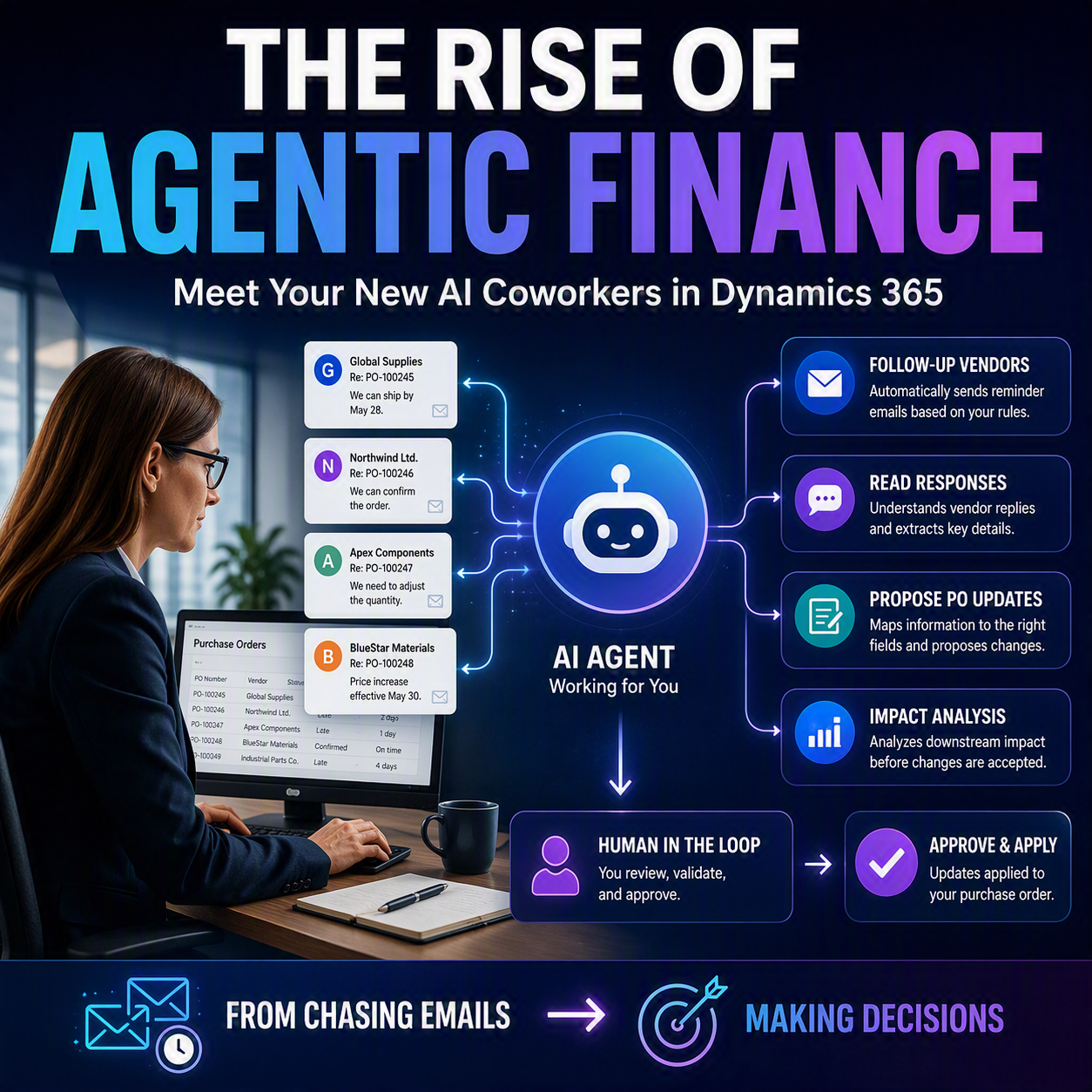
Microsoft is building AI “agents” directly into F&SC. These aren’t chatbots you have to prompt; they’re semi-autonomous helpers that watch for specific triggers (a late PO, an unread vendor email) and take the first pass at handling them. The most visible example right now is the Supplier Communication Agent, which drafts and sends follow-up emails to vendors, reads their replies, and proposes purchase order updates based on what they say. You still approve the work, but the drudgery of chasing, reading, and re-typing is increasingly the agent’s job, not yours.
What “agentic” actually means (in plain English)
“Agentic AI” is one of those phrases that sounds fancier than it is. It just means AI that doesn’t wait for you to ask a question. It monitors a process, notices something needs attention, and does something about it on its own, within limits you set. Think of it less like a search bar and more like a diligent junior employee who checks a specific queue every day and flags (or handles) what’s in it. In F&SC, this is a real feature you can turn on today, not a future promise. Copilot and AI innovation is a standing investment area for 2026 release wave 1, and supplier communication is where it’s most concrete right now.
The Supplier Communication Agent, up close 📧
If you work in procurement, or you’re the finance person who ends up in the supplier email threads anyway, this is the feature to know. Here’s what it does, based on Microsoft’s own documentation:
- Follows up automatically. It watches purchase orders for conditions you define (unconfirmed orders, delayed deliveries) and drafts (or, if you allow it, sends) reminder emails to vendors, so you don’t have to remember to chase them.
- Reads vendor replies for you. When a supplier writes back, the agent figures out what it’s about (confirmation, a quantity change, a price change, a rejection) and pulls the relevant details into a summary.
- Proposes the PO update. Instead of you opening the purchase order and re-typing what the vendor just told you, the agent maps that information to the right fields and presents it for your review.
And per the 2026 release wave 1 plan, it’s getting more capable this wave: “The Supplier Communication Agent now supports Microsoft Excel attachments and allows communications to be entered directly in Supply Chain Management. New extensibility options make it easier to incorporate custom fields and actions, aligning supplier interactions with your unique business processes.” Translation: it can now handle the Excel files suppliers so often attach, you can log a phone call directly in the system instead of your inbox, and your IT team can extend it with your own fields, so it fits how your business actually works.

By default, the agent doesn’t have free rein. Generated emails typically go through you for review before sending, and every proposed PO change needs your approval, not applied automatically. Microsoft currently labels this “production-ready preview,” stable enough for real use but still evolving. ✅
There’s a related payoff here too: when a supplier requests a change, F&SC can now analyze the downstream impact first, checking how it affects linked sales orders, production schedules, and inventory levels, so you’re not accepting or rejecting a change blind.
Why this matters for you, not just IT
If you’re an accountant, controller, or ops manager, none of this requires you to become technical. It means less time hunting for which PO needs a nudge, less manual re-keying of what a vendor just told you over email, and more of your day spent reviewing and deciding (the part that actually needs a human) instead of chasing and typing.
That’s basically the throughline for this whole series. Your judgment still runs the show in F&SC, agents just clear the busywork out of the way so you can use it. ☕
Thank you for reading! Next up in the series, we’re looking at what’s coming for demand planning: how new AI capabilities are helping teams connect pricing decisions to demand patterns for smarter, more unified forecasts. See you in post #2, “Smarter Demand Planning.”
Sources
- Overview of Dynamics 365 Supply Chain Management 2026 release wave 1: Microsoft Learn
- Supplier Communications Agent overview (production-ready preview): Microsoft Learn
- Supplier communications features of the Procurement Agent (production-ready preview): Microsoft Learn
- Manage the downstream impact of PO changes with Procurement Agent impact analysis: Microsoft Learn
- FAQ and solving typical issues when setting up and configuring the Supplier Communications Agent: Microsoft Learn
- 2026 release wave 1 plans for Microsoft Dynamics 365, Microsoft Power Platform, and Copilot Studio offerings: Microsoft Dynamics 365 Blog
Thank you for reading!
Interested in learning more? Below are some of my latest posts:

Leave a Reply