
AI in Microsoft ERP · Tax Compliance · Series 3 · Post #025
Tax is one of the highest-stakes areas in ERP — errors have financial and legal consequences. AI is changing what’s possible for tax automation, but the judgment layer hasn’t moved. Here’s the honest picture.
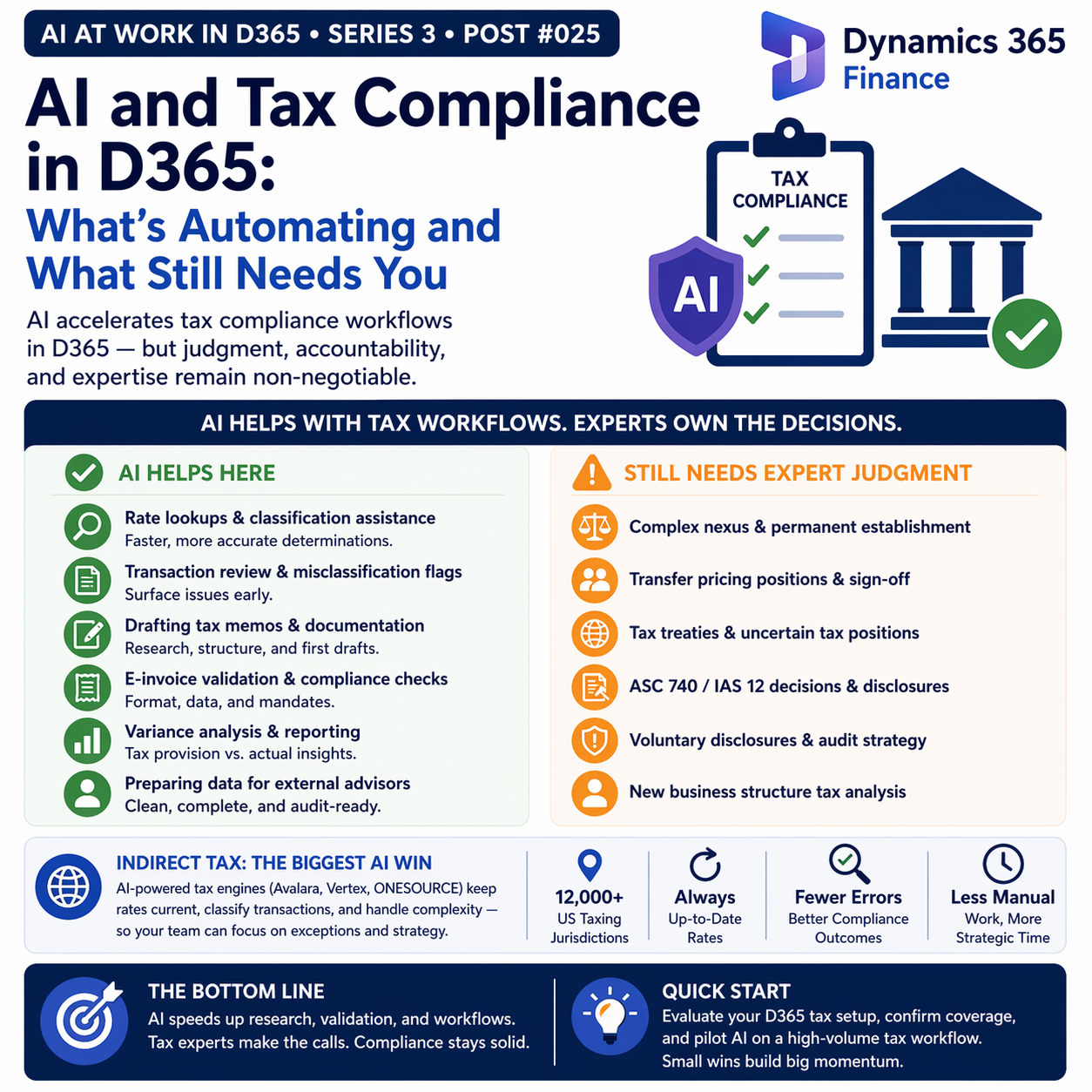
I want to lead this post with the most important thing I can say about AI and tax: tax is not an area where you want AI making the final call. The tax positions your organization takes carry financial, legal, and reputational consequences that require qualified professional judgment. Where AI adds value in the tax context is in the preparation and compliance workflow that surrounds those judgment decisions, not in replacing them.
What D365 Already Does for Tax – Natively
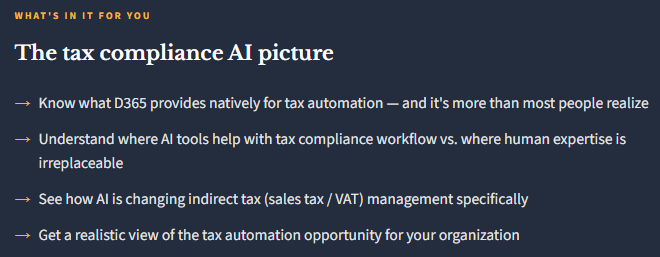
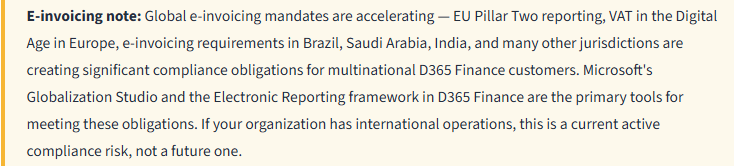
D365 Finance has robust native tax capabilities that are often underutilized in implementations. The tax engine handles sales tax and VAT calculation across transactions, with tax group and item tax group logic that can accommodate complex jurisdictional rules. Microsoft’s Globalization Studio supports e-invoicing mandates and local tax reporting requirements for over 210 jurisdictions. The Electronic Reporting framework handles statutory tax filing formats.
These are configuration capabilities, not AI capabilities – but they’re worth understanding because they form the foundation on which AI-layer tools build. An organization that hasn’t fully configured D365’s native tax engine won’t get much from AI tax tools on top.
Where AI Is Changing the Tax Compliance Workflow
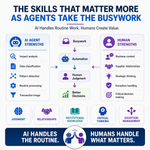
✓ AI Helps Here
Indirect tax rate lookups and classification assistance. Transaction review for potential misclassifications. Drafting of tax position documentation and memos. E-invoice data validation and format compliance checking. Variance analysis for tax provision vs. actual. Research compilation for tax positions. Responding to routine compliance questions. Preparing data packages for external tax advisors.
⚠ Still Needs Expert Judgment
Complex nexus and permanent establishment determinations. Transfer pricing positions and documentation sign-off. Tax treaty interpretation. Uncertain tax positions under ASC 740 / IAS 12. Tax provision sign-off and disclosure review. Voluntary disclosure decisions. Audit response strategy. New business structure tax analysis.
The Indirect Tax Automation Story
The clearest AI win in tax is in indirect tax compliance — sales tax in the US and VAT/GST globally. The complexity of indirect tax is enormous: US sales tax involves over 12,000 taxing jurisdictions with different rates, exemptions, and product classifications. VAT rules vary significantly across EU member states and change frequently. Managing this manually is both expensive and error-prone.
D365’s native tax engine handles straightforward scenarios well. For organizations with complex indirect tax exposure — multi-state US operations, international VAT registrations, marketplace seller obligations — the standard D365 tax configuration is typically supplemented by tax compliance solutions like Avalara, Vertex, or Thomson Reuters ONESOURCE that provide continuously-updated rate databases and automated determination logic. These third-party solutions are increasingly AI-native, with machine-learning classification engines that improve accuracy over time.
The AI layer in these integrations handles the transaction-by-transaction determination work. The human tax professional handles the exception review, the exemption certificate management, and the jurisdictional nexus analysis that determines where the organization is even required to collect and remit.

AI for Tax Research and Documentation
One of the highest-value AI applications for in-house tax teams is research and documentation work. Tax research has always been labor-intensive — reading rulings, statutes, and guidance documents to support a position, then writing the memorandum that documents the position and the support for it. AI tools (Claude is well-suited for this work) can dramatically reduce the time required for research compilation and first-draft documentation.
The workflow: tax professional identifies the issue and the relevant jurisdiction. Claude or a specialized tax research AI compiles the relevant authorities — statutes, regulations, rulings, cases. Tax professional reviews and selects the most relevant authorities. Claude drafts the position memorandum structure. Tax professional reviews, adjusts, and adds the professional judgment that makes the memo defensible.
This is not AI replacing the tax professional. It’s AI handling the research compilation and first-draft structure work, freeing the tax professional to spend more time on the judgment and review work that actually requires their expertise.

📚 Go Deeper — Microsoft Resources
- Indirect Tax Overview in D365 Finance
- Globalization Studio — Global Tax and E-Invoicing
- Electronic Invoicing Overview — D365 Finance
Tax compliance in D365 benefits from AI in the preparation and workflow layer — research compilation, documentation drafting, transaction classification assistance, e-invoice validation. The professional judgment layer remains firmly in the hands of qualified tax professionals. Organizations that understand that division of labor will get significant efficiency benefits from AI tax tools while maintaining the compliance integrity that tax positions require.
BB
Bobbi Bricker
ERP Capability Lead and D365 Functional Architect at Centric Consulting. Former controller. This series reflects fifteen + years in ERP (as an end user and a Consultant) and a genuine belief that AI, used thoughtfully, makes finance and operations teams more capable — not less. Reach out with questions, pushback, or war stories from your own organizations.
Thank you for reading!
If you are interested in learning more, below are some of my latest posts:



Leave a Reply