Category: D365 Business Central


  • Manufacturing and Production Orders in Business Central

    Bill of materials, production orders, routings and capacity, costing methods for manufactured items, variance analysis, and the GL entries that happen when you build something instead of just buying it. What BC’s Manufacturing Module Covers BC’s Manufacturing module (available in BC Premium) handles discrete manufacturing — the process of building finished goods from component materials…

  • Intercompany Accounting in BC: Multi-Entity Without the Manual Layer

    How BC’s intercompany module automates reciprocal transactions between related entities, the setup sequence Finance must complete before the first intercompany transaction posts, the intercompany reconciliation and elimination process Finance must run before consolidating, and the five intercompany accounting failures that keep Finance teams reconciling related-party balances manually every close when BC was designed to handle…

  • Purchasing and Supply Chain in Business Central

    Purchase orders, vendor catalogs, item charges, receipt and invoice matching, blanket orders, and the procurement configuration decisions that determine whether your AP close is clean or chaotic. “Post 4 in this series covered the AP end of purchasing — vendor ledger, invoice posting, payment runs. This post is about what happens before the invoice arrives.…

  • Jobs and Project Management in Business Central

    Job cards, job tasks, WIP accounting, billing, and how BC connects project costing to the general ledger — for anyone who bills by the hour, manages fixed-fee engagements, or wants to know whether projects are profitable before the invoice goes out. What Business Central’s Jobs Module Actually Does BC’s Jobs module is project accounting built into the…

  • Budgeting and Forecasting in Business Central

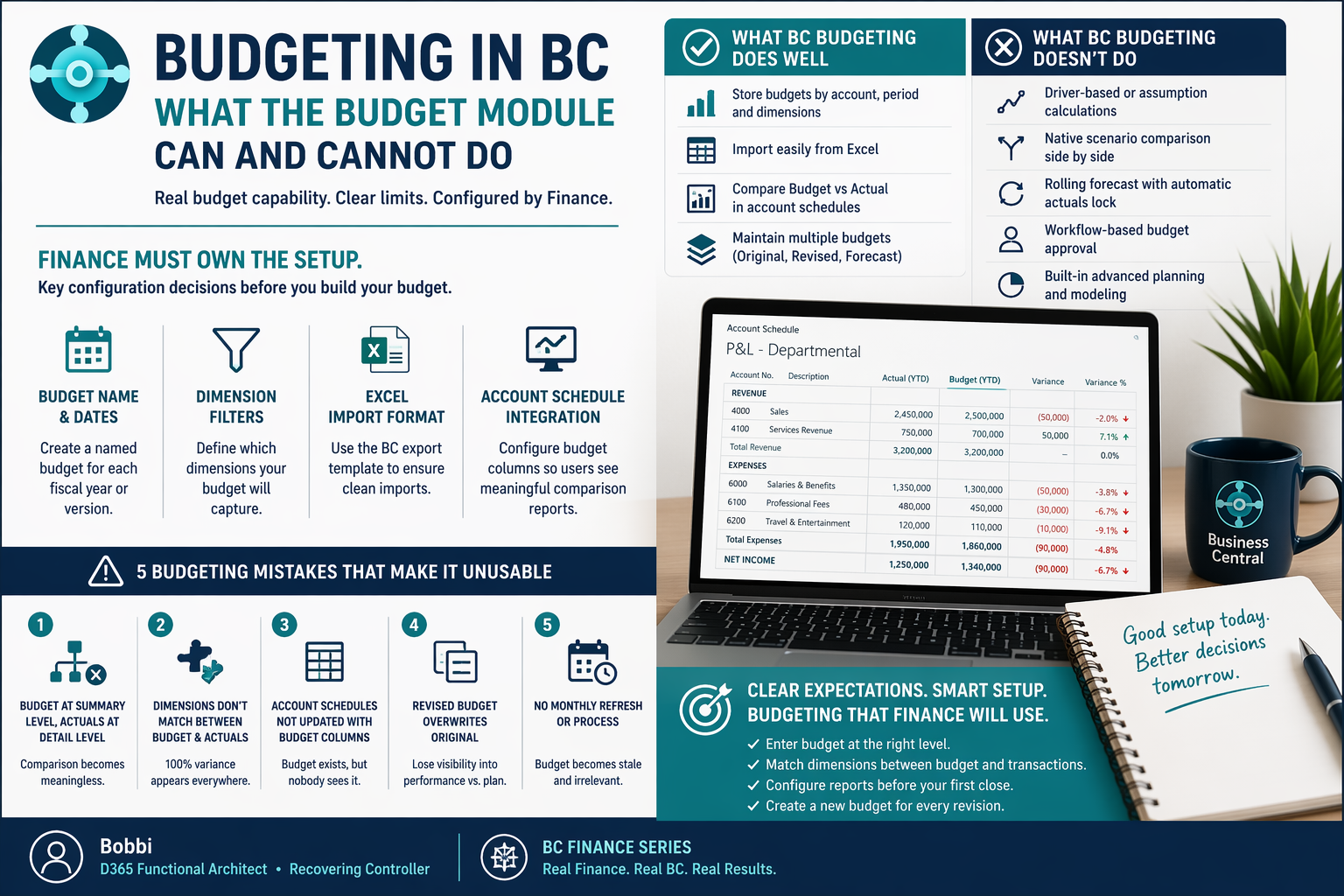
    BC’s native budget tool, how to enter and maintain budgets by account and dimension, building the budget vs. actual column that management actually uses, and the honest conversation about what BC does well — and when to reach for a dedicated planning tool instead. How BC’s Budget Feature Works BC’s native budget tool is straightforward:…

  • Period Close and Month-End in Business Central

    Accounting periods, the close sequence, subledger reconciliations, year-end close, and the habits that separate a predictable two-day close from a month-end that feels different every cycle. How BC Manages Accounting Periods Before you can close anything, you need to understand how BC thinks about time. BC organizes the fiscal year into Accounting Periods — defined in the…

  • Dimensions in Business Central: Segment Reporting Without the Sprawl

    What dimensions are, how to design them for your management reporting needs, how default dimensions automate the coding, and how Analysis by Dimensions turns your GL data into the answers your leadership is actually asking for. What a Dimension Actually Is A Dimension in BC is an additional classification tag you attach to a GL entry —…

  • Inventory and Item Setup in Business Central

    Item cards, item groups, costing methods, locations, item tracking — and why the decisions made on the item card follow every transaction for the life of your system. Why the Item Card Is a Finance Document Operations thinks of the item card as a product record — the place where you define what something is…

  • Financial Reporting in Business Central: From Trial Balance to Board-Ready

    Account schedules, Financial Reports, Analysis Views, dimensions-based slicing, and the reporting habits that separate a finance team that trusts its numbers from one that’s constantly second-guessing them. How BC’s Reporting Architecture Works — The Layers Before we get into the configuration steps, it helps to understand how reporting in BC is structured. There are several…