Asset cards, depreciation books, acquisition posting, disposals, the asset register-to-GL reconciliation, and why the decisions made in FA setup determine whether your asset register and your balance sheet agree at year-end. The Fixed Asset Card — What Every Asset Needs Configured Every physical or intangible asset tracked in BC has a Fixed Asset Card — the master…
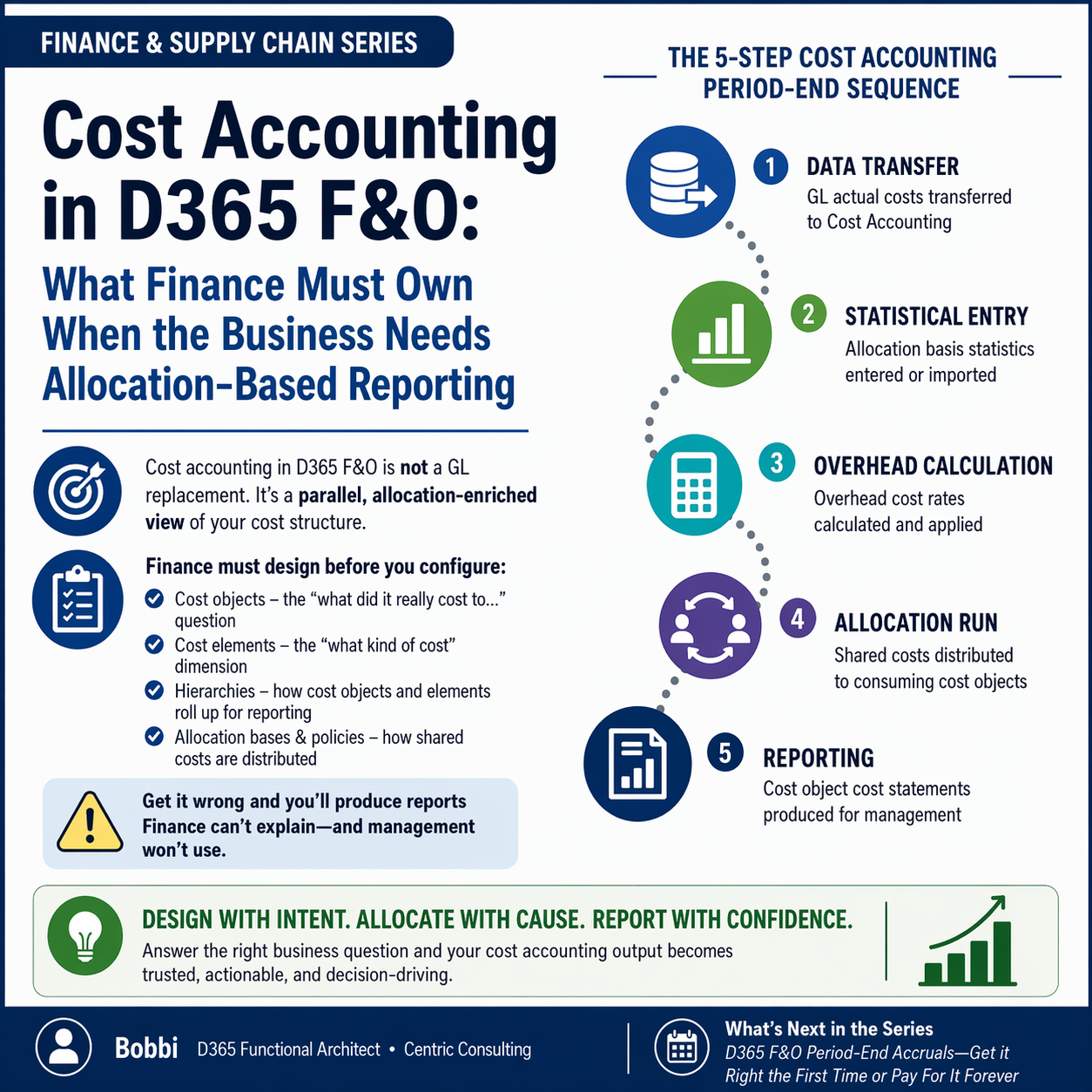
The Cost Accounting module, cost objects, allocation hierarchies, overhead calculation, and how D365’s dedicated cost accounting layer produces management P&L reporting that the general ledger — even with dimensions — simply cannot deliver on its own. Why the GL Alone Isn’t Enough for Management Profitability Analysis The general ledger in D365 F&O — even with…
Multi-entity transactions, intercompany AR/AP, automated posting across legal entities, consolidation, elimination entries, and the configuration decisions that determine whether your multi-entity close is a manageable process or a monthly investigation. The Multi-Entity Architecture in D365 F&O D365 F&O manages multiple legal entities as separate Legal Entities within a single instance. Each legal entity has its own chart…
Accounting periods, the close sequence, subledger reconciliations, year-end close, and the habits that separate a predictable two-day close from a month-end that feels different every cycle. How BC Manages Accounting Periods Before you can close anything, you need to understand how BC thinks about time. BC organizes the fiscal year into Accounting Periods — defined in the…
Project types, contracts, cost categories, revenue recognition methods, WBS structure, billing rules, and the GL integration that Finance teams need to own — for the organizations where project accounting is the whole financial story. Why Project Accounting Is Different From Everything Else Every other module we’ve covered in this series handles transactions that map cleanly…
Location hierarchies, receiving and picking, the Basic vs. WMS decision, cycle counting, and — most importantly for Finance — exactly which warehouse transactions generate GL entries and why. The Finance-Relevant Question About Warehouse Management Warehouse Management in D365 F&O is a large module with enormous operational depth — warehouse automation, mobile device workflows, wave processing,…
Ledger period management, the close sequence that matters, subledger reconciliations, the year-end close transaction, and how to build a month-end process that runs the same way every month — without heroics, without surprises, and without the 11 PM email asking if the books are ready. Ledger Periods and Period Status — The Control Mechanism In…
What dimensions are, how to design them for your management reporting needs, how default dimensions automate the coding, and how Analysis by Dimensions turns your GL data into the answers your leadership is actually asking for. What a Dimension Actually Is A Dimension in BC is an additional classification tag you attach to a GL entry —…
Bank account setup, the Payment Reconciliation Journal, Copilot bank matching, foreign currency cash, and the reconciliation habits that keep your book cash honest — every period, without the spreadsheet. Bank Account Setup — The Foundation That Reconciliation Depends On Every bank account in BC has a Bank Account Card — the record that connects the physical bank…
Item cards, item groups, costing methods, locations, item tracking — and why the decisions made on the item card follow every transaction for the life of your system. Why the Item Card Is a Finance Document Operations thinks of the item card as a product record — the place where you define what something is…